
Structure and Interpretation of Classical Mechanics
.
A bead of mass m moves without friction on a triaxial ellipsoidal surface. In rectangular coordinates the surface satisfies

for some constants a, b, and c. Identify suitable generalized coordinates, formulate a Lagrangian, and find Lagrange’s equations.
~~~
[guess]
The generalized coordinates:
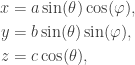
where

.
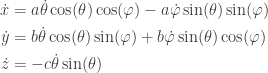
(define ((F->C F) local)
  (->local (time local)
           (F local)
           (+ (((partial 0) F) local)
              (* (((partial 1) F) local)
                 (velocity local)))))

;

(define ((e->r a b c) local)
  (let ((q (coordinate local)))
    (let ((theta (ref q 0))
          (phi (ref q 1)))
      (let ((x (* a (sin theta) (cos phi)))
	    (y (* b (sin theta) (sin phi)))
	    (z (* c (cos theta))))
        (up x y z)))))

;

(define ((L-rect m) local)
  (let ((q (coordinate local))
        (v (velocity local)))
    (* 1/2 m (square v))))

(define (L-e m a b c)
  (compose (L-rect m) (F->C (e->r a b c))))

;

(show-expression
  ((L-e 'm 'a 'b 'c)
   (->local 't
             (up 'theta 'phi)
             (up 'thetadot 'phidot))))

;

(show-expression
 (((Lagrange-equations
    (L-e 'm 'a 'b 'c))
   (up (literal-function 'theta) (literal-function 'phi)))
  't))
[guess]
— Me@2021-03-01 06:22:50 PM
.
.
2021.03.02 Tuesday (c) All rights reserved by ACHK
 Physics Town