
Structure and Interpretation of Classical Mechanics
.
b. Write the formal Lagrangian

such that Lagrange’s equations will yield the Newton’s equations you derived in part a.
~~~
[guess]
(define (U-constraint q0 q1 F l)
  (* (/ F (* 2 l))
     (- (square (- q1 q0))
        (square l))))

(define ((extract-particle pieces) local i)
  (let* ((indices (apply up (iota pieces (* i pieces))))
         (extract (lambda (tuple)
                    (vector-map (lambda (i)
                                  (ref tuple i))
                                indices))))
    (up (time local)
        (extract (coordinate local))
        (extract (velocity local)))))

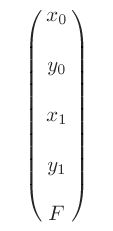
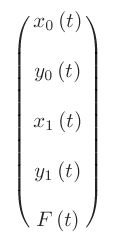
(define q-rect
  (up (literal-function 'x_0)
      (literal-function 'y_0)
      (literal-function 'x_1)
      (literal-function 'y_1)
      (literal-function 'F)))

(show-expression q-rect)
(show-expression (q-rect 't))

(show-expression (Gamma q-rect))

(show-expression ((Gamma q-rect) 'w))
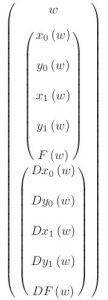
(show-expression ((Gamma q-rect) 't))

(show-expression (time ((Gamma q-rect) 't)))

(show-expression (coordinate ((Gamma q-rect) 't)))
[guess]
— based on /sicmutils/sicm-exercises
— Me@2021-04-27 05:03:59 PM
.
.
2021.04.28 Wednesday (c) All rights reserved by ACHK
 Physics Town
You must be logged in to post a comment.