
Structure and Interpretation of Classical Mechanics
.
A spherical pendulum is a massive bob, subject to uniform gravity, that may swing in three dimensions, but remains at a given distance from the pivot.
Formulate a Lagrangian for a spherical pendulum, driven by vertical motion of the pivot.
…
~~~
How come [the equations]?
Maybe just using the above equation but set the 
to add a something in order to realize the moving center.
— Me@2006
.
[guess]
(define (KE-particle m v)
  (* 1/2 m (square v)))

(define ((extract-particle pieces) local i)
  (let* ((indices (apply up
                         (iota pieces
                               (* i pieces))))
         (extract (lambda (tuple)
                    (vector-map
                     (lambda (i) (ref tuple i))
                     indices))))
    (up (time local)
        (extract (coordinate local))
        (extract (velocity local)))))

(define (U-constraint R qs q lambd)
  (* lambd
     (- (square (- q qs))
        (square R))))

(define ((U-gravity g m) q)
  (let ((z (ref q 2)))
    (* m g z)))

(define ((L-rect m R qs U) local)
  (let* ((extract (extract-particle 3))

         (p (extract local 0))
         (t (time p))
         (q (coordinate p))
         (v (velocity p))

         (lambd (ref (coordinate local) 3)))

    (- (KE-particle m v)
       (U q)
       (U-constraint R (qs t) q lambd))))

(let* ((U (U-gravity 'g 'm))
       (xs (lambda (t) 0))
       (ys (lambda (t) 0))
       (zs (literal-function 'z_s))
       (qs (up xs ys zs))
       (L (L-rect 'm 'R qs U))
       (q-rect (up (literal-function 'x)
                   (literal-function 'y)
                   (literal-function 'z)
                   (literal-function 'lambda))))
  (show-expression
   ((compose L (Gamma q-rect)) 't)))
(+ (* (expt R 2) (lambda t))
   (* -1 g m (z t))
   (* 1/2 m (expt ((D x) t) 2))
   (* 1/2 m (expt ((D y) t) 2))
   (* 1/2 m (expt ((D z) t) 2))
   (* -1 (lambda t) (expt (z_s t) 2))
   (* 2 (lambda t) (z_s t) (z t))
   (* -1 (lambda t) (expt (z t) 2))
   (* -1 (lambda t) (expt (y t) 2))
   (* -1 (lambda t) (expt (x t) 2)))

(define ((sf->rf qs) state-with-force)
  (let* ((extract (extract-particle 3))

         (p (extract state-with-force 0))
         (t (time p))
         (q (coordinate p))

         (lambd (ref (coordinate
                      state-with-force) 3))

         (r (ref q 0))
         (theta (ref q 1))
         (phi (ref q 2))

         (xs (ref qs 0))
         (ys (ref qs 1))
         (zs (ref qs 2))

         (x (+ (xs t)
               (* r (sin theta) (cos phi))))
         (y (+ (ys t)
               (* r (sin theta) (sin phi))))
         (z (+ (zs t)
               (* r (cos theta)))))

    (up x y z lambd)))

(let* ((xs (literal-function 'x_s))
       (ys (literal-function 'y_s))
       (zs (literal-function 'z_s))
       (qs (up xs ys zs))
       (q (up (literal-function 'r)
              (literal-function 'theta)
              (literal-function 'phi)
              (literal-function 'lambda))))
  (show-expression
   ((compose (sf->rf qs) (Gamma q))
    't)))
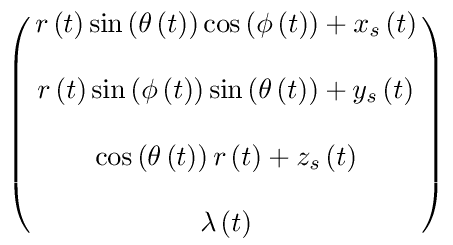
(define ((F->C F) local)
  (->local (time local)
           (F local)
           (+ (((partial 0) F) local)
              (* (((partial 1) F) local)
                 (velocity local)))))

(define (L-driven m R qs U)
  (compose
   (L-rect m R qs U)
   (F->C (sf->rf qs))))
…
[guess]
— Me@2023-08-20 05:02:09 PM
.
.
2023.08.23 Wednesday (c) All rights reserved by ACHK
 Physics Town
You must be logged in to post a comment.