
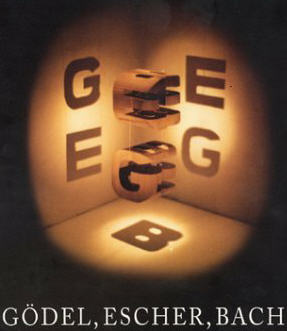
Douglas Hofstadter’s Godel, Escher, Bach uses self-referencing mathematical (formal language) and English (natural language) sentences, pictures (M.C. Escher’s dragon for example), and music (Bach’s fugues) to convey the concept and its recursive nature.
— Wikipedia on Self-reference
In response to confusion over the book’s theme, Hofstadter has emphasized that GEB is not about mathematics, art, and music but rather about how cognition and thinking emerge from well-hidden neurological mechanisms. In the book, he presents an analogy about how the individual neurons of the brain coordinate to create a unified sense of a coherent mind by comparing it to the social organization displayed in a colony of ants.
— Wikipedia on Godel, Escher, Bach
2012.05.23 Wednesday ACHK
 Physics Town