
Structure and Interpretation of Classical Mechanics
.
A bead of mass m is constrained to move on a frictionless helical wire. The helix is oriented so that its axis is horizontal. The diameter of the helix is d and its pitch (turns per unit length) is h. The system is in a uniform gravitational field with vertical acceleration g. Formulate a Lagrangian that describes the system and find the Lagrange equations of motion.
~~~
[guess]
The coordinates of the bead is

where the 


.
Lagrangian 
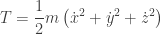



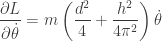
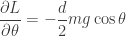
.
The Lagrange equation:
![\displaystyle{ \begin{aligned} D ( \partial_2 L \circ \Gamma[q]) - (\partial_1 L \circ \Gamma[q]) &= 0 \\ \frac{d}{dt} \frac{\partial L}{\partial \dot \theta} - \frac{\partial L}{\partial \theta} &= 0 \\ m \left( \frac{d^2}{4} + \frac{h^2}{4 \pi^2} \right) \ddot{\theta} + \frac{d}{2} m g \cos \theta &= 0 \\ \end{aligned}}](https://s0.wp.com/latex.php?latex=%5Cdisplaystyle%7B+%5Cbegin%7Baligned%7D+D+%28+%5Cpartial_2+L+%5Ccirc+%5CGamma%5Bq%5D%29+-+%28%5Cpartial_1+L+%5Ccirc+%5CGamma%5Bq%5D%29+%26%3D+0+%5C%5C+++%5Cfrac%7Bd%7D%7Bdt%7D+%5Cfrac%7B%5Cpartial+L%7D%7B%5Cpartial+%5Cdot+%5Ctheta%7D+-+%5Cfrac%7B%5Cpartial+L%7D%7B%5Cpartial+%5Ctheta%7D+%26%3D+0+%5C%5C++++m+%5Cleft%28+%5Cfrac%7Bd%5E2%7D%7B4%7D+%2B+%5Cfrac%7Bh%5E2%7D%7B4+%5Cpi%5E2%7D+%5Cright%29+%5Cddot%7B%5Ctheta%7D+%2B+%5Cfrac%7Bd%7D%7B2%7D+m+g+%5Ccos+%5Ctheta+%26%3D+0+%5C%5C+++%5Cend%7Baligned%7D%7D&bg=ffffff&fg=333333&s=0&c=20201002)
.
(define ((T-hl d h m g) local)
  (let ((t (time local))
        (thetadot (velocity local)))
    (* 1/8 m (square thetadot) 'H)))

;; (+ (square d)
;; (/ (square h) (square 'pi))))))

(show-expression
  ((T-hl 'd 'h 'm 'g)
    (->local 't
             'theta
             'thetadot)))

(define ((V-hl d h m g) local)
  (let ((t (time local))
        (theta (coordinate local)))
    (let ((y (* 1/2 d (sin theta))))
      (* m g y))))


(show-expression
  ((V-hl 'd 'h 'm 'g)
    (->local 't
             'theta
             'thetadot)))

(define L-hl (- T-hl V-hl))

(show-expression
  ((L-hl 'd 'h 'm 'g)
    (->local 't
             'theta
             'thetadot)))

(show-expression
 (((Lagrange-equations
    (L-hl 'd 'h 'm 'g))
   (literal-function 'theta))
  't))
[guess]
— Me@2021-02-05 04:23:02 PM
.
.
2021.02.06 Saturday (c) All rights reserved by ACHK
 Physics Town