
Monty Hall problem 1.5.4

機會率哲學 4.1.4

這段改編自 2010 年 4 月 3 日的對話。

主持人選擇先打開哪一扇門,其實受制於參賽者的原初選擇,是否房車。換句話說,「房車在第一扇門後面,而主持人打開第三扇」和「房車在第二扇門後面,而主持人打開第三扇」這兩個遊戲中途結果,是不對稱的,因為兩者有著不同的歷程。既然不等價,機會率就自然不同。

(安:我同意這個想法,會得到這個結論。但是,如果我用另一個想法,卻會得出另一個結論。

假設原本的參賽者叫做「甲」,而在遊戲中途,會加入另一位參賽者「乙」。主持人在打開第三扇門後,會改為叫乙,為甲繼續選擇。亦即是話,乙要為甲決定,究竟是選第一道門,還是第二道門。如果乙的選擇可為甲贏得房車,乙自己亦會獲得一千元的獎金。

那樣,對於乙來說,他見到的,就只是一個「二選其一」的「開門抽獎遊戲」。
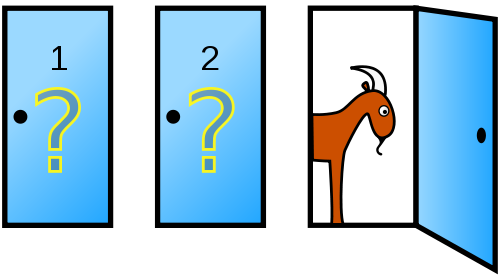
如果主持人沒有任何提示,乙就只會知道「那裡有兩道門」、「一道有房車」和「另一道有山羊」,而不會掌握任何其他資料。換而言之,乙對第一第二道門,無所偏好。所以,兩道門的中獎機會率,理應相同,都是二分之一。

我這個想法有錯嗎?)

如果乙在兩門選其一時,不知道甲的原本選擇,你的講法就是正確的。兩門的中獎機會相同,都是二分之一。

但是,如果乙知道甲的原選,兩門的歷史,相對乙來說,就會不同。所以,機會率不會均等。

— Me@2012.12.02

2012.12.02 Sunday (c) All rights reserved by ACHK

Godel 5

Now when you combine the Completeness and Incompleteness Theorems, you can get some really remarkable results. If you work with the axioms of number theory, call them N (which include many of the above axioms F along with axioms for < and axioms for mathematical induction), for example, we know by the Incompleteness Theorem that there is a statement X such that neither X nor (not X) is provable. Hence, by the Completeness Theorem, there is a model of N in which X is true and a model of N in which X is false.

It follows that there are mathematical universes which look and act very much like the regular natural numbers, but do in fact have some subtle differences. One of the most fascinating results I’ve seen is that there is a model of number theory which “thinks” (in a precise sense) that the axioms N are inconsistent, even though they are not (roughly, the “proof” of an inconsistency that it “sees” is infinitely long, and so is not a real proof).

— Godel’s Completeness Theorem

— Joe Mileti

2012.12.02 Sunday ACHK