A First Course in String Theory
.
Residues
The behavior for non-positive 


choosing 


— Wikipedia on Gamma function
.
.
2024.07.30 Tuesday ACHK

A First Course in String Theory
.
Residues
The behavior for non-positive
choosing
— Wikipedia on Gamma function
.
.
2024.07.30 Tuesday ACHK
An important and unique property of quantum key distribution is the ability of the two communicating users to detect the presence of any third party trying to gain knowledge of the key. This results from a fundamental aspect of quantum mechanics: the process of measuring a quantum system in general disturbs the system. A third party trying to eavesdrop on the key must in some way measure it, thus introducing detectable anomalies.
— Wikipedia on Quantum key distribution
.
The common language of quantum mechanics is convenient but not accurate:
Eavesdropping would cause the collapse of the wave function, so Alice and Bob must be aware of it.
The accurate language:
A wave function encodes the probability distribution of various possible experimental outcomes of a system. In other words, the wave function is a property of the system (the experimental setup), encompassing the experimental operations, including measurements.
To eavesdrop, Eve has to add an extra detector to the system. Thus, the system is altered (replaced). So the probability distribution is no longer that of the original system. That is the meaning of “collapse of the wave function”.
— Me@2024-06-19 02:17:35 PM
.
.
2024.07.30 Tuesday (c) All rights reserved by ACHK
~ con text
~ what puts the texts together
— Me@2015-12-11 07:16:47 AM
.
.
2024.07.24 Wednesday (c) All rights reserved by ACHK
這段改編自 2010 年 4 月 24 日的對話。
.
If you’re good at something, never do it for free.
— The Dark Knight
.
「搞 gag」(弄笑話)要成功的其中一個先決條件是,容許失敗。
不許失敗的話,就沒有人膽敢嘗試。
.
作為聽眾,遇到冷笑話時,合理的反應是,不要笑。
但部分人卻會,立刻大聲指責,彷彿你是他的殺父仇人般。
.
聽眾之中,本身不懂講笑話的人,往往把你,責怪得最重。
.
合情合理之人,不會在別人沒有惡意的情況下,尖酸刻薄。
.
不應對尖酸刻薄的人,主動表達善意。
嘗試搞 gag,是善意的一種。
— Me@2024-07-20 05:54:18 PM
.
.
2024.07.22 Monday (c) All rights reserved by ACHK

Find the sum of the digits in the number 
import Data.Char ( digitToInt )

p_20 = sum
       $ map digitToInt
       $ show $ product [1..100]

λ> p_20
648
— Haskell official
— Me@2024-07-17 03:44:42 PM
.
.
2024.07.18 Thursday (c) All rights reserved by ACHK
Functional Differential Geometry
.
p. 21
…
3.2
…
is the direction derivative of the function
at the point
.
Note that it is not the ordinary directional derivative.
3.2.1
Instead, the ordinary directional derivative is
or
3.2.2
The first generalization of directional derivative is replacing 


3.2.3
The second generalization of directional derivative is replacing 


In differential geometry, a vector is an operator that takes directional derivatives of manifold functions at its anchor point.
The directional derivative of a scalar function
with respect to a vector
at a point (e.g., position)
may be denoted by any of the following:
…
Let
be a differentiable manifold and
a point of
Suppose that
is a function defined in a neighborhood of
If
(see Exterior derivative),
(see Covariant derivative),
(see Lie derivative), or
(see Tangent space § Definition via derivations), can be defined as follows.
Let
be a differentiable curve with
and
. Then the directional derivative is defined by
This definition can be proven independent of the choice of
, provided
— Wikipedia on Directional derivative
Tangent vectors as directional derivatives
Another way to think about tangent vectors is as directional derivatives. Given a vector
in
, one defines the corresponding directional derivative at a point
by
This map is naturally a derivation at
. Furthermore, every derivation at a point in
is of this form. Hence, there is a one-to-one correspondence between vectors (thought of as tangent vectors at a point) and derivations at a point.
— Wikipedia on Tangent space
4. In a more user-friendly language:
where 
This is a self-consistency check.
— Me@2024-02-03 04:45:17 PM
.
.
2024.07.13 Saturday (c) All rights reserved by ACHK
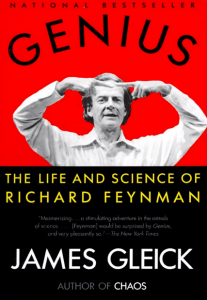
The traditional diffusion equation bore a family resemblance to the standard Schrödinger equation; the crucial difference lay in a single exponent where the quantum mechanical version was an imaginary factor, 
— page 175
— Genius: The Life and Science of Richard Feynman
— James Gleick
.
.
2024.07.10 Wednesday ACHK


![\displaystyle{ \forall f\in {C^{\infty }}(\mathbb {R} ^{n}):\qquad (D_{v}f)(x):=\left.{\frac {\mathrm {d} }{\mathrm {d} {t}}}[f(x+tv)]\right|_{t=0}=\sum _{i=1}^{n}v^{i}{\frac {\partial f}{\partial x^{i}}}(x).}](https://s0.wp.com/latex.php?latex=%5Cdisplaystyle%7B+%5Cforall+f%5Cin+%7BC%5E%7B%5Cinfty+%7D%7D%28%5Cmathbb+%7BR%7D+%5E%7Bn%7D%29%3A%5Cqquad+%28D_%7Bv%7Df%29%28x%29%3A%3D%5Cleft.%7B%5Cfrac+%7B%5Cmathrm+%7Bd%7D+%7D%7B%5Cmathrm+%7Bd%7D+%7Bt%7D%7D%7D%5Bf%28x%2Btv%29%5D%5Cright%7C_%7Bt%3D0%7D%3D%5Csum+_%7Bi%3D1%7D%5E%7Bn%7Dv%5E%7Bi%7D%7B%5Cfrac+%7B%5Cpartial+f%7D%7B%5Cpartial+x%5E%7Bi%7D%7D%7D%28x%29.%7D&bg=EAEFF3&fg=333333&s=1&c=20201002)


 Physics Town
You must be logged in to post a comment.