無理數 2.1

乘法意思 5.1

這段改編自 2010 年 4 月 3 日的對話。

剛才討論「乘法意思」時,提及過「無理數」。我現在想詳細講述一下。

一般而言,需不需要用小數,要視乎你所用的單位。例如,你用間尺量度一條線,發現長度等於 2.4cm。你需要用小數 2.4,是因為你用了厘米 cm 作為單位。如果轉用毫米 mm,你就可以用整數,來表達同樣的長度。

2.4 cm = 24 mm

但是,有時,無論用整數還是小數,都好像表達不到某些長度。例如,如果你間尺的最小間隔是 1mm,而你所度的長度是介乎 12mm 和 13mm 之間,一方面,你不能用整數來表達那長度,因為那既不是 12mm,又不是 13mm;另一方面,你亦不能用小數來表達,因為憑那把間尺,你並不知道,那長度是 12 點幾。

按常識,只要使用刻度精細一點的間尺,就可以解決這個問題 —— 你就可以用整數,準確表達那個長度。用厘米 cm 作刻度不行的話,就用毫米 mm;用毫米都不行的話,就用十分之一毫米;如此類推。在這個「可以透過縮小單位,來把小數化成整數」的情況下,你所量度的長度數值,如果堅持用原本的單位,就會表達成一個「有理數」(rational number),可以用「有盡小數」或者「循環小數」來表達。

但是,數學世界卻隱藏了,一些不按一般人「常識」的情況。有一些線的長度,無論你間尺的刻度有多精細,它永遠止於兩個刻度之間。例如,如果一個正方形的邊長是一個單位,它的對角線長度,就會是「開方 2」個單位()。
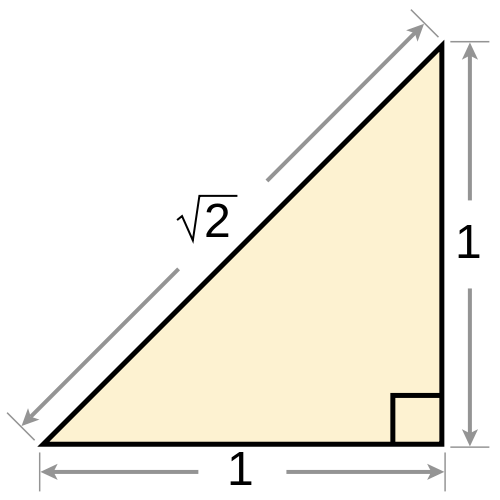
This is a file from the Wikimedia Commons.

「開方 2」就為之「無理數」(irrational number)。表達成小數的話,它會「無盡不循環」。

(安:那如果用對角線作為單位呢?

如果用一把刻度間隔,剛好是那條對角線長度的間尺,你就相當於把那長度,定義為「一個單位」。那樣,你就可以用「一」這個數字,來表達那對角線長度,而迴避了「無理數」。)

但是,那樣的話,你就犧牲了那正方形的邊長。你會被迫把它表達成「無理數」

— Me@2013.02.20

2013.02.22 Friday (c) All rights reserved by ACHK

Rediscovery

I hold with the Swiss psychologist Jean Piaget that the process of learning mathematics is itself a process of rediscovery. A similar view was expressed by the logician Ludwig Witgenstein, asserting in the preface to his famous Tractatus Logico-Philosophicus that he would probably not be understood except by those who had already had similar thoughts themselves.

— A Unified Language for Mathematics and Physics

— David Hestenes

— Clifford Algebras and their Applications in Mathematical Physics

2013.02.18 Monday ACHK

無限蘋果 1.4

無限年 2.4 | 微積分 4.4

這段改編自 2010 年 6 月 15 日的對話。

這個 limit(極限值)的正式運算方法是:

lim_{x -> infinity} x^2/(x^3 + 6)

= lim_{x -> infinity} (1/x)/(1 + 6/x^3)

= (0)/(1 + 0)

= 0

這個方法的的精髓是,雖然,因為「無限」()並不是一個數,你不可以代它於任何變數 x 之中;但是, 是卻一個數,而且等於零,所以,你可以把「零」代於所有(1/x)出現的地方。

( lim_{x -> infinity} 1/x ) = 0

剛才講過,如果分子和分母同時趨向「無限」,整個分數究竟是趨向「零」、「有限數」或者「無限大」,要視乎分子中 x 次方比較大,還是分母。例如在這一題中,分子的 x 是二次方(x^2),而分母的 x 是三次方(x^3),所以,分母的「無限大」高級過分子的「無限大」。結果,整個分數趨向零。

以下只是輔助記憶的密碼,並不是正確合法的數學符號:

你可以在心裡運用,但不可以寫出來。

lim_{x -> infinity} x^2/(x^3 + 6)

= (無限)^2/((無限)^3 + 6)

= 0

換句話說,這個高速心算方法,其實就是由 x 次方的大小,來比較眾多「超大」的級數。有了這個「比較次方 法」,你在作正式的運算前,就可以直接知道答案。所以,除了剛才提及,「用計數機代 x = 100,000」的方法外,你還可以用這個方法來驗算,牽涉「無限」的極限題目。

— Me@2013.02.17

2013.02.17 Sunday (c) All rights reserved by ACHK

The Heisenberg picture, 2

As I suggested in the article about the solution of the Hydrogen atom using the SO(4) symmetry, one of the reasons why almost no people properly learn the “foundations of quantum mechanics” is the textbooks’ and teachers’ excessive focus on the Schrödinger picture (and the wave functions) and their disrespect for the Heisenberg picture (and the operators) even though operators – the observables – is what quantum mechanics is all about.

— Celebrating the Heisenberg picture

— Lubos Motl

2013.02.17 Sunday ACHK

Panaceas

Health care providers often call exercise the “miracle” or “wonder” drug — alluding to the wide variety of proven benefits that it provides.

— Wikipedia on Physical exercise

Doing physics (for my mind) and doing physical exercises (for my body) are my panaceas (for health). 

— Me@2011.10.10

— Me@2013.02.16

2013.02.16 Saturday (c) All rights reserved by ACHK

乘法意思 4.3

這段改編自 2010 年 4 月 3 日的對話。

乘法第五關:何謂「負數次方」?

如果是正數次方,例如 a^2,即是在原本數字的右邊,乘多兩個 a:

(a^3) a^2 = (a^3) a a = a^5

那樣,按常理,負數次方,例如 a^{-2},就應該代表,要令到原本的數字,乘少兩個 a:

(a^3) a^{-2} = a a a = a

(a^3) a^{-2} = a a a (but cancel two a’s) = a

然後,你回想一下,一生之中,學過什麼數字或者符號,乘在原本數字的右邊後,會等於「刪除了其中兩個 a」?

a a a (?) (?) = a

只有「a 分之一」有這個效果:

(a^3) a^{-2} = a a a (1/a) (1/a) = a

所以,

a^{-2} = 1/a^2

— Me@2013.02.15

2013.02.16 Saturday (c) All rights reserved by ACHK

Constraints

Give me a million dollars and I’ll figure out what to do. But it’s harder than it looks. Constraints give your life shape. Remove them and most people have no idea what to do: look at what happens to those who win lotteries or inherit money.

— How to do what you love

— Paul Graham

A goal is a set of constraints. 

— Me@2010.12.19

Constraints define your art.

— Me@2010.12.19

2013.02.15 Friday (c) All rights reserved by ACHK

無限蘋果 1.3

無限年 2.3 | 微積分 4.3

這段改編自 2010 年 6 月 15 日的對話。

由於「無限」不可以用來比較大小,它不是一個數字。所以,例如

\lim_{x -> infinity} (x^2)/(x^3+6)

的意思,並不是要你把「無限」代落 x 之中。換句話說,這個極根值題目並不是問你,當 x 的數值是「無限」時,整個分數的數值是多少,因為,「無限」根本不是一個「數值」。題目真正問你的是,如果分子是一個「超大」的數,而「分母」又同時是一個「超大」數的話,整個分數的數值會是多少。

留意,這個問題並不能直接回答,因為,如果不作詳細一點的分析,我們知道的只是,當 x 是「超大」時,分子的 x^2 會變成「超大」,而分母的 (x^3+6) 又會變成「超大」。整個分數會變成「超小」、「正常」還是「超大」,則暫時不知道。

它究竟是趨向「零」、「有限數」或者「無限大」,要視乎分子的「超大」,還是分母的「超大」,會大過對方。在這個例子中,由於分母中 x 的次方,比分子中 x 的次方大,所以分母的「超大」,會遠遠大過分子的「超大」。例如,當 x = 100,000 (十萬)時,x^2 = 10^10(一百億),而 x^3 卻已經變成 10^15(一千兆)。結果,(x^2)/(x^3+6) 會非常接近零。

— Me@2013.02.14

2013.02.14 Thursday (c) All rights reserved by ACHK

The 6th Day

Copy Me, 7

The 6th Day is a 2000 American science fiction action thriller film directed by Roger Spottiswoode, starring Arnold Schwarzenegger as family man Adam Gibson, who is cloned without his knowledge or consent in the future of 2015.

— Wikipedia on The 6th Day

This movie has helped me to understand that identity is memory and memory is software.

— Me@2013-02-14 10:55:47 AM

2013.02.14 Thursday (c) All rights reserved by ACHK

Snowball

Flywheel 2

Learning anything is like learning language — you cannot learn a language by just reading books or dictionaries.

— Me@2013-02-11 06:28:56 PM

天才之道

點滴累積

— Me@2007.09.19

Language courses are an anomaly. I think they’re better considered as extracurricular activities, like pottery classes. They’d be far more useful when combined with some time living in a country where the language is spoken. On a whim I studied Arabic as a freshman. It was a lot of work, and the only lasting benefits were a weird ability to identify semitic roots and some insights into how people recognize words.

– Paul Graham

Learning math and physics takes a whole lifetime. Luckily, it’s a lot of fun… if you have a reasonably patient attitude.

— How to Learn Math and Physics

— John Baez

Life is like a snowball. The important thing is finding wet snow and a really long hill.

— Warren Buffett

2013.02.13 Wednesday (c) All rights reserved by ACHK

乘法意思 4.2

這段改編自 2010 年 4 月 3 日的對話。

乘法的第四個難題是,何謂「二分一次方」。

「a 的 n 次方」的意思是,有 n 個 a 乘在一起。所以,「a 的二分一次方」,就即是有半個 a 乘在一起。但是,何謂「半個 a 乘在一起」呢?

如果你用數學公式 ,你就可以推斷到:

a^m a^n = a^{m+n}

a^{1/2} a^{1/2} = a^1

留意,「半個 a」如果是在「加法」的上文下理中,是指

a/2

但是,現在討論「乘法」。所以,這裡是指「乘法上的半個 a」。如果有這個概念,即使不用數學公式 ,你都可以推斷到, 是什麼。

a^{1/2} a^{1/2} = ?

試想想,根據「一半」這個詞語的意思,「兩個半」就即是「一個」。所以,「乘以兩次半個 a」,很明顯等於「乘以一個 a」。

a^{1/2} a^{1/2} = a^1

然後,你回想一下,一生之中,學過什麼數字或者符號,自乘兩次後,會等於「a 的一次方」?

(?)(?) = a

只有「a 平方根」有這個效果:

\sqrt{a} \sqrt{a} = a

所以,

a^{1/2} = \sqrt{a}

— Me@2013.02.13

2013.02.13 Wednesday (c) All rights reserved by ACHK

無限蘋果 1.2

無限年 2.2 | 微積分 4.2

這段改編自 2010 年 6 月 15 日的對話。

其實,並不是真的有一樣東西,或者一個數字,叫做「無限」。它只是一個語言的技巧,說話的方法。每逢我們說「無限」時,即是沒有那樣東西。

例如,甲問乙:「你欠我的錢,什麼時候會歸還呢?」

乙答:「無限年之後。」

乙的意思,並不是真的有一個時間長度,叫做「無限年」。他等「無限年」之後,會把錢還給甲。乙的真正意思是,他不肯還錢。

再例如,「無人跑得快過我」,並不是指有一個人名叫「無人」,他跑得快過我。「無人」只是一種說話的方法。「無人跑得快過我」的真正意思是,「我是所有人之中,跑得最快的。」

「只是一種說話方法」的意思是,凡是有「無人」這個詞語的句子,你都可以改成沒有「無人」的版本,而又百分百保存到原本的意思。

— Me@2013.02.12

2013.02.12 Tuesday (c) All rights reserved by ACHK

Two dimensional time 3

二次元時間 3

儲存 save

~ 累積 accumulate

cumulative

~ timeless

~ lasting 待久

~ transcend time 

— Me@2013.02.09

If you keep doing timeless things, every event exists not just at a particular point on your timeline. Instead, it exists on the whole timeline.

In a sense, you are living a two-dimensional history, because you are not just considering the progress along the timeline, but also the progress of the whole timeline itself.

— Me@2013.02.11

2013.02.11 Monday (c) All rights reserved by ACHK

乘法意思 4.1

這段改編自 2010 年 4 月 3 日的對話。

第三個難解的數學基礎內容是,為何「零次方是一」。

「零次方是一」的意思是,如果一個數本身不是零,它的零次方,就會等如一。

a^0 = 1

要明白這道公式的來源,我們要首先明白,何謂「次方」。「次方」的意思是「重複相乘」。如果聽眾是小學生,我就會說,「次方」就即是「有多少個英文字母乘在一起」。例如,

a^3 = aaa

「a 三次方」的意思是,有三個 a 相乘在一起。那樣的話,「『a 三次方』乘以『a 二次方』」的意思則會是,把「三個 a」和「兩個 a」各自乘在一起後,再把兩者乘在一起:

(a^3)(a^2) = (aaa)(aa) = a^5

所以,結果有五個 a 乘在一起,簡稱「a 的五次方」。

另外一個講法是,

(a^3)(a^2)

就即是在 (a^3) 的右邊,再乘兩個 a。

(a^3)(a^2)

= (a^3)(aa)

所以,結果有五個 a 乘在一起,簡稱「a 的五次方」。

根據這個講法,

(a^3)(a^0)

的意思則會是,在 (a^3) 的右邊,乘多零個 a。「乘多零個 a」其實就即是「什麼也不乘」。既然是在 (a^3) 的右邊「什麼也不乘」,(a^3)(a^0) 就會等於 (a^3):

(a^3)(a^0) = a^3

如果要符合這個意思,(a^0) 就要定義為 1:

a^0 = 1

如果你偏好直接解釋,你可以這樣說:

(a^0) 就是「乘以零個 a 」。「乘以零個 a 」其實就即是「什麼也不乘」。然後你回想一下,一生之中,學過什麼數字,「乘了等如沒有乘」。數字 1 就有這個效果。

(a^3)(1) = a^3

任何數乘以 1,數值都不會有變。「乘以 1 」等如「什麼也不乘」,符合 (a^0) 的目標。

— Me@2013.02.10

2013.02.11 Monday (c) All rights reserved by ACHK

Frame-dragging 2

Rotational frame-dragging (the Lense–Thirring effect) appears in the general principle of relativity and similar theories in the vicinity of rotating massive objects. Under the Lense–Thirring effect, the frame of reference in which a clock ticks the fastest is one which is revolving around the object as viewed by a distant observer.

This also means that light traveling in the direction of rotation of the object will move past the massive object faster than light moving against the rotation, as seen by a distant observer. It is now the best known effect, partly thanks to the Gravity Probe B experiment.

Qualitatively, frame-dragging can be viewed as the gravitational analog of electromagnetic induction.

— Wikipedia on Frame-dragging

2013.02.09 Saturday ACHK