.
People who work in accounting departments often work 12 hour days creating reports that nobody cares about. This gives them a very bad attitude. Do not attempt humor around them.
— Dilbert
.
.
.
2008.11.26 Wednesday

.
People who work in accounting departments often work 12 hour days creating reports that nobody cares about. This gives them a very bad attitude. Do not attempt humor around them.
— Dilbert
.
.
.
2008.11.26 Wednesday
國家統一綱領
中華民國八十年二月二十三日國家統一委員會第三次會議通過
中華民國八十年三月十四日行政院第二二二三次會議通過
壹、前言
中國的統一,在謀求國家的富強與民族長遠的發展,也是海內外中國人共同的願望。海峽兩岸應在理性、和平、對等、互惠的前提下,經過適當時期的坦誠交流、合作、協商,建立民主、自由、均富的共識,共同重建一個統一的中國。基此認識,特制訂本綱領,務期海內外全體中國人同心協力,共圖貫徹。
貳、目標
建立民主、自由、均富的中國。
參、原則
一、 大陸與台灣均是中國的領土,促成國家的統一,應是中國人共同的責任。
二、 中國的統一,應以全民的福祉為依歸,而不是黨派之爭。
三、 中國的統一,應以發揚中華文化,維護人性尊嚴,保障基本人權,實踐民主法治為宗旨。
四、 中國的統一,其時機與方式,首應尊重台灣地區人民的權益並維護其安全與福祉,在理性、和平、對等、互惠的原則下,分階段逐步達成。
肆、進程
一、 近程--交流互惠階段
(一) 以交流促進瞭解,以互惠化解敵意;在交流中不危及對方的安全與安定,在互惠中不否定對方為政治實體,以建立良性互動關係。
(二) 建立兩岸交流秩序,制訂交流規範,設立中介機構,以維護兩岸人民權益;逐步放寬各項限制,擴大兩岸民間交流,以促進雙方社會繁榮。
(三) 在國家統一的目標下,為增進兩岸人民福祉:大陸地區應積極推動經濟改革,逐步開放輿論,實行民主法治;台灣地區則應加速憲政改革,推動國家建設,建立均富社會。
(四) 兩岸應摒除敵對狀態,並在一個中國的原則下,以和平方式解決一切爭端,在國際間相互尊重,互不排斥,以利進入互信合作階段。
二、 中程--互信合作階段
(一) 兩岸應建立對等的官方溝通管道。
(二) 開放兩岸直接通郵、通航、通商,共同開發大陸東南沿海地區,並逐步向其他地區推展,以縮短兩岸人民生活差距。
(三) 兩岸應協力互助,參加國際組織與活動。
(四) 推動兩岸高層人士互訪,以創造協商統一的有利條件。
三、 遠程--協商統一階段
成立兩岸統一協商機構,依據兩岸人民意願,秉持政治民主、經濟自由、社會公平及軍隊國家化的原則,共商統一大業,研訂憲政體制,以建立民主、自由、均富的中國。
.
.
.
2008.11.13 Thursday
.
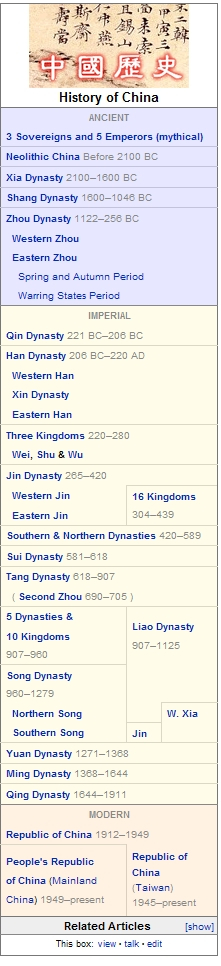
.
.
Wikipedia
.
.
.
2008.11.12 Wednesday


In 2004, Lin Chong-pin (林中斌), former deputy Minister of Defense ROC, said that one of thinking tanks in Beijing gave a proposal for United Republics of China (中華聯合共和國). None of this proposal was known. But in the same years the officials and thinking tanks of PRC often are interesting of the history of mainland Tanganyika and archipelago Zanzibar to form the United Republic of Tanzania. As Zanzibar has its own president, government, parliament, autonomy, etc. and the president of Zanzibar is the vice-president of Tanzania, it seems to be the example of Deng Xiaoping “One country, two systems” in Africa.
— Wikipedia
.
.
.
2008.11.09 Sunday
.
Talent hits a target no-one else can hit;
genius hits targets no-one else can see.
.
.
— Arthur Schopenhauer
.
.
.
2008.11.04 Tuesday
.
A few weeks later, the Great Depression began. Campbell would spend the next five years (1929-1934) trying to figure out what to do with his life (Larsen and Larsen, 2002:160) and he engaged in a period of intensive and rigorous independent study.
Campbell states that he “would divide the day into four four-hour periods, of which I would be reading in three of the four hour periods, and free one of them… I would get nine hours of sheer reading done a day. And this went on for five years straight.
— Wikipedia
.
.
.
2008.10.08 Wednesday
.
不記得是 2002年 還是 2003年,
Mr Lee 主動給他家的電話號碼給我.
他說我可以約他出來談天.
在兩年多後, 我才敢打電話給他.
.
.
今天是第三次的小型聚會, 有 Mr Lee, 安, 輝, Alex 出席.
聚會的大部分時間, 竟然是討論物理問題 —- 相對論加量子力學.
.
.
Mr. Lee 送了他著作的兩個版本給我:
1. 珍藏本
2. 大陸的簡體版 (比繁體版還要終定的終定本)
.
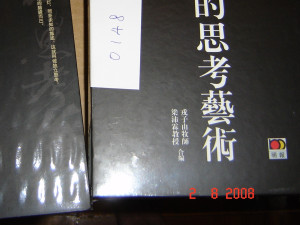
.
謝謝老師.
.
.
.
2008.08.02 Saturday
Aaron Eckhart as Harvey Dent / Two-Face: The Gotham district attorney who is hailed as Gotham’s “White Knight”; Dent’s battle with the Joker turns Dent into a murderous, disfigured vigilante called “Two-Face”.
Producer Charles Roven described Dent as initially the “white knight of the city”.

Wayne sees Dent as his heir, which comes back to the theme of him realizing that being Batman will be a lifelong mission, and the tragedy that follows when Dent is corrupted.
Whereas Two-Face is an evil villain in the comics, Nolan chose to portray him as a twisted vigilante to emphasize his role as Batman’s counterpart, and Eckhart, who has played corrupt men in films such as The Black Dahlia, Thank You For Smoking and In the Company of Men, notes: “[He] is still true to himself. He’s a crime fighter, he’s not killing good people. He’s not a bad guy, not purely,” while admitting: “I’m interested in good guys gone wrong.”
— Wikipedia on the Dark Knight
.
.
2008.07.24 Thursday
誰終將聲震人間,必長久深自緘默;誰終將點燃閃電,必長久如雲漂泊。
我的時代還沒有到來。有的人死後方生。
— 尼采
.
.
2008.06.17 Tuesday
I have lived in the pursuit of a vision, both personal and social.
Personal: to care for what is noble, for what is beautiful, for what is gentle; to allow moments of insight to give wisdom at more mundane times.
Social: to see in imagination the society that is to be created, where individuals grow freely, and where hate and greed and envy die because there is nothing to nourish them.
These things I believe, and the world, for all its horrors, has left me unshaken.
— Russell’s Autobiography
.
.
2008.05.19 Monday
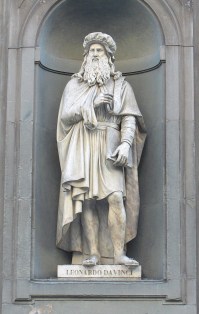
Leonardo di ser Piero da Vinci (April 15, 1452 – May 2, 1519) was an Italian polymath; a scientist, mathematician, engineer, inventor, anatomist, painter, sculptor, architect, botanist, musician and writer.
— Wikipedia
.
* Let no man who is not a Mathematician read the elements of my work.
— The Notebooks of Leonardo da Vinci
.
.
2008.04.24 Thursday
Time present and time past
Are both perhaps present in time future
And time future contained in time past.
We shall not cease from exploration
And the end of all our exploring
Will be to arrive where we started
And know the place for the first time.
— T. S. Eliot
.
.
2008.02.24 Sunday
* Every morning I jump out of bed and step on a landmine. The landmine is me. After the explosion, I spent the rest of the day putting the pieces together.
— Ray Bradbury
.
.
2008.02.20 Wednesday
* Stuff your eyes with wonder . . . live as if you’d drop dead in ten seconds. See the world. It’s more fantastic than any dream made or paid for in factories.
— Ray Bradbury
.
.
2008.02.18 Monday
* Don’t think. Thinking is the enemy of creativity. It’s self-conscious and anything self-conscious is lousy. You can’t try to do things. You simply must do things.
.
* If we listened to our intellect we’d never have a love affair. We’d never have a friendship. We’d never go in business because we’d be cynical: “It’s gonna go wrong.” Or “She’s going to hurt me.” Or,”I’ve had a couple of bad love affairs, so therefore . . .” Well, that’s nonsense. You’re going to miss life. You’ve got to jump off the cliff all the time and build your wings on the way down.
— Ray Bradbury
.
.
2008.02.17 Sunday
* Time dissipates to shining ether the solid angularity of facts.
— Emerson
.
.
2008.01.30 Wednesday
These hints, dropped as it were from sleep and night, let us use in broad day. The student is to read history actively and not passively; to esteem his own life the text, and books the commentary. Thus compelled, the Muse of history will utter oracles, as never to those who do not respect themselves. I have no expectation that any man will read history aright, who thinks that what was done in a remote age, by men whose names have resounded far, has any deeper sense than what he is doing to-day.
— Emerson
.
.
2008.01.29 Tuesday
As to methods there may be a million and then some, but principles are few.
The man who grasps principles can successfully select his own methods.
The man who tries methods, ignoring principles, is sure to have troubles.
— Ralph Waldo Emerson
.
.
2008.01.22 Tuesday
沒有無刺的玫瑰
但有很多沒有玟瑰的刺
— 叔本華
.
.
2008.01.20 Sunday
Self-Reliance is an essay written by American Transcendentalist philosopher and essayist, Ralph Waldo Emerson. It was first published in his 1841 collection, Essays: First Series. It contains the most solid statement of one of Emerson’s repeating themes, the need for each individual to avoid conformity and false consistency, and follow his or her own instincts and ideas.
In this essay, Emerson conveys his Transcendentalist philosophy and belief in self-reliance, an essential part of which is to trust in one’s present thoughts and impressions rather than those of other people or of one’s past self. This philosophy is exemplified in the quote: “A foolish consistency is the hobgoblin of little minds.” Emerson stresses the need to believe one’s own thoughts, while actively searching one’s internal mind in order to capture the flash thought that may or may not come across. However, Emerson articulates that although one may have unlimited potential, few actually possess the confidence to develop their minds fully. Emerson then writes, “Trust yourself,” for God will not have his work made manifested by “cowards”. Immediately afterwards, he asserts that everyone has the innate tendency to express independent, genuine verdicts when young, but when young men become adults, Emerson argues, they will become, “clapped into jail by [their] consciousness.”
The essay states that, “To be great is to be misunderstood,” Emerson illustrates this by showing how enormously influential historical characters (Jesus Christ, Pythagoras, Copernicus) were fiercely opposed during their lifetimes, while time later demonstrated their genius.
Emerson also stresses originality, believing in one’s own genius and that creativity lives within all people. From this springs the quote: “Envy is ignorance, imitation is suicide.”
— Wikipedia, December 2007
.
.
2008.01.06 Sunday


 Physics Town
You must be logged in to post a comment.