找例外 5

4.5.2 part 2

“Do not follow the rules. Instead, look for exceptions.”

– What color is your parachute? 2005 Edition

.

.

不要老是跟著規則走.

老是跟著規則走的話, 你會損失很多  大機會.

.

.

例子二:

以前在實驗室工作時,

教授請來了一位同事.

該位同事的寫程式才能很高.

.

.

但是研究院認為他的英文能力未達基本要求, 不能收他.

另一方面, 教授卻認為該位同事是一位程式奇才, 不能放棄.

結果, 在教授的推薦下, 研究院收了他.

條件只是要他補考英文的公開試, 以證明他的英文有進步, 已達研究院的英文基本要求.

.

.

試想想,

如果那位同事是跟著規則走, 按一般程序報讀研究院的話,

以他的英文能力, 在第一階段的遴選將會被拒絕.

.

.

哪他怎樣不跟規則走呢?

.

.

他先找教授, 說服教授

他的程式能力是一個大優點.

這個優點所帶來的好處, 遠遠超過他的英文所帶來的不好處.

而他英文差這個缺點是不難補救的.

令教授願意收他為研究生.

.

.

.

2008.08.14 Thursday copyright CHK^2

找例外 3

4.5.2 part 2

“Do not follow the rules. Instead, look for exceptions.”

– What color is your parachute? 2005 Edition

.

.

但是怎樣想到辦法, 先找到一份教學工作呢?

.

.

可以試試這樣想:
(改篇自 <<What Color is Your Parachute?>> 的說法)

.

.
有哪個人曾經   在沒有教育文憑的情況下    找到教學的工作呢?

他額外做了些什麼事情  或者  他有什麼特別的資歷

導致他能避免教育文憑呢?

你有沒有那些特別的資歷?

.

.

.
2008.08.08 Friday copyright CHK^2

找例外 2

4.5.2 part 2

“Do not follow the rules. Instead, look for exceptions.”

– What color is your parachute? 2005 Edition

.

.

.

不跟規則走的話, 可以這樣:

先想想有沒有辦法

在沒有教育文憑的情況下

找到一份教學工作

找到以後, 那就可能不用再讀教育文憑了.

如果要的話, 你可以讀 part time 的教育文憑補救.

這樣的話, 你就不用擔心讀完教育文憑後, 找不到教學的工作.

.

.

但是怎樣想到辦法, 找到一份教學工作呢?

.

.

.
2008.08.05 Tuesday copyright CHK^2

找例外

4.5.2 part 2

Do not follow the rules. Instead, look for exceptions.”

— What color is your parachute? 2005 Edition

.

.

不要老是跟著規則走.

老是跟著規則走的話, 你會損失很多  大機會.

.

.

例子一:

假切你已大學畢業生. 你想做老師.

做老師的先決條件是有教育文憑.

但是你沒有教育文憑.

.

.

跟著規則走的話,

解決方法是你先讀一個教育文憑, 然後再找教學工作.

但是這樣有一個小問題, 一個中問題, 一個大問題:

.

1. 讀教育文憑需要額外花一年的學費;

2. 讀教育文憑需要額外花一年的時間,

那一年你將沒有薪金 (大約180,000港元);

3. 近年, 由於學生的人數大量減少, 大部分教育文憑的畢業生也找不到教學工作, 需另投他行.

.

.

.

2008.08.03 Sunday copyright CHK^2

Edward Witten

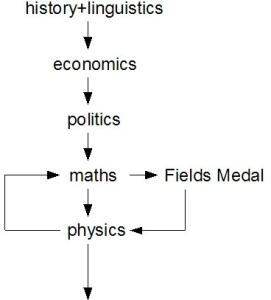
Edward Witten has the highest h-index among physicists. In this sense, he is the best physicist in the world now.^1 What really surprises me is that he did not major in physics as an undergraduate student. He majored in history. While working as a physicist, he received the highest honor in mathematics, the Fields Medal.^2

Birth and education

Edward Witten was born in Baltimore, Maryland to a Jewish family, the son of Lorraine W. Witten and Louis Witten, a physicist specializing in gravitation and general relativity. He received his bachelor’s degree in history (with a minor in linguistics) from Brandeis University. Witten planned to become a political journalist, and published articles in The New Republic and The Nation. He worked briefly for George McGovern’s presidential campaign. Then, he attended the University of Wisconsin-Madison for one semester as an economics graduate student before dropping out. He then returned to academia, enrolling in applied mathematics at Princeton University before shifting departments and receiving a Ph.D. in physics in 1976 under David Gross, the Nobel laureate in Physics in 2004.

— Wikipedia

.

witten

Figure 4.1: Witten’s career path

(This figure is made and copyrighted by me. Copy it as you like.)

.

Even the best people in the world need such a long time to find their true love career.

How about you?

What is your true love?

.

1 As of 2007
2 The Fields Medal is the “Nobel prize” in Mathematics.

.

.

2008.07.19 Saturday \copyright CHK^2

4.3 Lisp

4.3.2 Have a habit of doing good work in your current job, whether it is your favourite

In order to get your favourite job, you have to get used to doing good work in your current job. So, even if you choose to quit your current job later, you know that you are quitting not because you want to give up, but because you have a better job or a better chance.

.

.

2008.07.09 Wednesday \copyright CHK^2

4.3 Paul Graham

LISP writer Paul Graham has written an essay called “How to do what you love”, giving some practical advice.

There are three main points, for me, in the essay:

  1. Do not feel guilty about not doing some boring jobs.

  2. Have a habit of doing good work in your current job, whether it is your favourite.

  3. Always produce in your favourite area, whether it is your current job.

.

4.3.1 Do not feel guilty about not doing some boring jobs

Sometimes, I faced some boring work. When I wanted to get rid of it, I had a thought: “Someone has to do it anyway. If I do not do it, someone else will have to. That means I am wasting other people’s time. I will feel guilty about that.”

Now I do not think in that way. If I choose not to do a job, the number of people available for that job will decrease. That means the price to get a person to do the job will rise. Then the person who has chosen that job will get a higher salary. So, instead of wasting his time, I make him earn a higher salary.

If a job is so boring that it is virtually impossible to get any human being to do it, people will create a machine to get the job done.

.

.

2008.06.30 Monday \copyright CHK^2

Chapter 4 Master

Two roads diverged in a wood, and I-
I took the one less traveled by,
And that has made all the difference.

— Robert Frost

.

4.1 Autobiography

每一個人也是,自己自傳的主角.

— Me, inspired by Mr. Lee

.

4.2 根據地

Select one single thing that you are the best in the world, stand firmly on it, and then move the whole world.

— Me, based on Archimedes and Mr. Lee

.

e.g. Google had only one function — the search function. It did the very best for the search engine. Once it started to dominate, it expanded its functions, such as Gmail and Google Calender, based on its search technology.

Google’s own words on Google’s Philosophy page:

It’s best to do one thing really, really well.

Google does search. With one of the world’s largest research groups focused exclusively on solving search problems, we know what we do well, and how we could do it better. … Our dedication to improving search has also allowed us to apply what we’ve learned to new products, including Gmail, Google Desktop, and Google Maps.

.

.

2008.06.25 Wednesday \copyright CHK^2

2.4.2 Newton, Leibniz, Einstein

Newton

Two distinct views exist on the meaning of time. One view is that time is part of the fundamental structure of the universe, a dimension in which events occur in sequence. This is the realist view, to which Sir Isaac Newton subscribed, in which time itself is something that can be measured.

Leibniz

A contrasting view is that time is part of the fundamental intellectual structure (together with space and number) within which we sequence events, quantify the duration of events and the intervals between them, and compare the motions of objects. In this view, time does not refer to any kind of entity that that objects “move through”, or that is a “container” for events. This view is in the tradition of Gottfried Leibniz and Immanuel Kant, in which time, rather than being an objective thing to be measured, is part of the mental measuring system.

Einstein

Many fields avoid the problem of defining time itself by using operational definitions that specify the units of measurement that quantify time. Regularly recurring events and objects with apparent periodic motion have long served as standards for units of time. Examples are the apparent motion of the sun across the sky, the phases of the moon, and the swing of a pendulum.

— Wikipedia

.

.

2008.06.22 Sunday CHK_2

因果網絡也

2.4 Pure Definition

2.4.1 What is Time

Time is a subtle concept. In this section, we get a proper definition of time. We begin with Newton and Leibniz.

As the creators of calculus, Newton and Leibniz are famous rivals. On the nature of time, they had completely opposite views. For Newton, time (and space) is the stage for events to happen. Time is something real in itself.

For Leibniz, time is not a real substance. Time is just a bookkeeping system to relate different objects and different events. Time is a system of relations.[3]

For example, consider the statement “the cloud is higher than the ground.” The cloud is an object. The ground is another object. But “higher than” is not an object. Instead, it is a relation between objects.

— Me

[3] The Elegant Universe Appendix

.

.

2008.06.19 Thursday \copyright CHK^2

2.3.2 As time goes

Wisdom and Next

Is there anything higher than wisdom? If yes, what is the process of going from wisdom to there?

Dying. (This can be trivial. When you age to a certain extent, you die.)

data_and_information

Then what is Next?

How can I know? I have not died yet!

.

2.3.2 As time goes

— 時光流逝
— 歲月蹉跎
— 人海浮沉
— 物轉星移
— 滄海桑田

.

.

2008.06.16 Monday \copyright CHK^2

2.3 Statistics

2.1.3 Collections and recollections

2.2 Dispersion
2.2.1 Why is there dispersion
2.2.2 Guided reading

2.3 Statistics

2.3.1 What is statistics

Data Statistics Information Studying Knowledge Aging Wisdom Dying Next What is Next

Data and Information

First, differentiate data and information: Data is raw. Data have no meaning. Information is processed data. Information has meaning. The process to transform data to information is statistics.

Information and Knowledge

Information is at higher level than data.

What is higher than information?

Knowledge.
What is the process of transforming information to knowledge?

Studying. (or AI for computers)

If you want a lot of mathematics information, just buy 50 maths books, then you get a lot of information. But if you want a lot of mathematics knowledge, you have a lot of hard work to do.

Knowledge and Wisdom

After knowledge, what is next? Wisdom.

What is the process of transforming knowledge to wisdom?

Aging.
If you want to have a lot of knowledge, buy a lots of books, read them and read them well. But if you want to have a lot of wisdom, you need to live your life for a long time or a long long time.

Wisdom and Next

Is there anything higher than wisdom?

If yes, what is the process to go from wisdom to there?

Dying. (This can be trivial. When you age to a certain extent, you die.)

.

.

2008.06.11 Wednesday \copyright CHK^2

2.1.2 Chemical Physics and Physical Chemistry

Chemical physics is a subdiscipline of physics that investigates physicochemical phenomena using techniques from atomic and molecular physics and condensed matter physics; it is the branch of physics that studies chemical processes from the point of view of physics. While at the interface of physics and chemistry, chemical physics is distinct from physical chemistry in that it focuses more on the characteristic elements and theories of physics. Meanwhile, physical chemistry studies the physical nature of chemistry. Nonetheless, the distinction between the two fields is vague, and workers often practice in each field during the course of their research.

— Wikipedia

.

.

2008.06.09 Sunday \copyright CHK^2

2.1.1 Mathematical and Theoretical Physics

2.1.1 Mathematical Physics and Theoretical Physics

.

The term ‘mathematical’ physics is also sometimes used in a special sense, to distinguish research aimed at studying and solving problems inspired by physics within a mathematically rigorous framework.

Mathematical physics in this sense covers a very broad area of topics with the common feature that they blend pure mathematics and physics. Although related to theoretical physics, ‘mathematical’ physics in this sense emphasizes the mathematical rigour of the same type as found in mathematics.

On the other hand, theoretical physics emphasizes the links to observations and experimental physics which often requires theoretical physicists (and mathematical physicists in the more general sense) to use heuristic, intuitive, and approximate arguments. Such arguments are not considered rigorous by mathematicians.

Arguably, rigorous mathematical physics is closer to mathematics, and theoretical physics is closer to physics.

— Wikipedia

.

.

2008.06.03 Tuesday CHK^2

Microscope 2

Chapter 2

Applied Mathematics

.

2.11 Knowledge map

Language, Logic, Maths, Physics, Chemistry, Biology

Logic, Pure Maths, Applied Maths, Mathematical Physics, Theoretical Physics, Experimental Physics

Logic, Pure Maths, Applied Maths, Pure Physics, Applied Physics, Engineering

Logic, Maths, Physics, Chemical Physics, Physical Chemistry

2.12 A Geography of Knowledge

Language, Logic, Symbolic Logic, Mathematical Logic, Mathematics, Mathematical Physics, Theoretical Physics, Physics, Experimental Physics, Chemical Physics, Physical Chemistry, Chemistry, Biochemistry, Molecular Biology, Biology

Language, Logic, Mathematics, Physics, Engineering

.

.

2008.05.27 Tuesday \copyright CHK^2

Contents Chapter 1

Contents

Preface 緣起

1 Additional Mathematics

.

1.1 General Mathematics
1.1.1 Analytic and Synthetic
1.1.2 Logic and Pure Mathematics
1.1.3 Scene One
1.1.4 Scene Two
1.1.5 Constrast
1.1.6 Mathematics

1.2 Additional Additional Mathematics
1.2.1 Deduction and Induction
1.2.2 Mathematical Induction
1.2.3 數學歸納法
1.2.4 數學感應法

2 Applied Mathematics
3 Storyline
4 Master
5 Writing
6 Doctor
7 Painting

.

A Storyarc

.

.

2008.05.24 Saturday \copyright CHK^2