Do what you fear and fear disappears.
.
To fight fear, act. To increase fear — wait, put off postpone.
— David J. Schwartz
.
.
2008.02.08 Friday

Do what you fear and fear disappears.
.
To fight fear, act. To increase fear — wait, put off postpone.
— David J. Schwartz
.
.
2008.02.08 Friday
The time you confront your fear the fear disappears.
—
.
.
2008.02.07 Thursday
1.1 專博之爭 1.2 第二是沒有意思的
2.1 軟硬智力 2.2 提昇軟硬智力 2.21 提昇硬智力 2.22 硬件常識
.
2.23 提昇軟智力 2.231 作業系統 2.232 公用程式 2.233 主題程式
2.2331 程式情境 2.2332 情境程式
2.2341 程式員 2.2342 Brain programmers 2.235 寫程式
2.236 寫 寫程式 程式
.
3.1 幻想智力 3.11 洗衣機與電飯煲 3.12 鱷魚與長頸鹿
3.21 迷宮 3.22 G.Maths by A.Maths
.
4. 專等於博
假設你的核心學問是物理.
物理是你知識網絡的中心.
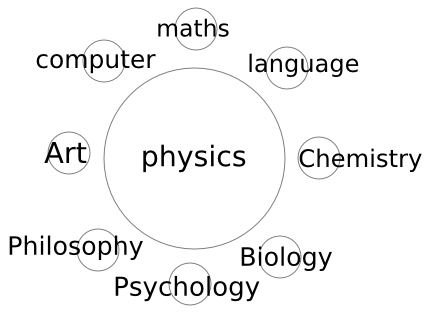
第一層次的看法是 中心為專 周邊為博.
第二層次的看法是 以專攻博: 透過物理掌握其他學問.
第三層次的看法是 以博攻專: 透過各門學問掌握物理,
以物理作為, 各門學問的學習主題.
例如:
學數學時問, 這個物理課題, 需要哪門數學? 需要知到甚麼程度?
學語言時問, 物理文章恰當的風格是甚麼? 用甚麼字眼可以, 令行外人也能明白?
學心理時問, 研究物理需要, 甚麼心理素質? 物理大家的思考方法, 工作習慣中, 有哪些是值得學習的呢?
學程式時問, 這冗長的運算是必須的嗎? 可否用電腦來代勞?
.
第四層次的看法是 專博合一:

PHYSICS = logic + language + mathematics + physics + chemistry + computer + psychology + …

Model of the atom by Ernest Rutherford: Permission is granted to copy, distribute and/or modify this document (refers to the above graph only) under the terms of the GNU Free Documentation License, Version 1.2 or any later version published by the Free Software Foundation.
.
當一塊大鑽石弄碎時, 價值只等於許多小鑽石.
當一個偉大的心靈, 被干擾而分散時, 就只是一個平凡的心靈.
偉大心靈的優越之處在於, 集中一切心力於某一點, 如凹鏡集中所有光線一樣.
— 叔本華
.
— This is the end of the StoryArc. —
.
.
2008.02.06 Wednesday
To be a catalyst is the ambition most appropriate for those who see the world as being in constant change, and who, without thinking that they can control it, wish to influence its direction.
— Theodore Zeldin
.
.
2008.02.03 Sunday
People have a way of becoming what you encourage them to be—not what you nag them to be.
— S.N. Parker
.
.
2008.02.01 Friday
God teach you through your mind;
help you through your actions.
— Me@Last Century
.
.
2008.01.31 Thursday
* Time dissipates to shining ether the solid angularity of facts.
— Emerson
.
.
2008.01.30 Wednesday
These hints, dropped as it were from sleep and night, let us use in broad day. The student is to read history actively and not passively; to esteem his own life the text, and books the commentary. Thus compelled, the Muse of history will utter oracles, as never to those who do not respect themselves. I have no expectation that any man will read history aright, who thinks that what was done in a remote age, by men whose names have resounded far, has any deeper sense than what he is doing to-day.
— Emerson
.
.
2008.01.29 Tuesday
學問者
因果
理由
之理解也
— Me@2007
.
.
2008.01.28 Monday
每一個人也是, 自己自傳的主角.
— Me, inspired by Mr. Lee
.
.
2008.01.27 Sunday
The intent here is
to gain a clearer perception of ourselves,
of humanity in general:
where we’ve been,
where we’re going,
the pitfalls and the possibilities,
the perils and the promise …
perhaps even an answer to
that universal question:
Why?
— Back to the Future 2
.
.
2008.01.23 Wednesday
As to methods there may be a million and then some, but principles are few.
The man who grasps principles can successfully select his own methods.
The man who tries methods, ignoring principles, is sure to have troubles.
— Ralph Waldo Emerson
.
.
2008.01.22 Tuesday
Two years ago, about May or June 2006, a student started to collect my interesting sentences.
Several months ago, November, a Form 4 student started to collect my interesting sentences.
Last week, my Form 1 students started to collect my interesting sentences.
But don’t expect too much, I am tired.
.
.
2008.01.20 Sunday
沒有無刺的玫瑰
但有很多沒有玟瑰的刺
— 叔本華
.
.
2008.01.20 Sunday
PHY5570 Methods in Theoretical Physics 數學物理 B-
PHY4450 Solid State Physics 固態物理 this semester
.
.
2008.01.10 Thursday
Everybody searching for a hero
People need someone to look up to
I never found anyone to fulfill my needs
A lonely place to be
So I learned to depend on me
— The Greatest Love of All
— Michael Masser & Linda Creed
.
.
2008.01.07 Monday
Self-Reliance is an essay written by American Transcendentalist philosopher and essayist, Ralph Waldo Emerson. It was first published in his 1841 collection, Essays: First Series. It contains the most solid statement of one of Emerson’s repeating themes, the need for each individual to avoid conformity and false consistency, and follow his or her own instincts and ideas.
In this essay, Emerson conveys his Transcendentalist philosophy and belief in self-reliance, an essential part of which is to trust in one’s present thoughts and impressions rather than those of other people or of one’s past self. This philosophy is exemplified in the quote: “A foolish consistency is the hobgoblin of little minds.” Emerson stresses the need to believe one’s own thoughts, while actively searching one’s internal mind in order to capture the flash thought that may or may not come across. However, Emerson articulates that although one may have unlimited potential, few actually possess the confidence to develop their minds fully. Emerson then writes, “Trust yourself,” for God will not have his work made manifested by “cowards”. Immediately afterwards, he asserts that everyone has the innate tendency to express independent, genuine verdicts when young, but when young men become adults, Emerson argues, they will become, “clapped into jail by [their] consciousness.”
The essay states that, “To be great is to be misunderstood,” Emerson illustrates this by showing how enormously influential historical characters (Jesus Christ, Pythagoras, Copernicus) were fiercely opposed during their lifetimes, while time later demonstrated their genius.
Emerson also stresses originality, believing in one’s own genius and that creativity lives within all people. From this springs the quote: “Envy is ignorance, imitation is suicide.”
— Wikipedia, December 2007
.
.
2008.01.06 Sunday
人生苦短
點解要改卷? :-(
.
.
2008.01.06 Sunday
Man is his own star; and the soul that can
Render an honest and a perfect man,
Commands all light, all influence, all fate;
Nothing to him falls early or too late.
Our acts our angels are, or good or ill,
Our fatal shadows that walk by us still.
— Epilogue to Beaumont and Fletcher’s Honest Man’s Fortune
.
.
01.01.2008 Tuesday
.
明月幾時有?
把酒問青天。
不知天上宮闕,
今夕是何年?
.
我欲乘風歸去,
唯恐瓊樓玉宇,
高處不勝寒。
起舞弄清影,
何似在人間!
轉朱閣,
低綺戶,
照無眠。
不應有恨,
何事長向別時圓?
.
人有悲歡離合,
月有陰晴圓缺,
此事古難全。
但願人長久,
千里共嬋娟。
.
.
New Year Eve 2007,


 Physics Town
You must be logged in to post a comment.