
Consciousness 3

Copy Me, 4

Being conscious is being able to form memories.

forming memories

~ forming an identity

~ forming a causal chain of thoughts

To form memories, one needs to access and then store its own states.

But due to metadox (paradox), no one, or no single part of the brain, can access its own now-here state directly.

That is why different parts of the brain have to communicate and coordinate in order to be conscious.

— Me@2013-05-30 1:47 PM

2013.06.23 Sunday (c) All rights reserved by ACHK
Consciousness 2

So when we’re awake and conscious, a single shock initiates a series of responses. Because they are well-connected, the different parts of the cerebral cortex are able to communicate and the integration results in this being conscious.

But when we’re asleep and unconscious, the communication channels temporarily shut down. So the same shock produces only a short likewise response.

— The Secret You

— BBC Horizon Documentary

conscious

Etymology

From Latin conscius, itself from con– (a form of com– (“together”) + scire (“to know”).

— Wiktionary on conscious

Consciousness and self-awareness is due to the communications between different parts of the brain.

— Me@2013-06-06

2013.06.06 Thursday (c) All rights reserved by ACHK

Consciousness | 自我 | 意識

There is no direct self-interaction.

An observation or measurement is an interaction between the observer and the observed, involving two objects. So there is logically impossible to have direct self-observation.

— Me@2013-05-29 12:09:46 AM

You cannot see yourself directly from your own point of view. Instead, you can only see your mirror, photo, and video images. In other words, you can only indirectly see yourself.

— Me@2013-01-20 01:08:34 AM

— Me@2013-05-31 10:45:49 PM

2013.05.31 Friday (c) All rights reserved by ACHK

潛行凶間 2.2

夢中多重自我

Permission is granted to copy, distribute and/or modify this document under the terms of the GNU Free Documentation License, Version 1.2 or any later version published by the Free Software Foundation; with no Invariant Sections, no Front-Cover Texts, and no Back-Cover Texts.

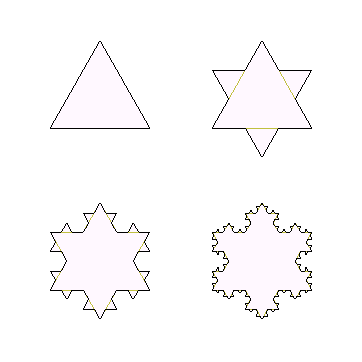
A human mind is a fractal.

— Me@2010.08.02

2012.02.18 Saturday (c) All rights reserved by ACHK

Inner and outer, 5

Layer, 3 | 水平 7 | Onion self 5

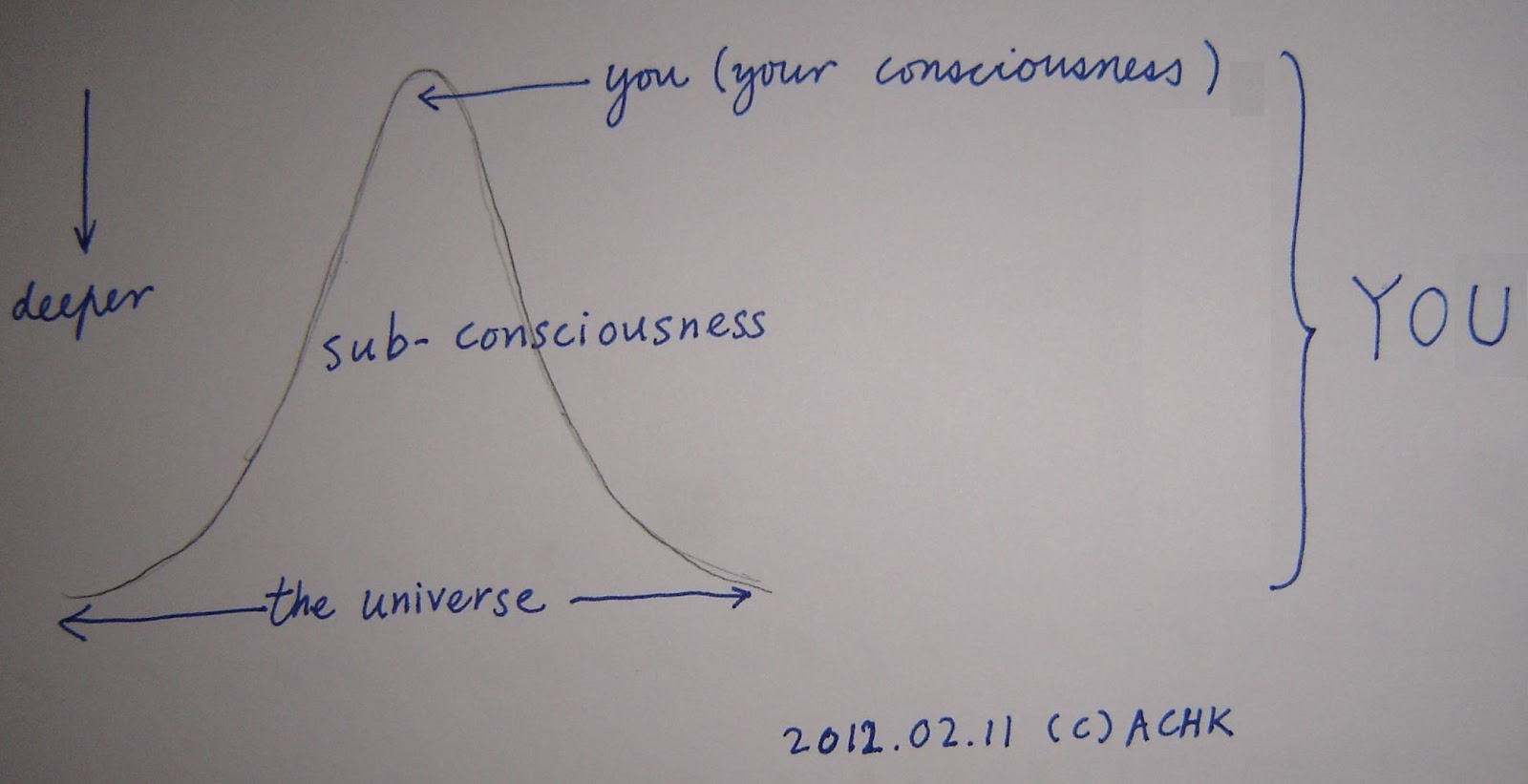
The deeper the consciousness, the more powerful it is.

— Me@2010.08.06

The diagram is not the truth. Instead, it is an analogy. It is a model only.
— 
Me@2012-02-08 12:55:31 PM

The deepest self is the universe.

— Me@2012-01-16 2:20:19 AM

The diagram is not the truth. Instead, it is an analogy. It is a model only.

— Me@2012.02.11

2012.02.11 Saturday (c) All rights reserved by ACHK

Recursion 8.2

I am a Strange Loop, 3.2

When I am conscious, different times of myself-s interact.

When different times of the same (software) object interact, there comes consciousness.

The past is part of the present.

So consciousness comes from the whole-part interaction.

— Me@2012-01-24 11:03:37 AM

2012.02.05 Sunday (c) All rights reserved by ACHK
Neural correlates of consciousness

The neural correlates of consciousness (NCC) constitute the minimal set of neuronal events and mechanisms sufficient for a specific conscious percept. Neuroscientists use empirical approaches to discover neural correlates of subjective phenomena. The set should be minimal because, while the entire brain is clearly sufficient to give rise to any given conscious experience, the question is which of its components were necessary to produce it.

— Wikipedia on Neural correlates of consciousness

2011.11.07 Monday ACHK

Copy Me, 3

Cumulative concept of time, 8

Since my present-self have the memory of my younger self, my younger self is part of my present-self.   

1. What is the meaning of the “same” file?

If two files contain exactly the same data, they are the “same” file.

2. Memory is the definition of identity. 

Since I have the memory of my younger self, I am the same person as my younger self. Moreover, since I have more memory than my younger self, I am more than my younger self. My younger self is part of me.

3. If I am a book, my younger self is like the one with fewer chapters:

younger self ~ chapter 1,2,3       

older self ~ chapter 1,2,3,4,5,6

— Me@2011.07.10

— Me@2011.08.04

2011.08.04 Thursday (c) All rights reserved by ACHK

Copy Me

Philosopher John Locke published “An Essay Concerning Human Understanding” in 1689, in which he proposed the following criterion for personal identity: if you remember thinking something in the past, then you are the same person as he or she who did the thinking. Later philosophers raised various logical snarls, most of them caused by applying Boolean logic, the prevalent logic system at the time. It has been proposed that modern fuzzy logic can solve those problems, showing that Locke’s basic idea is sound if one treats personal identity as a continuous rather than discrete value.

– Wikipedia

.

.

2008.04.13 Saturday ACHK