3 Vector Fields and One-Form Fields, 1.2

p. 21

5.

\displaystyle{(Df(x)) b(x) \ne (Df(x)) \Delta x}

Instead, \displaystyle{(Df(x)) b(x)} is a generalization of \displaystyle{(Df(x)) \Delta x}.

6.

However, how to calculate \displaystyle{(Df(x)) b(x)}?

By this:

\displaystyle{f(x + \Delta x) \approx f(x) +  (Df(x)) \Delta x}

Then:

\displaystyle{(Df(x)) = \lim_{\Delta x \to 0} \frac{f(x + \Delta x) - f(x)}{\Delta x}}

So:

\displaystyle{(Df(x)) b(x) = \left( \lim_{\Delta x \to 0} \frac{f(x + \Delta x) - f(x)}{\Delta x} \right) b(x)}

7.

b is written as subscript to capture the meaning of “with respect to b“. The original directional derivative uses the same convention:

So the spatial rate of change of \displaystyle{f} along the direction of the vector \displaystyle{\mathbf{v}} is

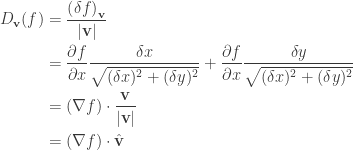
\displaystyle{\begin{aligned}  D_{\mathbf{v}}(f)    &= \frac{\left(\delta f\right)_{\mathbf{v}}}{|\mathbf{v}|} \\    &= \frac{1}{|\mathbf{v}|} \left( \frac{\partial f}{\partial x} \delta x + \frac{\partial f}{\partial x} \delta y \right) \\    &= \frac{\partial f}{\partial x} \frac{\delta x}{\sqrt{(\delta x)^2 + (\delta y)^2}}  + \frac{\partial f}{\partial x} \frac{\delta y}{\sqrt{(\delta x)^2 + (\delta y)^2}} \\    &= \left(\nabla f\right) \cdot \frac{\mathbf{v}}{|\mathbf{v}|} \\  &= \left(\nabla f\right) \cdot \hat{\mathbf{v}} \\  \end{aligned}}

\displaystyle{D_{\mathbf{v}}(f)} is called directional derivative.

— Me@2016-02-06 09:49:22 PM

— Me@2023-12-27 01:37:32 PM

— Functional Differential Geometry

.

.

2023.12.27 Wednesday (c) All rights reserved by ACHK

3 Vector Fields and One-Form Fields, 1

Chain Rule of Differentiation, 2

Functional Differential Geometry

.

p. 21

1.

In multiple dimensions the derivative of a function is the multiplier for the best linear approximation of the function at each argument point:

\displaystyle{f(x + \Delta x) \approx f(x) +  (Df(x)) \Delta x}

In other words:

\displaystyle{  \begin{aligned}  f(x + \Delta x) &= f(x) + a_1 (\Delta x) + a_2 (\Delta x)^2 + \cdots \\   (Df(x)) &= a_1 \\   \end{aligned}  }

2.

The derivative Df(x) is independent of \Delta x.

3.

… the product \displaystyle{(Df(x))\Delta x} is invariant under change of coordinates …

4.

\displaystyle{(Df(x)) \Delta x} is the directional derivative of \displaystyle{f} at \displaystyle{x} with respect to \displaystyle{\Delta x}.

5.

\displaystyle{(Df(x)) b(x) \ne (Df(x)) \Delta x}

Instead, \displaystyle{(Df(x)) b(x)} is a generalization of \displaystyle{(Df(x)) \Delta x}.

— Me@2023-09-29 11:48:36 PM

.

.

2023.09.30 Saturday (c) All rights reserved by ACHK

The Jacobian of the inverse of a transformation

The Jacobian of the inverse of a transformation is the inverse of the Jacobian of that transformation

.

In this post, we would like to illustrate the meaning of

the Jacobian of the inverse of a transformation = the inverse of the Jacobian of that transformation

by proving a special case.

.

Consider a transformation \mathscr{T}: \bar{x}^i=\bar{x}^i (x^1,x^2), which is an one-to-one mapping from unbarred x^i‘s to barred \bar{x}^i coordinates, where i=1, 2.

By definition, the Jacobian matrix J of \mathscr{T} is

J= \begin{pmatrix} \displaystyle{\frac{\partial \bar{x}^1}{\partial x^1}} & \displaystyle{\frac{\partial \bar{x}^1}{\partial x^2}} \\ \displaystyle{\frac{\partial \bar{x}^2}{\partial x^1}} & \displaystyle{\frac{\partial \bar{x}^2}{\partial x^2}} \end{pmatrix}

.

Now we consider the the inverse of the transformation \mathscr{T}:

\mathscr{T}^{-1}: x^i=x^i(\bar{x}^1,\bar{x}^2)

By definition, the Jacobian matrix \bar{J} of this inverse transformation, \mathscr{T}^{-1}, is

\bar{J}= \begin{pmatrix} \displaystyle{\frac{\partial x^1}{\partial \bar{x}^1}} & \displaystyle{\frac{\partial x^1}{\partial \bar{x}^2}} \\ \displaystyle{\frac{\partial x^2}{\partial \bar{x}^1}} & \displaystyle{\frac{\partial x^2}{\partial \bar{x}^2}} \end{pmatrix}

.

On the other hand, the inverse of Jacobian J of the original transformation \mathscr{T} is

J^{-1}=\displaystyle{\frac{1}{ \begin{vmatrix} \displaystyle{\frac{\partial \bar{x}^1}{\partial x^1}} & \displaystyle{\frac{\partial \bar{x}^1}{\partial x^2}} \\ \displaystyle{\frac{\partial \bar{x}^2}{\partial x^1}} & \displaystyle{\frac{\partial \bar{x}^2}{\partial x^2}} \end{vmatrix} }} \begin{pmatrix} \displaystyle{\frac{\partial \bar{x}^2}{\partial x^2}} & \displaystyle{-\frac{\partial \bar{x}^1}{\partial x^2}} \\ \displaystyle{-\frac{\partial \bar{x}^2}{\partial x^1}} & \displaystyle{\frac{\partial \bar{x}^1}{\partial x^1}} \end{pmatrix}

.

If \bar{J} = J^{-1}, their (1, 1)-elementd should be equation:

\displaystyle{\frac{\partial x^1}{\partial \bar{x}^1}}\stackrel{?}{=}\displaystyle{\frac{1}{\displaystyle{\frac{\partial \bar{x}^1}{\partial x^1}}\displaystyle{\frac{\partial \bar{x}^2}{\partial x^2}}-\displaystyle{\frac{\partial \bar{x}^1}{\partial x^2}}\displaystyle{\frac{\partial \bar{x}^2}{\partial x^1}} }} \bigg( \displaystyle{\frac{\partial \bar{x}^2}{\partial x^2}} \bigg)

Let’s try to prove that.

.

Consider equations

\bar{x}^1 = \bar{x}^1(x^1,x^2)

\bar{x}^2 = \bar{x}^2(x^1,x^2)

Differentiate both sides of each equation with respect to \bar{x}^1, we have:

A := 1=\displaystyle{\frac{\partial \bar{x}^1}{\partial \bar{x}^1}=\frac{\partial \bar{x}^1}{\partial x^1}\frac{\partial x^1}{\partial \bar{x}^1}+\frac{\partial \bar{x}^1}{\partial x^2}\frac{\partial x^2}{\partial \bar{x}^1}}

B := 0 = \displaystyle{\frac{\partial \bar{x}^2}{\partial \bar{x}^1}=\frac{\partial \bar{x}^2}{\partial x^1}\frac{\partial x^1}{\partial \bar{x}^1}+\frac{\partial \bar{x}^2}{\partial x^2}\frac{\partial x^2}{\partial \bar{x}^1}}

.

A \times \displaystyle{\frac{\partial \bar{x}^2}{\partial x^2}}:~~~~~C := \displaystyle{\frac{\partial \bar{x}^2}{\partial x^2}=\frac{\partial \bar{x}^1}{\partial x^1}\frac{\partial x^1}{\partial \bar{x}^1}\frac{\partial \bar{x}^2}{\partial x^2}+\frac{\partial \bar{x}^1}{\partial x^2}\frac{\partial x^2}{\partial \bar{x}^1}\frac{\partial \bar{x}^2}{\partial x^2}}

B \times \displaystyle{\frac{\partial \bar{x}^1}{\partial x^2}}:~~~~~D := \displaystyle{0=\frac{\partial \bar{x}^2}{\partial x^1}\frac{\partial x^1}{\partial \bar{x}^1}\frac{\partial \bar{x}^1}{\partial x^2}+\frac{\partial \bar{x}^2}{\partial x^2}\frac{\partial x^2}{\partial \bar{x}^1}\frac{\partial \bar{x}^1}{\partial x^2}}

.

D-C:

\displaystyle{ \frac{\partial \bar{x}^2}{\partial x^2}= \bigg( \frac{\partial \bar{x}^1}{\partial x^1}\frac{\partial \bar{x}^2}{\partial x^2} - \frac{\partial \bar{x}^2}{\partial x^1}\frac{\partial \bar{x}^1}{\partial x^2}\bigg) \frac{\partial x^1}{\partial \bar{x}^1}},

results

\displaystyle{ \frac{\partial x^1}{\partial \bar{x}^1}}=\frac{\displaystyle{\frac{\partial \bar{x}^2}{\partial x^2}}}{\displaystyle{\frac{\partial \bar{x}^1}{\partial x^1}\frac{\partial \bar{x}^2}{\partial x^2} - \frac{\partial \bar{x}^1}{\partial x^2}\frac{\partial \bar{x}^2}{\partial x^1}}}

— Me@2018-08-09 09:49:51 PM

.

.

2018.08.09 Thursday (c) All rights reserved by ACHK

Chain Rule of Differentiation

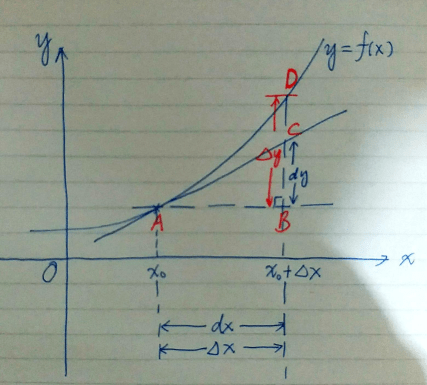
Consider the curve y = f(x).

.

\displaystyle{\frac{d}{dx}} is an operator, meaning “the slope of the tangent of”. So the expression \displaystyle{\frac{dy}{dx}}, meaning \displaystyle{\frac{d}{dx} (y)}, is not a fraction.

In order words, it means the slope of the tangent of the curve y = f(x) at a point, such as point A in the graph.

d_2018_07_15__21_31_32_PM_

The symbol dx has no relation with the symbol \displaystyle{\frac{dy}{dx}}. It means \Delta x as shown in the graph. In other words,

dx = \Delta x

.

The symbol dy also has no relation with the symbol \displaystyle{\frac{dy}{dx}}. It means the vertical distance between the current point A(x_0, y_0), where y_0 = f(x_0), and the point C on the tangent line y = mx + c, where m is the slope of the tangent line. In other words,

dy = m~dx

or

\displaystyle{dy = \left[ \left( \frac{d}{dx} \right) y \right] dx}

.

The relationship of \Delta y and dy is that

\displaystyle{\Delta y = \frac{dy}{dx} \Delta x + \text{higher order terms}}

\displaystyle{\Delta y = \frac{dy}{dx} dx + \text{higher order terms}}

\Delta y = dy + \text{higher order terms}

.

Similarly, for functions of 2 variables:

\displaystyle{\Delta f(x,y) = \frac{\partial f}{\partial x} \Delta x + \frac{\partial f}{\partial y} \Delta y + \text{higher order terms}}

\displaystyle{df = \frac{\partial f}{\partial x} dx + \frac{\partial f}{\partial y} dy}

.

For functions of 3 variables:

\displaystyle{df = \frac{\partial f}{\partial x} dx + \frac{\partial f}{\partial y} dy + \frac{\partial f}{\partial z} dz}

\displaystyle{\frac{df}{dt} = \frac{\partial f}{\partial x} \frac{dx}{dt} + \frac{\partial f}{\partial y}\frac{dy}{dt} + \frac{\partial f}{\partial z}\frac{dz}{dt}}

— Me@2018-07-15 09:30:29 PM

.

.

2018.07.15 Sunday (c) All rights reserved by ACHK

Gradient 1.2

Distance vs Displacement, 2

.

The physical reason of “the magnitude of the gradient vector represents the spatial rate of change” of a scalar field is that \displaystyle{\frac{\partial f}{\partial x}} represents the spatial rate of change of a scalar field along the \displaystyle{x} direction.

Directional derivative has exactly the same meaning except that its direction may not be along any one of the coordinate axes.

— Me@2016-02-06 07:23:32 AM

.

Assume that \displaystyle{\delta x} represents a displacement from point 1 to point 2 along the \displaystyle{x} direction and \displaystyle{\delta y} represents a displacement from point 2 to point 3 along the \displaystyle{y} direction.

Denote “the value of the vector field” as “height”. Then

the height difference between point 3 and point 1

= the height difference between point 2 and point 1

+ the height difference between point 3 and point 2

.

That is the exact reason that the change of the \displaystyle{f} due to the displacement \displaystyle{\mathbf{v}} is

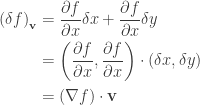
\displaystyle{    \begin{aligned}    \left(\delta f\right)_{\mathbf{v}}    &= \frac{\partial f}{\partial x} \delta x + \frac{\partial f}{\partial x} \delta y \\  &= \left(\frac{\partial f}{\partial x}, \frac{\partial f}{\partial x}\right) \cdot (\delta x, \delta y) \\  &= \left(\nabla f\right) \cdot \mathbf{v} \\    \end{aligned}}

The “height difference” does not care about the cause or process that introduces that height change.

— Me@2016-04-21 11:16:06 PM

.

.

2016.05.01 Sunday (c) All rights reserved by ACHK

Gradient

Assume \displaystyle{(x, y)} represents the position of an object and \displaystyle{f(x,y)} is a scalar field on the \displaystyle{x}\displaystyle{y} plane. Then \displaystyle{\frac{\partial f}{\partial x}} represents the change of \displaystyle{f} per unit length along the positive \displaystyle{x} direction. In other words, it is the spatial rate of change of \displaystyle{f} along the \displaystyle{x} direction.

Similarly, derivative \displaystyle{\frac{\partial f}{\partial y}} represents the spatial rate of change of \displaystyle{f} along the \displaystyle{y} direction.
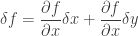
For an arbitrary direction, due to the nature of displacement, the change of \displaystyle{f} is \displaystyle{\delta f = \frac{\partial f}{\partial x} \delta x + \frac{\partial f}{\partial x} \delta y} when the object has finished moving \displaystyle{\delta x} in \displaystyle{x} direction and then \displaystyle{\delta y} in \displaystyle{y} direction.

Then, the spatial rate of change of \displaystyle{f} is

\displaystyle{   \begin{aligned}   &\frac{\delta f}{\sqrt{(\delta x)^2 + (\delta y)^2}} \\  &= \frac{\partial f}{\partial x} \frac{\delta x}{\sqrt{(\delta x)^2 + (\delta y)^2}}  + \frac{\partial f}{\partial x} \frac{\delta y}{\sqrt{(\delta x)^2 + (\delta y)^2}} \\  \end{aligned} }

.

For simplicity, denote the resultant displacement as \displaystyle{\mathbf{v}}:

\displaystyle{\mathbf{v} = (\delta x, \delta y)}

and define \displaystyle{\nabla f(x)} as

\displaystyle{\left( \frac{\partial f}{\partial x}, \frac{\partial f}{\partial y} \right)}

Then, the change of the \displaystyle{f} due to the displacement \displaystyle{\mathbf{v}} is

\displaystyle{\begin{aligned}  \left(\delta f\right)_{\mathbf{v}}  &= \frac{\partial f}{\partial x} \delta x + \frac{\partial f}{\partial x} \delta y \\  &= \left(\frac{\partial f}{\partial x}, \frac{\partial f}{\partial x}\right) \cdot (\delta x, \delta y) \\  &= \left(\nabla f\right) \cdot \mathbf{v} \\  \end{aligned}}

.

So the spatial rate of change \displaystyle{f} along the direction of the vector \displaystyle{\mathbf{v}} is

\displaystyle{\begin{aligned}  D_{\mathbf{v}}(f)  &= \frac{\left(\delta f\right)_{\mathbf{v}}}{|\mathbf{v}|} \\  &= \frac{\partial f}{\partial x} \frac{\delta x}{\sqrt{(\delta x)^2 + (\delta y)^2}}  + \frac{\partial f}{\partial x} \frac{\delta y}{\sqrt{(\delta x)^2 + (\delta y)^2}} \\  &= \left(\nabla f\right) \cdot \frac{\mathbf{v}}{|\mathbf{v}|} \\  &= \left(\nabla f\right) \cdot \hat{\mathbf{v}} \\  \end{aligned}}

\displaystyle{D_{\mathbf{v}}(f)} is called directional derivative.

— Me@2016-02-06 09:49:22 PM

.

This is the reason that \displaystyle{\nabla f} is in the steepest direction.

If \displaystyle{\hat{\mathbf{v}}} is chosen to be parallel to \displaystyle{\nabla f}, the directional derivative \displaystyle{\left(\nabla f\right) \cdot \hat{\mathbf{v}}} would be maximized.

— Me@2021-08-20 05:20:02 PM

.

.

2016.02.21 Sunday (c) All rights reserved by ACHK