Paradox 3.4

Meta-time 3.4

Time travel is only possible if there is a meta-time. Time travel is only possible if our physical time is fake, in a sense that it is not the real causal chain; and the meta-time is real, in a sense that it is the real causal chain.

For example, if our so-called physical world is actually a computer video game simulation, then the “physical” laws and the “physical” time are fake, in a sense that they are illusions simulated by a computer. The world to which that computer belongs is our meta-time. That meta-world is the real physical world. That meta-time is the real causal chain.

— Me@2012-10-01 12:53:48 PM

— Me@2012-10-03 02:21:45 PM

— Me@2012-10-05 11:24:43 AM

2012.10.06 Saturday (c) All rights reserved by ACHK

Paradox 3.3

Meta-time 3.3

Paradox is due to the mixing of para-level (meta-level) and original level, including the time-travel paradoxes.

The grandpa paradox has the similar structure as

“This sentence is true.”

The ontological paradox has the similar structure as

“This sentence is false.”

— Me@2012-10-06 09:35:11 AM

2012.10.06 Saturday (c) All rights reserved by ACHK

Paradox 3.2

Meta-time 3.2

Paradox is due to the mixing of para-level (meta-level) and original level. For example, consider this sentence:

“This sentence is false. “

There are two problems for this sentence.

First, is this sentence true or false? 

If it is true, according to itself, it is false.

But if it is false, then the assertion that “this sentence is false” is false, so it is true.

Second, what is the level of this sentence?

We don’t know, because it is referring to nothing, except itself. Let us just assume that it is an order-n sentence.

But since it describes itself, it describes an order-n sentence. So it is an order-(n+1) sentence.

But since it describes itself, it describes an order-(n+1) sentence. So it is an order-(n+2) sentence.

Contradiction!

How can the same sentence have more than one order?

That is exactly the problem of mixing levels. The meaning of the sentence and the meaning of the meta-sentence may contradict.

“This sentence is false.” is with level n, (n+1), (n+2), … at the same time.

But if it is true at level n, it is false at level (n+1), and true at level (n+2), etc.

So it is true and false and true …

Paradox is due to the mixing of para-level (meta-level) and original level. As long as we do not allow mixing levels, there are no paradoxes. Every sentence should only be allowed to describe sentences which have lower levels. For example, a sentence, S, is with level n.

Then S is not allowed to describe any other level n (or higher than level n) sentences.

— Me@2012-10-05 02:00:04 PM

2012.10.05 Friday (c) All rights reserved by ACHK

Paradox 3.1

Meta-time 3.1

Objects and events are of level zero.

Sentences about objects and events are of level one. They are called order-one sentences, e.g.

“Here is an apple.”

Sentences about sentences are of level two. They are called order-two sentences or meta-sentences, e.g.

“”Here is an apple.” has 4 words.”

Sentences about order-two sentences are of level three. They are called order-three sentences or meta-meta-sentences, e.g.

“”Here is an apple.” has 5 words.” is false.”

— Me@2012-10-05 12:00:04 PM

2012.10.05 Friday (c) All rights reserved by ACHK
Paradox 2

Meta-time 2

Paradox is due to the mixing of para-level (meta-level) and original level.

— Me@2012-09-29 02:22:14 PM

… including the time-travel paradoxes.

As long as you put time-travel into a story, you mix the meta-time and the original time within that story. Thus time-travel paradoxes appear.

— Me@2012-10-01 10:33:05 AM

The two typical time-travel paradoxes are the grandfather paradox and the ontological paradox.

The grandfather paradox is that time-travel would create an inconsistent story. For example, if you time-travel back to 10 years ago and kill your younger self, you present-self cannot exist. So you could not have time-travelled back to 10 years ago and kill your younger self, you present-self can exist. But your present-self have time-travelled back to 10 years ago and kill your younger self, then you present-self cannot exist.

The ontological paradox is that information can come from nowhere and events can happen with no cause. For example, your future-self goes back in time to give you the solution of a homework problem. After copying it, you go back in time to give your past-self the solution of that homework problem. The question is, where does that homework solution come from?

The meta-time is the author’s time or the readers’ time, which is the real, in a sense that it is the real causal chain. The original-time is the time within that story, which is fake, in a sense that it is not the real causal chain. As long as we distinguish the meta-time (author’s time) and the original-time (story-time) clearly, the two paradoxes can be transcended.

To avoid the grandfather paradox, only the author should be allowed to go back into an earlier story-time. For example, after finishing the 10 chapters of a story, the author goes back to the first chapter to rewrite and polish it. The characters within that story should not be able to go back into an earlier story-time.

To transcend the ontological paradox, we should realize that the “information from nowhere” is actually from the meta-time; the “event with no cause” is actually caused by the author of that story.

— Me@2012-10-03 02:21:45 PM

2012.10.03 Wednesday (c) All rights reserved by ACHK

Paradox

Meta-time

para- (“above, beyond; abnormal”)

— Wiktionary

Paradox is PARAdox.        

Paradox is due to the mixing of para-level (meta-level) and original level.

— Me@2012-09-29 02:22:14 PM

… including the time-travel paradoxes.

As long as you put time-travel into a story, you mix the meta-time and the original time within that story. Thus time-travel paradoxes appear.

— Me@2012-10-01 10:33:05 AM

2012.10.01 Monday (c) All rights reserved by ACHK

Universal Grammar, 2

Predicate logics may be viewed syntactically as Chomsky grammars. As such, predicate logics (as well as modal logics and mixed modal predicate logics) may be viewed as context-sensitive, or more typically as context-free, grammars. As each one of the four Chomsky-type grammars have equivalent automata, these logics can be viewed as automata just as well.

— Wikipedia on Predicate logic

2012.09.29 Saturday ACHK

西瓜 5

[physical geometry]

In so far as the statements of geometry speak about reality, they are not certain;

[mathematical geometry]

and in so far as they are certain, they do not speak about reality.

— Albert Einstein

Analytic statements are about the languages.

Synthetic statements are about the world.

Choosing the best language describing the world is itself a synthetic problem. 

— Me@2012-03-24 12:02:44 AM 

“Is logic empirical?” is not a valid question, because it does not specify the meaning of “logic”.

“Is logic empirical?” is due to the confusion of two different concepts. 

If you have no such confusion, the answer to the question is trivial.

As systems of analytical statements, the different theories of logic are not empirical.

But choosing the best among the logic systems to describe the real world is itself empirical.

— Me@2012-09-23 05:10:23 PM

2012.09.28 Friday (c) All rights reserved by ACHK

Completeness theorem, 4

Why truth table is not used in logic?

— JiminP

… the difference between semantics and syntax. A syntactic proof is a finite formal derivation of a sentence from the axioms of a theory using the logical axioms and the rules of inference of a logic. A proof by a truth table is a semantic proof; in allowing truth tables you are tacitly assuming the completeness theorem of propositional logic. Essentially, a priori, we don’t know that everything we can prove by studying the models of a theory (i.e. truth tables, in the case of propositional logic) can be proven syntactically, or even for that matter vice versa. It’s a non-trivial result in logic, …

— Zhen Lin

— This work is licensed under a Creative Commons Attribution-ShareAlike 3.0 Unported License.

— Mathematics – Stack Exchange

2012.09.27 Thursday ACHK

Principia Mathematica, 3

Principia is nowadays only of historical interest, since the subject has developed in quite different directions from those initiated by Russell and Whitehead. The idea of basing mathematics (including the development of the usual integers, reals, function spaces) purely on “logic” has largely been abandoned in favour of set-theory based formulations. And Principia does not have a clear separation between syntax and semantics. Such a separation is essential to the development of Model Theory in the past 80 years.

— This work is licensed under a Creative Commons Attribution-ShareAlike 3.0 Unported License.

— Mathematics – Stack Exchange

— Andre Nicolas

2012.09.25 Tuesday ACHK

Existential Import, 1

Universal claims about empty sets are all true, because there are no falsifying instances.

NOTE: Claims about empty sets are trivially true. Sure, “all irrational prime numbers are odd” because there are no irrational prime numbers, but it is equally true that “all irrational prime numbers are even”.

— Tutorials, PL 120 Symbolic Logic I, Fall 2011

— Professor H. Hamner Hill

2012.09.22 Saturday ACHK

Godel’s completeness theorem, 2

Using the compactness and completeness theorems

Godel’s completeness theorem (not to be confused with his incompleteness theorems) says that a theory has a model if and only if it is consistent, i.e. no contradiction is proved by the theory. This is the heart of model theory as it lets us answer questions about theories by looking at models and vice-versa.

One should not confuse the completeness theorem with the notion of a complete theory. A complete theory is a theory that contains every sentence or its negation.

— Wikipedia on Model theory

2012.09.20 Thursday ACHK

Consistency, 2

In logic, a consistent theory is one that does not contain a contradiction. The lack of contradiction can be defined in either semantic or syntactic terms.

The semantic definition states that a theory is consistent if and only if it has a model, i.e. there exists an interpretation under which all formulas in the theory are true. This is the sense used in traditional Aristotelian logic, although in contemporary mathematical logic the term satisfiable is used instead.

The syntactic definition states that a theory is consistent if and only if there is no formula P such that both P and its negation are provable from the axioms of the theory under its associated deductive system.

If these semantic and syntactic definitions are equivalent for a particular logic, the logic is complete.[clarification needed][citation needed]

— Wikipedia on Consistency

2012.09.17 Monday ACHK

Godel’s completeness theorem

Any proof of the Completeness Theorem consists always of two parts.

First we have show that all formulas that have a proof are tautologies. This implication is also called a Soundness Theorem, or soundness part of the Completeness Theorem.

The second implication says: if a formula is a tautology then it has a proof. This alone is often called a Completeness Theorem. In our case, we call it a completeness part of the Completeness Theorem.

— Cse371, Math371, LOGIC, Fall 2011

— Professor Anita Wasilewska

2012.09.14 Friday ACHK

Consistency

There exist two definitions of consistency: semantical and syntactical.

Semantical definition uses the notion of a model and says:

a set is consistent if it has a model.

Syntactical definition uses the notion of provability and says:

a set is consistent if one can’t prove a contradiction from it.

— Cse371, Math371, LOGIC, Fall 2011

— Professor Anita Wasilewska

2012.09.12 Wednesday ACHK

Logical implication

Entailment [logical implication] vs material implication

The difference between material implication and entailment is that they apply in different contexts. The first is a statement of logic, the second of metalogic. If p and q are two sentences then the difference between “p implies q” and “p is a proof of q” is that the first is a statement within formal logic, the second is a statement about it. Entailment is a concept of proof theory, whereas material implication is the mechanics of a proof.

— Wikipedia on Entailment

2012.09.03 Monday ACHK 

Semantics

The formal description of a process of assigning a logical value (true or false) to all formulas is called a semantics of the classical propositional logic.

— Cse371, Math371, LOGIC, Fall 2011

— Professor Anita Wasilewska

2012.07.24 Tuesday ACHK

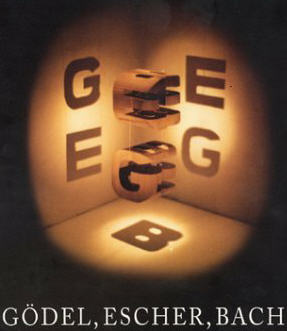
Godel, Escher, Bach

Douglas Hofstadter’s Godel, Escher, Bach uses self-referencing mathematical (formal language) and English (natural language) sentences, pictures (M.C. Escher’s dragon for example), and music (Bach’s fugues) to convey the concept and its recursive nature.

— Wikipedia on Self-reference

In response to confusion over the book’s theme, Hofstadter has emphasized that GEB is not about mathematics, art, and music but rather about how cognition and thinking emerge from well-hidden neurological mechanisms. In the book, he presents an analogy about how the individual neurons of the brain coordinate to create a unified sense of a coherent mind by comparing it to the social organization displayed in a colony of ants.

— Wikipedia on Godel, Escher, Bach

2012.05.23 Wednesday ACHK