energy ~ ability of causing change
energy used ~ amount of change
— Me@2014-08-19 02:44:22 AM
2014.08.21 Thursday (c) All rights reserved by ACHK

energy ~ ability of causing change
energy used ~ amount of change
— Me@2014-08-19 02:44:22 AM
2014.08.21 Thursday (c) All rights reserved by ACHK
Why did the universe have such low entropy in the past, resulting in the distinction between past and future and the second law of thermodynamics? Why are CP violations observed in certain weak force decays, but not elsewhere? Are CP violations somehow a product of the Second Law of Thermodynamics, or are they a separate arrow of time? Are there exceptions to the principle of causality? Is there a single possible past? Is the present moment physically distinct from the past and future or is it merely an emergent property of consciousness? Why does time have a direction?
— Wikipedia on List of unsolved problems in physics
2014.08.17 Sunday ACHK
.
all = 100%
Without a context, the word “all” is meaningless.
Without specifying 100% of what, the phrase “100%” is meaningless.
— Me@2014-07-26 02:49:06 PM
2014.08.04 Monday (c) All rights reserved by ACHK
Dear @anna, yes, the electron is pretty likely to be the last “remainder” of a black hole. Before it becomes an electron, the black hole may be a W boson that decays into an electron and a neutrino. Before it was a W boson, it could have been a much more excited string state… – Lubos Motl Feb 28 ’11 at 8:18
… the conclusion that black hole microstates are continuously connected to (other) elementary particle species – there’s no qualitative difference – doesn’t really depend on specific features of string theory. It’s a general fact that strings just confirm and make more specific.
— Physics Stack Exchange
— user contributions licensed under cc by-sa 3.0 with attribution required
— Mar 1 ’11 at 15:20
— Lubos Motl
2014.07.21 Monday ACHK
Are elementary particles ultimate fate of black holes?
From the “no hair theorem” we know that black holes have only 3 characteristic external observables, mass, electric charge and angular momentum (except the possible exceptions in the higher dimensional theories). These make them very similar to elementary particles. One question naively comes to mind. Is it possible that elementary particles are ultimate nuggets of the final stages of black holes after emitting all the Hawking radiation it could?
Yes, black holes are special kinds of elementary particles. That’s how they have to be represented in every consistent quantum theory of gravity. This representation of a black hole becomes especially useful and important for small black holes – whose mass is not much larger than the Planck mass.
And indeed, a black hole evaporates, which is just a form of a decay of a heavy elementary particle, and when it becomes very light, at the end of the Hawking evaporation process, it is literally indistinguishable from a heavy elementary particle that ultimately decays into a few stable elementary particles.
However, a difference that you seem to neglect is that black holes actually carry a large entropy
S = \frac{A}{4A_0} k_B
where A is the area of the black hole’s event horizon and (
A_0 ) is the Planck area (
A_0=\hbar G / c^3 ). The constant (
k_B ) is Boltzmann’s constant. This means that there actually exists a huge number of microstates
N = \exp(S / k_B)
and a single black hole, with a fixed value of mass, charges, and spin, is just a macroscopic description of the ensemble of N “microstates”. In reality, the black hole carries a huge information – the world distinguishes which of the N microstates is actually present.
It is these “microstates” that are really analogous to types of elementary particles. But the number of particle species that macroscopically look like the black hole of given mass, charges, and spin is not one: instead, it is huge, approximately N.
— Physics Stack Exchange
— user contributions licensed under cc by-sa 3.0 with attribution required
— answered Feb 27 ’11 at 16:45
— Lubos Motl
2014.07.18 Friday ACHK
Als 4 days ago
I’m happy to see that you still work on string theory. Do you intend to start publishing again?
Lubos Motl Als 3 days ago
No, I do not.
Kimmo Rouvari Lubos Motl 3 days ago
Why? (just curious) Obviously you have ideas and something to say.
Lubos Motl Kimmo Rouvari 3 days ago
I just virtually never had a real pleasure out of this process which has something like dozens of consumers in the world in average and which is laborious and demanding various formalities. This part of what I would be doing was always more or less just work and I was doing these things as a part of the package for the salary.
I am not getting the income for that, I am not a communist who would think it’s really right to do the expert work for free, so I won’t do these things. I think it’s common sense and it’s very simple.
I am sufficiently frustrated when I just report on someone’s excellent paper and the feedback is 100 times less excited than the feedback following some anti-science rant by a worthless sithead … And that’s something I may ignore because it’s just not my business.
— Lubos Motl
2014.07.15 Tuesday ACHK
Deus ex machina 3C
「時間旅行」、「蟲洞」、「平行宇宙」、「奇蹟」等情節,都是「天外救星」。它們的出現往往代表,該故事有著,不可修補的漏洞。
故事凡是時間錯亂,就宣稱是「時間旅行」。
故事凡是地點有誤,就宣稱是「瞬間轉移」。
故事凡是自相矛盾,就宣稱是「平行宇宙」。
故事凡是有違常理,就宣稱有「奇蹟」。
— Me@2014-07-11 04:59:55 PM
2014.07.13 Sunday (c) All rights reserved by ACHK
天外救星 3
Time travels, wormholes, parallel universes, miracles are all deus ex machina.
When a story’s author uses those deus ex machina, it means that the story broken, in the sense that the story has plot holes that the author cannot fix.
With time travel, the story’s time logic is given up. With wormholes, the story’s space logic is given up. With parallel universes, the story’s internal consistency is given up. With miracles, the story’s scientific consistency is given up.
— Me@2014-07-12 01:15:25 PM
2014.07.13 Sunday (c) All rights reserved by ACHK
天外救星 2
Towards the end of the 19th century, Friedrich Nietzsche criticized Euripides for making tragedy an optimistic genre via use of the device, and was highly skeptical of the “Greek cheerfulness”, prompting what he viewed as the plays’ “blissful delight in life”.
Nietzsche argues that the deus ex machina creates a false sense of consolation that ought not to be sought in phenomena.
— Wikipedia on Deus ex machina
2014.07.12 Saturday ACHK
天外救星
Deus ex machina is a plot device whereby a seemingly unsolvable problem is suddenly and abruptly resolved by the contrived and unexpected intervention of some new event, character, ability or object. Depending on how it is done, it can be intended to move the story forward when the writer has “painted himself into a corner” and sees no other way out, to surprise the audience, to bring the tale to a happy ending, or as a comedic device.
Origin of the expression
The Latin phrase deus ex machina, from deus, meaning “a god”, ex, meaning “from”, and machina, meaning “a device, a scaffolding, an artifice”, is a calque from Greek ἀπὸ μηχανῆς θεός (apò mēkhanḗs theós), meaning “god from the machine”. Such a device was referred to by Horace in his Ars Poetica (lines 191–2), where he instructs poets that they should never resort to a “god from the machine” to resolve their plots “unless a difficulty worthy a god’s unraveling should happen”. He was referring to the conventions of Greek tragedy, where a machine is used to bring actors playing gods onto the stage. The machine could be either a crane (mechane) used to lower actors from above or a riser that brought actors up through a trapdoor.
Ancient usage
Aristotle criticized the device in his Poetics, where he argued that the resolution of a plot must arise internally, following from previous action of the play …
In modern literature
A deus ex machina is generally deemed undesirable in writing and often implies a lack of creativity on the part of the author. The reasons for this are that it does not pay due regard to the story’s internal logic (although it is sometimes deliberately used to do this) and is often so unlikely that it challenges suspension of disbelief, allowing the author to conclude the story with an unlikely, though perhaps more palatable, ending. Following Aristotle, Renaissance critics continued to view the deus ex machina as an inept plot device, …
— Wikipedia on Deus ex machina
2014.07.11 Friday ACHK
「天外救星」是意料外的、突然的、牽強的解圍角色、手段或事件,在虛構作品內,突然引入來為緊張情節或場面解圍。近似詞有「天降神兵」和「如有神助」等。
Deus ex machina
拉丁語片語Deus ex machina(英譯:God from the machine)翻譯自希臘語,意思是「機關跑出的神」,中文一般翻譯為「舞台機關送神」、「機械降神」、「機器神」、「解圍之神」等。
在古希臘戲劇,當劇情陷入膠着,困境難以解決時,突然出現擁有強大力量的神,將難題解決,令故事得以收拾。方法是利用起重機,或起升機的機關,將扮演神的演員,下降至舞台上。這種表演手法是人為的,製造出意料之外的劇情大逆轉。
現代批評
這種手法通常被評論家認為是,不高明的說書技巧,因為它破壞了故事的內在邏輯,縱使有時候會為了這個理由,而故意採用。繼亞里士多德之後,文藝復興時期評論家將其視為,一種迂拙的情節計策…
— 改編自維基百科
2014.07.10 Thursday ACHK
However, general relativity predicts and experiments confirm that gravitational waves do exist: the relevant observations were awarded by the 1993 physics Nobel prize, too. The waves are vibrations of the space itself. It means that the metric tensor remembers the information about the geometry – and curvature at each point, even in the empty space, something that Mach’s principle specifically wanted to prohibit.
…
Einstein had thought that Mach’s Principle was the way to go because it (also) made the universality encoded in the equivalence principle manifest. The equivalence principle says that all objects will be influenced equally – the same acceleration – by the whatever agent is causing gravity. Mach’s principle satisfies the criterion “totally” – it removes any field-like agent. Well, it’s going “too far” in this sense. Of course that Einstein was struggling for years to make Mach’s Principle compatible with the speed limit c – and GR is what eventually came out of it.
– Lubos Motl
2014.06.29 Sunday ACHK
In theoretical physics, particularly in discussions of gravitation theories, a Mach principle is any of a class of principles which are more specific statements of Mach’s principle.
The broad notion is that “mass there influences inertia here”. Any statement which — though possibly far more specific than this — follows in this spirit may be classified as a “Mach principle”. The truth of these statements depends on the particular statement. (The truth also depends on the theory of gravity, though Einstein’s general relativity is the most frequently discussed theory.)
Examples
Hermann Bondi and Joseph Samuel have listed eleven distinct statements which can be called Mach principles, labelled by Mach0 through Mach10. Though their list is not necessarily exhaustive, it does give a flavor for the variety possible.
\Omega \ \stackrel{\mathrm{def}}{=}\ 4 \pi \rho G T^2 ) is a definite number, of order unity, where \rho ) is the mean density of matter in the universe, and T is the Hubble time.— Wikipedia on Mach principle
2014.06.22 Sunday ACHK
Charge (physics), the susceptibility of a body to one of the fundamental forces
— Wikipedia on Charge
Symmetry and conservation
Conservation of momentum is a mathematical consequence of the homogeneity (shift symmetry) of space (position in space is the canonical conjugate quantity to momentum). That is, conservation of momentum is a consequence of the fact that the laws of physics do not depend on position; this is a special case of Noether’s theorem.
— Wikipedia on Momentum
Momentum is the Noether charge of translational invariance. As such, even fields as well as other things can have momentum, not just particles. However, in curved spacetime which isn’t asymptotically Minkowski, momentum isn’t defined at all.
—
2014.06.19 Thursday ACHK
Lessons from the Light, 5.3
They found that T is indeed violated.
…
All perfectly fine and glorious. The pet peeve only comes up in the sub-headline of the SLAC press release: “Time’s quantum arrow has a preferred direction, new analysis shows.” Colorful language rather than precise statement, to be sure, but colorful language that is extremely misleading.
“Time’s arrow,” in the sense that the phrase is conventionally used (by the kind of folks who would conventionally use such a phrase), refers to the myriad ways in which the past is different from the future in our macroscopic experiential reality. Entropy increases with time; … This new measurement in the B meson system — indeed, the entire phenomenon of T violation — has absolutely nothing to do with that arrow of time.
The reason is pretty simple to understand. The arrow of time centers on the concept of irreversibility — things happen in one direction of time but not the other. You can scramble eggs, but not unscramble them, etc. That’s not at all what’s going on in the B mesons. The oscillations between different types of meson happen perfectly well in both directions of time, just with ever-so-slightly different rates.
…
The particle-physics processes in question, in other words, are perfectly reversible. Information is not lost over time; you can figure out exactly what the quantum state used to be by knowing what it is now. (It’s “unitary,” to use the jargon word.) That’s utterly different from the macroscopic arrow of time.
…
— Time-Reversal Violation Is Not the “Arrow of Time”
— Sean Carroll
2014.06.13 Friday ACHK
Lessons from the Light, 5.2
Note that among C, P, T, only T is an “antilinear operator” which means that
T | \lambda \psi \rangle = \lambda* T | \psi \rangle
including the asterisk which means complex conjugation (that’s the reason of the prefix, anti-). Various combinations of C, P, T are linear or antilinear depending on whether T is included.
Note that the complex conjugation is needed for the time reversal already in ordinary non-relativistic quantum mechanics because the complex conjugation is the only sensible way to change (
\exp(+ipx/\hbar) ) to (
\exp(-ipx/\hbar) ), i.e. to change the sign of the momentum p – and the velocity v = dx/dt – which is needed for particles to evolve backwards.
— BaBar directly measures time reversal violation
— Lubos Motl
2014.06.11 Wednesday ACHK
Dear Giotis, they were formally at least 99.9999999% certain, that’s what the 6-7 sigma confidence level means, and even when some possible “qualitatively different errors” are considered as possibilities, their certainty is still vastly higher than 99%.
As I wrote in an update, Pryke of BICEP2 says that the rumors about the planned retractions by BICEP are pure bullshit.
99% is no real certainty. It’s just a laymen’s myth that 99% is high enough to treat something as a certainty. It’s less than 2 sigma. In hard sciences, if something comes out to confirm a theory at a 99% level, a scientist doesn’t consider it even as significant evidence to be carefully studied!
— Lubos Motl
 |
| This file is licensed under the Creative Commons Attribution 2.5 Generic license. Author: Mwtoews |
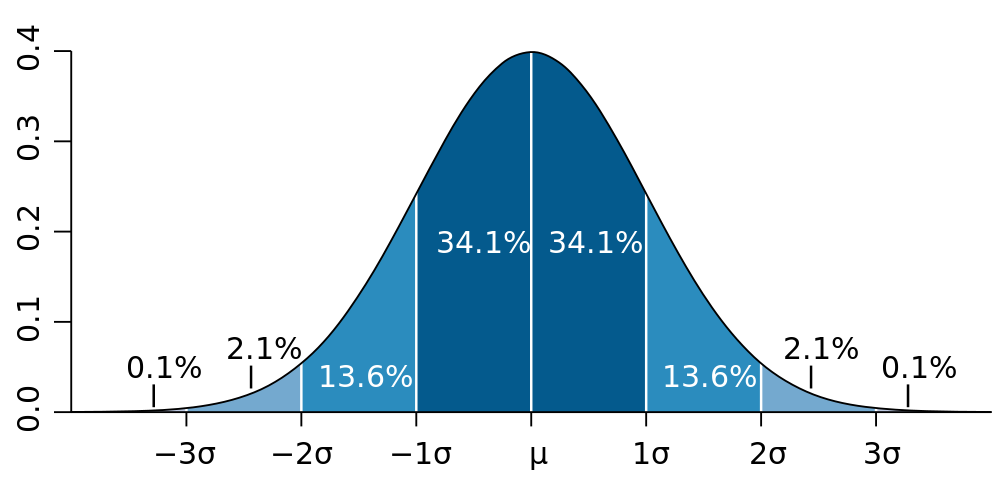
In statistics, the 68–95–99.7 rule, also known as the three-sigma rule or empirical rule, states that nearly all values lie within three standard deviations of the mean in a normal distribution.
68.27% of the values lie within one standard deviation of the mean. Similarly, 95.45% of the values lie within two standard deviations of the mean. Nearly all (99.73%) of the values lie within three standard deviations of the mean.
— Wikipedia on 68–95–99.7 rule
2014.06.03 Tuesday ACHK
using probability
~ ignoring the details
~ caring about only the results
— Me@2014-05-21 09:28:35 PM
2014.05.28 Wednesday (c) All rights reserved by ACHK
存在 ~ is ~ exist ~ can be found
有 ~ have ~ possess ~ can find
— Me@2012.10.27
2014.05.08 Thursday (c) All rights reserved by ACHK
Maldacena and Susskind proposed to identify ER (non-traversable wormholes i.e. Einstein-Rosen bridges) with EPR (entanglement). The former is a universal geometric visualization of the latter – which may become “simple” in special cases, just like in the case of a duality.
— An anti-ER-EPR paper
— Lubos Motl
2014.05.03 Saturday ACHK
 Physics Town
You must be logged in to post a comment.