Fourth dimension

Visual scope

Being three-dimensional, we are only able to see the world with our eyes in two dimensions. A four-dimensional being would be able to see the world in three dimensions. For example, it would be able to see all six sides of an opaque box simultaneously, and in fact, what is inside the box at the same time, just as we can see the interior of a square on a piece of paper. It would be able to see all points in 3-dimensional space simultaneously, including the inner structure of solid objects and things obscured from our three-dimensional viewpoint.

— Wikipedia on Fourth dimension

2010.06.27 Sunday ACHK

Anti de Sitter space

Some of the differences between the familiar Newtonian equation of gravity and the predictions of general relativity flow from the fact that gravity in general relativity bends both time and space, not just space. In normal circumstances, gravity bends time so slightly that the difference between Newtonian gravity and general relativity that results is so slight that it is impossible to detect without scientific instruments.

— Wikipedia on Anti de Sitter space

2010.06.26 Saturday ACHK

The Phone Book

In physics, Gravitation is a very important reference book on Einstein’s theory of gravity by Charles W. Misner, Kip S. Thorne, and John Archibald Wheeler. Often considered the “Bible” of General Relativity by researchers for its prominence, it is frequently called MTW after its authors’ initials, or “the Phone Book” due to its immense size. It was published by W.H. Freeman and Company in 1973. The book, a massive tome of over 1200 pages, covers many aspects of the General Theory of Relativity and also considers some extensions and experimental confirmation. The book is divided into two “tracks”, the second of which covers more advanced topics for more capable or determined students. MTW uses the -+++ metric convention. The book is famous/infamous for its use of boxes to add supplementary substance to the already thorough main text.

* Misner, Charles W.; Thorne, Kip S.; Wheeler, John Archibald (1973-09-15 1973), Gravitation, San Francisco: W. H. Freeman, ISBN 978-0-7167-0344-0

# This page was last modified on 30 October 2009 at 08:50.
# Text is available under the Creative Commons Attribution-ShareAlike License; additional terms may apply. See Terms of Use for details.

— Wikipedia on Gravitation (book)

2010.06.25 Friday ACHK

Aprioricity, necessity, and analyticity

Thus, the relationship between aprioricity, necessity, and analyticity is not easy to discern. However, most philosophers at least seem to agree that while the various distinctions may overlap, the notions are clearly not identical: the a priori/a posteriori distinction is epistemological, the analytic/synthetic distinction is linguistic, and the necessary/contingent distinction is metaphysical.

— Wikipedia on A priori and a posteriori

2010.06.24 Thursday ACHK

Action 2

Like all nice physical theories, we can in principle derive everything about our theory of superstrings once we know the formula for the action. For bosonic strings, the action is very simple. As time passes, a string traces out a 2-dimensional surface in spacetime called the “string worldsheet”. The action is just the area of this worldsheet.

— John Baez

2010.06.22 Tuesday ACHK

Black hole thermodynamics

Beyond black holes

Hawking and Page showed that black hole thermodynamics is more general than black holes, that cosmological event horizons also have an entropy and temperature.

More fundamentally, ‘t Hooft and Susskind used the laws of black hole thermodynamics to argue for a general Holographic Principle of nature, which asserts that consistent theories of gravity and quantum mechanics must be lower dimensional. Though not yet fully understood in general, the holographic principle is central to theories like the AdS/CFT correspondence.

— Wikipedia on Black hole thermodynamics

2010.06.19 Saturday ACHK

Images and animations

So, simplicity is key, and they purport to write such a system in a mere 20K LOC. To that end, they propose a sort of great unification theory of particles (homogeneous, extensible objects) and fields (the messages exchanged by myriad objects)—well, yes, it’s just a metaphor, but you can see it in action in the paper, applied to images and animations. The report also explains how the physical metaphor is completed with a proper simulation of the concept of time.

Reinventing programming
February 12, 2007 — jao

2010.06.18 Friday ACHK

Physics

* There is a theory which states that if ever anyone discovers exactly what the Universe is for and why it is here, it will instantly disappear and be replaced by something even more bizarre and inexplicable.

There is another theory which states that this has already happened.

— The Restaurant at the End of the Universe

— Douglas Adams

2010.06.16 Wednesday ACHK

Physicists’ mathematics

Physicists are coming up with lots of exciting mathematical “results” – often NOT rigorously proved! – and mathematicians are getting very interested.

— John Baez

2010.06.14 Monday ACHK

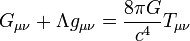
Einstein field equations


Einstein’s equation in plain English:

Given a small ball of freely falling test particles initially at rest with respect to each other, the rate at which it begins to shrink is proportional to its volume times: the energy density at the center of the ball, plus the pressure in the x direction at that point, plus the pressure in the y direction, plus the pressure in the z direction.

— John Baez

2010.06.12 Saturday ACHK

Renormalization

In quantum field theory, the statistical mechanics of fields, and the theory of self-similar geometric structures, renormalization refers to a collection of techniques used to take a continuum limit.

When describing space and time as a continuum, certain statistical and quantum mechanical constructions are ill defined. To define them, the continuum limit has to be taken carefully.

— Wikipedia on Renormalization

2010.06.11 Friday ACHK

Gauge invariance 2

Gauge invariance also implies that most force particles interact with themselves: …

— Fundamental Physics: Where We Stand Today

— John Baez

2010.06.10 Thursday ACHK

Gauge invariance

This is dictated by `gauge invariance’, a principle linking the Standard Model and general relativity.

— Fundamental Physics: Where We Stand Today

— John Baez

2010.06.09 Wednesday ACHK

Supergravity | E8

Another interesting discovery is that 11-dimensional supergravity is related to the exceptional Lie group E8: …

— John Baez

2010.06.06 Sunday ACHK

Quantum Gravity 3

Any meaningful theory of quantum gravity that makes sense and is predictive at all energy scales must have some deep principle that reduces the infinitely many unknown parameters to a finite number that can then be measured.

* One possibility is that normal perturbation theory is not a reliable guide to the renormalizability of the theory, and that there really is a UV fixed point for gravity. Since this is a question of non-perturbative quantum field theory, it is difficult to find a reliable answer, but some people still pursue this option.

* Another possibility is that there are new symmetry principles that constrain the parameters and reduce them to a finite set. This is the route taken by string theory, where all of the excitations of the string essentially manifest themselves as new symmetries.

— Wikipedia on Quantum gravity

2010.06.04 Friday ACHK

Quantum Gravity 2

Points of tension

There are two other points of tension between quantum mechanics and general relativity.

* First, classical general relativity breaks down at singularities, and quantum mechanics becomes inconsistent with general relativity in the neighborhood of singularities (however, no one is certain that classical general relativity applies near singularities in the first place).

* Second, it is not clear how to determine the gravitational field of a particle, since under the Heisenberg uncertainty principle of quantum mechanics its location and velocity cannot be known with certainty. The resolution of these points may come from a better understanding of general relativity.

— Wikipedia on Quantum gravity

2010.06.03 Thursday ACHK

Ideal clocks

* A clock is a recurrent process and a counter.
* A good clock is one which, when used to measure other recurrent processes, finds many of them to be periodic.
* An ideal clock is a clock (i.e., recurrent process) that makes the most other recurrent processes periodic.

— Wikipedia on Clock

2010.06.01 Tuesday ACHK

Metamathematics

Richard’s paradox (Richard 1905) concerning certain ‘definitions’ of real numbers in the English language is an example of the sort of contradictions which can easily occur if one fails to distinguish between mathematics and metamathematics.

— Wikipedia on Metamathematics

2010.05.31 Monday ACHK