I am a Strange Loop, 4

Godel, Escher, Bach, 2

這段改編自 2010 年 4 月 10 日的對話。

如果你接受到,「自我」其實是「軟件」,你就會明白,莫講話「教學」,即是只是「對話」,也是(部分)「自我」(互相)「複製」的過程。所以,如果你大大受過一位神級導師的影響,在很大程度上,你就是他。他的思想已經複製到你的腦中。

我有很多這類想法,都是來自《I am a Strange Loop》(「我」是一個奇異圈)這本書。

(安:那本書的內容是關於什麼呢?)

「自我」。

《I am a Strange Loop》的作者是 Douglas R. Hofstadter。而 Douglas 的成名作是《Godel, Escher, Bach》。

我從《I am a Strange Loop》中,吸收很深厚的教學功力。我當時的感覺是相當震撼的。這書竟然可以將,那麼高深的概念,例如「哥德爾不完備定理」、「自我來源」、「多重自我」、「自我程式」等,逐步舖排,表達到連初學者的我,也能明白。而它的舖排,往往是橫跨幾個章。如果不是作者對那幾門知識,有極深刻的瞭解,他並不可能作到,那樣宏觀的佈局。

雖然當年的我,程度不低,但是,那時的我,並沒有那幾門學問的詳細背景知識。例如,在那之前,我只知道「數理邏輯」這個學問中,有幾條重要的定理,都叫做「哥德爾定理」。除了名字以外,我對「哥德爾定理」的理解近乎是零。但是,經過《I am a Strange Loop》的介紹,我就了解到「哥德爾定理」的核心思想是什麼。

如果不是該書的精湛展示,我相信可能要用多十年的思考和研究,才能領悟到那些道理。

(安:他那兩本書,也和「哥德爾定理」有關?)

— Me@2014.09.20

2014.09.23 Tuesday (c) All rights reserved by ACHK

自我程式

這段改編自 2010 年 4 月 10 日的對話。

(安:… 如果實情真的是,你之前講過類似的思想給我,那它們是你原創的,還是其實你也是,受過維根斯坦的影響,才能領悟到呢?)

所以,大部分情況下,追究一個意念從何而來,是相當無謂的。或者說,追問究竟「你才華橫溢」,是因為你本身勁(厲害),還是你的老師勁,未必有什麼大意義。真正重要的是,那些才華思想意念,用處大不大。

我有沒有講過,「self as a software」(「自我」其實是一個軟件)?

「軟件」有趣的地方是,可以「無限複製」,可以同時存在於,超過一個地方。

如果你接受到,「自我」其實是「軟件」,你就會明白,莫講話「教學」,即是只是「對話」,也是(部分)「自我」(互相)「複製」的過程。所以,如果你大大受過一位神級導師的影響,在很大程度上,你就是他。他的思想已經複製到你的腦中。

— Me@2014.09.13

2014.09.14 Sunday (c) All rights reserved by ACHK

形上情人

天人之才

這段改編自 2010 年 4 月 10 日的對話。

.

我在自己的筆記中寫過,「Find a Metaphysical Lover」(尋找形上的情人)。後來,我發現在李生的著作中,也有類似的想法。他著作中其中一句的大概是,「愛情應該始於外在條件,成於形上。」

那就證明了「英雄所見略同」。又或者,可能是當年我閱讀過,李生的那一句,自始埋藏在我的潛意識之中。後來回想起,就以為該意念是我自己原創領悟的。

不過,那其實又沒有什麼分別,亦沒有必要分別,除非那是需要申請專利的科技發明。意念創意本來就不容易,很明確地劃分,哪是由誰,最先想出來的。

(安:無錯。即使你那一句背後的意念,真的是來自李生的意念,你的寫法卻截然不同。

又例如,我最近抽了一點維根斯坦(Ludwig Wittgenstein)的引言金句來讀,開始明白他的部分句子。但是,我明白,是因為我直接明白,還是你曾經也發表過,一些類似的意念給我呢?

如果實情真的是,你之前講過類似的思想給我,那它們是你原創的,還是其實你也是,受過維根斯坦的影響,才能領悟到呢?)

所以,大部分情況下,追究一個意念從何而來,是相當無謂的。或者說,追問究竟「你才華橫溢」,是因為你本身勁(厲害),還是你的老師勁,未必有什麼大意義。真正重要的是,那些才華思想意念,用處大不大。

— Me@2014.09.07

.

.

2014.09.07 Sunday (c) All rights reserved by ACHK

Craftsmanship

mantrax5 2 hours ago | link

“You know, one of the things that really hurt Apple was after I left John Sculley got a very serious disease. It’s the disease of thinking that a really great idea is 90% of the work. And if you just tell all these other people “here’s this great idea,” then of course they can go off and make it happen.

And the problem with that is that there’s just a tremendous amount of craftsmanship in between a great idea and a great product. And as you evolve that great idea, it changes and grows. It never comes out like it starts because you learn a lot more as you get into the subtleties of it. And you also find there are tremendous tradeoffs that you have to make. There are just certain things you can’t make electrons do. There are certain things you can’t make plastic do. Or glass do. Or factories do. Or robots do.

Designing a product is keeping five thousand things in your brain and fitting them all together in new and different ways to get what you want. And every day you discover something new that is a new problem or a new opportunity to fit these things together a little differently.

And it’s that process that is the magic.”

~ Steve Jobs

This is why Apple doesn’t make “vision” videos now, and it didn’t during the Jobs years. During the period they did, they had serious problems in shipping any of the visions they have shown the world.

Microsoft is a bit like that. They know where the world is going, and Bill Gates himself knew from the very start where the world is going (short of a brief period where he conveniently ignored the Internet will happen). But they thought the fact they knew, that they had this cool idea and projection of how things will happen was giving them enough advantage. Nope.

It’s risk-free to ship vision videos. They’re like free T-shirts. There’s infinite demand. But when it comes to shipping products based on them, most people can’t live with the compromises and risk-taking a real product requires in order to ship.

With a new product you can’t just look at the competition and confirm that what you have will work. You’re on your own. Do you have the guts?

— Hacker News

2014.06.24 Tuesday ACHK

長頸豹 3

尋找時間的定義 1.2

SICM, 3.2 | SICP, 2.2

這段改編自 2010 年 4 月 10 日的對話。

涉獵多門知識,即使對於「本行」的發展,也會有意想不到的幫助。

例如,我對「什麼是時間」這個物理問題,有極之大的興趣。我想像,如果我只閱讀和研究物理,可能窮一身的時間,也沒有寸進。

估不到,在大概 2006 年,我從一本電腦界的神作中,得到了靈感,開始對「時間定義」有一點理解。然後在今年(2010),再加上我在大學時代時,長期訓練得來的「語理分析」功力,我破解了,「時間」的大部分意思。

(安:你上星期也有提及過,那本電腦界的神作。)

又例如,如果一個人過身後,仍然以某種形式存在的話,究竟確實是以哪一種,或者怎麼樣的形式來存在呢?

從物理和電腦知識中,我得到了一些關鍵靈感。

「靈感」中的「靈」,其實就是解「靈活」、「靈通」,即是有大量和多類型的資料或消息來源。

— Me@2014.06.03

2014.06.03 Tuesday (c) All rights reserved by ACHK

The Magic City

.

The second theme is concerned explicitly with technology. It is a law of life in the magic city that if you wish for anything you can have it. But with this law goes a special rule about machines. If anyone wishes for a piece of machinery, he is compelled to keep it and go on using it for the rest of his life.

– Disturbing the Universe, p.4

.

.

.

2009.12.21 Monday ACHK

Ant colony optimization algorithms

Summary

In the natural world, ants (initially) wander randomly, and upon finding food return to their colony while laying down pheromone trails. If other ants find such a path, they are likely not to keep travelling at random, but to instead follow the trail, returning and reinforcing it if they eventually find food (see Ant communication).

Over time, however, the pheromone trail starts to evaporate, thus reducing its attractive strength. The more time it takes for an ant to travel down the path and back again, the more time the pheromones have to evaporate. A short path, by comparison, gets marched over more frequently, and thus the pheromone density becomes higher on shorter paths than longer ones.

Pheromone evaporation also has the advantage of avoiding the convergence to a locally optimal solution. If there were no evaporation at all, the paths chosen by the first ants would tend to be excessively attractive to the following ones. In that case, the exploration of the solution space would be constrained.

— Wikipedia on Ant colony optimization algorithms

2014.05.10 Saturday ACHK

VirtualBox

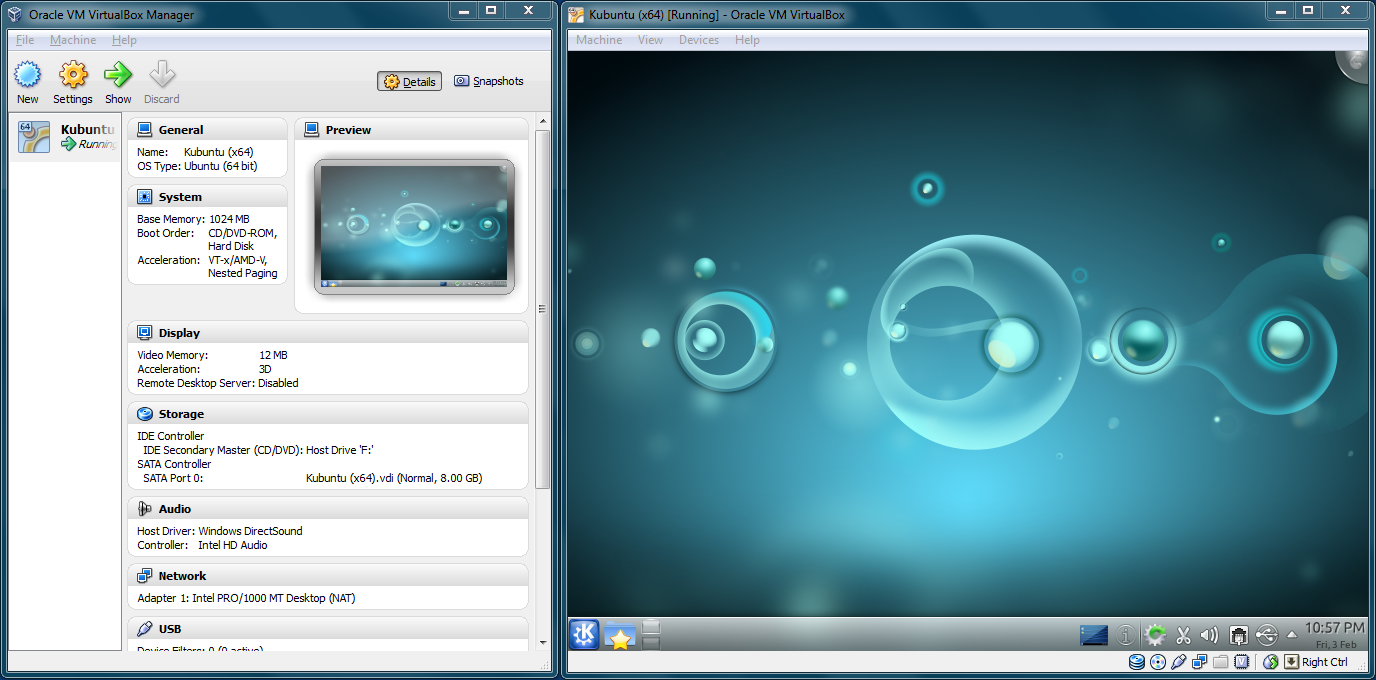
This is a file from the Wikimedia Commons.

Oracle VM VirtualBox (formerly Sun VirtualBox, Sun xVM VirtualBox and innotek VirtualBox) is a virtualization software package for x86 and AMD64/Intel64-based computers from Oracle Corporation as part of its family of virtualization products. It was created by innotek GmbH, purchased in 2008 by Sun Microsystems, and now developed by Oracle. It is installed on an existing host operating system as an application; this host application allows additional guest operating systems, each known as a Guest OS, to be loaded and run, each with its own virtual environment.

— Wikipedia on VirtualBox

2014.05.06 Tuesday ACHK

Free Software 6

自由軟體 6

Free software is a matter of liberty, not price. To understand the concept, you should think of free as in free speech, not as in free beer.

— Richard Stallman

Free software does not have to be free. Free software does not even have to be cheap.

Free Software Foundation sold each Emacs floppy disk copy for 100 dollars.

— based on my memory of a Richard Stallman’s speech in Hong Kong

[The “$100” may be incorrect. But spirit of the whole paragraph is intact.]

— Me@2013.07.17

R: We should use free software instead of proprietary software. My rule is: I will not use any programs that I cannot share with you.

Q: But sometimes proprietary software is more convenient than free software.

R: What if I want both freedom and convenience?

What can I do?

Either turn convenient software free or turn free software convenient. But turning convenient software free is impossible, because we don’t have the source code and the copyright law does not allow us to do so.

So all we should do is to turn free software convenient.

— based on my memory of a Richard Stallman’s speech in Hong Kong

— Me@2014.04.29

2014.04.29 Tuesday (c) All rights reserved by ACHK

Dropbox, 6

In the end, it really came down to one incredibly genius idea: Dropbox limited its feature set on purpose. It had one folder and that folder always synced without any issues — it was magic. Syncplicity could sync every folder on your computer until you hit our quota. (Unfortunately, that feature was used to synchronize C:\Windows\ for dozens of users — doh!) Our company had too many features and this created confusion amongst our customer base. This in turn led to enough customer support issues that we couldn’t innovate on the product, we were too busy fixing things.

— Isaac Hall

2014.04.20 Sunday ACHK

A writer reading books

chris_mahan 24 minutes ago | link

I don’t watch TV (at all) and I game maybe 4 hours a week, usually in 2 sittings.

(I will occasionally watch a DVD, but maybe 2 hours a month, max.)

When people give me grief that I play the games, I tell them I’m a software developer: it’s like a writer reading books.

— Hacker News

2014.04.20 Sunday ACHK

openSUSE

openSUSE is a general purpose operating system built on top of the Linux kernel, developed by the community-supported openSUSE Project and sponsored by SUSE and a number of other companies. After Novell acquired SUSE Linux in January 2004, Novell decided to release the SUSE Linux Professional product as a 100% open source project. In 2011 The Attachmate Group acquired Novell and split Novell and SUSE into two autonomous subsidiary companies. SUSE offers products and services around SUSE Linux Enterprise — their commercial offering that is based on openSUSE Linux.

— Wikipedia on openSUSE

2014.04.13 Sunday ACHK

Code, talk to users, sleep, eat, and exercise

It’s also the case that there is a lot less to do in the Valley than in San Francisco if you’re young and childless. You will work more. Part of PG’s advice is to do little other than code, talk to users, sleep, eat, and exercise. That advice is much simpler to follow when you’re living in Mountain View; there is only so much you can do on Castro Street.

— Going Through Y Combinator (S13): Nine Lessons Learned

— Zachary Townsend

2014.03.21 Friday ACHK

L.A. Noire

The case that makes you and the case that breaks you…

The one you never solve, the one that keeps you awake at night.

The case that gnaws at your guts and ruins your marriage.

The case that keeps you propping up a bar as you relive the what-ifs, the might-have-beens, the half-leads and half-truths.

The case that other cops murmur about whenever you walk past.

The case you never… ever… discuss.

— Herschel Biggs

— L.A. Noire

— Me@2014-03-17 05:27:25 PM

2014.03.19 Wednesday ACHK

Antichamber, 3

Gameplay/Plot

In Antichamber, the player controls the unnamed protagonist from a first-person perspective as they wander through non-Euclidean levels. Regarding typical notions of Euclidean space, Bruce has stated that “breaking down all those expectations and then remaking them is essentially the core mechanic of the game”.

— Wikipedia on Antichamber

2014.03.15 Saturday ACHK

Antichamber

The good part is that the game is a genre in itself. There are no similar games in this world.

The bad part is that a few levels, such as “Falling Forward” and “Laying the Foundation”, do not make any sense. They exist just for wasting the players’ time.

Whenever you get stuck, don’t try harder. Just consult a walkthrough.

— Me@2014-03-09 08:58:45 AM

2014.03.10 Monday (c) All rights reserved by ACHK

The Journey of Life

This is a logo owned by Alexander Bruce for Antichamber.

Antichamber (originally known as Hazard: The Journey of Life) is a single-player first-person puzzle-platform video game developed by Alexander Bruce. Many of the puzzles are based on phenomena that occur within the Non-Euclidean geometry created by the game engine, such as passages that lead the player to different locations depending on which way they face, and structures that seem otherwise impossible within normal three-dimensional space.

Author or copyright owner: Alexander Bruce

The game includes elements of psychological exploration through brief messages of advice to help the player figure out solutions to the puzzles as well as adages for real life. The game was released on Steam for Microsoft Windows on January 31, 2013, a version sold with the Humble Indie Bundle 11 in February 2014 added support for Linux and Mac OS X.

— Wikipedia on Antichamber

2014.03.05 Wednesday ACHK