魔法師是怎樣煉成的

這段改編自 2023 年 6 月 21 日的對話。

.

一般情形下,你是一個正常人,才有愛情吸引力,才會有人喜歡你。未必需要很優秀,但起碼要正常。而這裡「正常」的意思是,人格完整。如果人格有重大漏洞,例如永不守時,那就為之「不完整」。

但是,市面上,有些人,尤其是看得多韓劇的女子,有些不合理的期望:

自己雖然千瘡百孔,但是,我在未來會遇到,一位白馬王子,彌補我所有的缺撼。

那是的。

兩間公司要合併,從來是各自也,業務正常,財政健全。一般而言,不會有一間公司,在經營不善、賬目混亂、負債累累的情況下,竟然遇到一間白馬公司,願意將其收購之。

— Me@2024-08-13 04:04:35 PM

.

.

2024.08.14 Wednesday (c) All rights reserved by ACHK

Watermelon 2

Euler problem 21.2.1

.

primes :: [Integer]
primes = 2 : filter (null . tail . primeFactors) [3, 5 ..]

primeFactors :: Integer -> [Integer]
primeFactors n = factor n primes
  where
    factor n (p : ps)
      | p * p > n = [n]
      | n `mod` p == 0 = p : factor (n `div` p) (p : ps)
      | otherwise = factor n ps

groupFactors :: [Integer] -> [[Integer]]
groupFactors = gf []
  where
    gf acc lst
      | null lst = reverse acc
      | null acc = gf [[p,1]] ps
      --
      | p == head (head acc) =
        gf ([p, head (tail (head acc)) + 1]:tail acc) ps
      --  
      | otherwise = gf ([p,1]:acc) ps
      where
        p = head lst
        ps = tail lst

generateDivisors :: Integral b => [[b]] -> [b]
generateDivisors xs = go xs 1
  where
    go [] acc = [acc]
    go (pe:ps) acc = concat [go ps (acc*p^e) | e <- [0..n]]
      where
        p = head pe
        n = pe !! 1

sumProperDivisors :: Integer -> Integer
sumProperDivisors n
  = -n + sum (generateDivisors
              (groupFactors (primeFactors n)))

amicableNumbers :: Integer -> [Integer]
amicableNumbers limit
  = [a | a <- [1..(limit-1)],
      let b = sumProperDivisors a, 
            a == sumProperDivisors b,
            a /= b]

λ> :set +s
λ> sum (amicableNumbers 10000)
31626
(0.35 secs, 511,950,576 bytes)
λ> sum (amicableNumbers 100000)
852810
(4.73 secs, 6,902,354,168 bytes)
λ> sum (amicableNumbers 1000000)
27220963
(66.07 secs, 93,880,279,320 bytes)
λ> 

— Me@2024-08-11 10:40:06 AM

.

.

2024.08.12 Monday (c) All rights reserved by ACHK

3 Vector Fields and One-Form Fields, 3.1

Functional Differential Geometry

.

p. 22

Eq. (3.4):

\displaystyle{ \begin{aligned}  \textbf{v}(\text{f})(\textbf{m})  &= (D( \textbf{f} \circ \chi^{-1}) b_{\chi,\mathbf{v}}) \circ \chi) \\  \end{aligned} }

(define (components->vector-field components coordsys)
  (define (v f)
    (compose (* (D (compose f (point coordsys)))
        components)
         (chart coordsys)))
  (procedure->vector-field v))

An example:

(define R2->R (-> (UP Real Real) Real))

(define v
  (components->vector-field
   (up (literal-function 'b^0 R2->R)
       (literal-function 'b^1 R2->R))
   R2-rect))

(define R2-rect-chi-inverse
  (point R2-rect))

(define R2-rect-point
  (R2-rect-chi-inverse (up 'x_0 'y_0)))

((v (literal-manifold-function 'f-rect R2-rect))
 R2-rect-point)

(show-expression
 ((v (literal-manifold-function 'f-rect R2-rect))
  R2-rect-point))

(define v
  (literal-vector-field 'b R2-rect))

(show-expression
 ((v (literal-manifold-function 'f-rect R2-rect))
  R2-rect-point))

— Me@2024-08-10 07:06:38 AM

.

.

2024.08.10 Saturday (c) All rights reserved by ACHK

Posted in FDG

Ken Chan 去咗邊呢?2

失傳記 | 無足夠資料 13

.

他已退休。

為什麼我那麼肯定呢?

原因是,我竟然可以租到,他團隊的原官方網址

即使當年他仍在任教時,在網上也不會找到,他的真正身份。他懂網絡極端隱身術。那是魔法。所以,不要浪費時間找他了。

.

我相信暫時沒有人,可以替代他。而他既未有官方傳人,亦無教學的文字或影片紀錄。那就意味著,他的物理絕學,將會失傳。那格外可惜。

想當年,如果沒有他的教導,我大概不能升學,因為,在遇到他之前,我的物理題目,近乎完全不懂。那時,我的日校物理老師甲,只會講精采的故事,少有研究技術細節。亦即是話,甲不會跟我們,詳細研究考試題目。我那時不知道,日校老師甲有那問題。直到幾年後的中學同學聚會時,有一個師弟提起,我才知道。

他說,給甲教完,會不懂做題目。那時我才發現,原來「物理題目近乎完全不懂」,並不是我的責任。

.

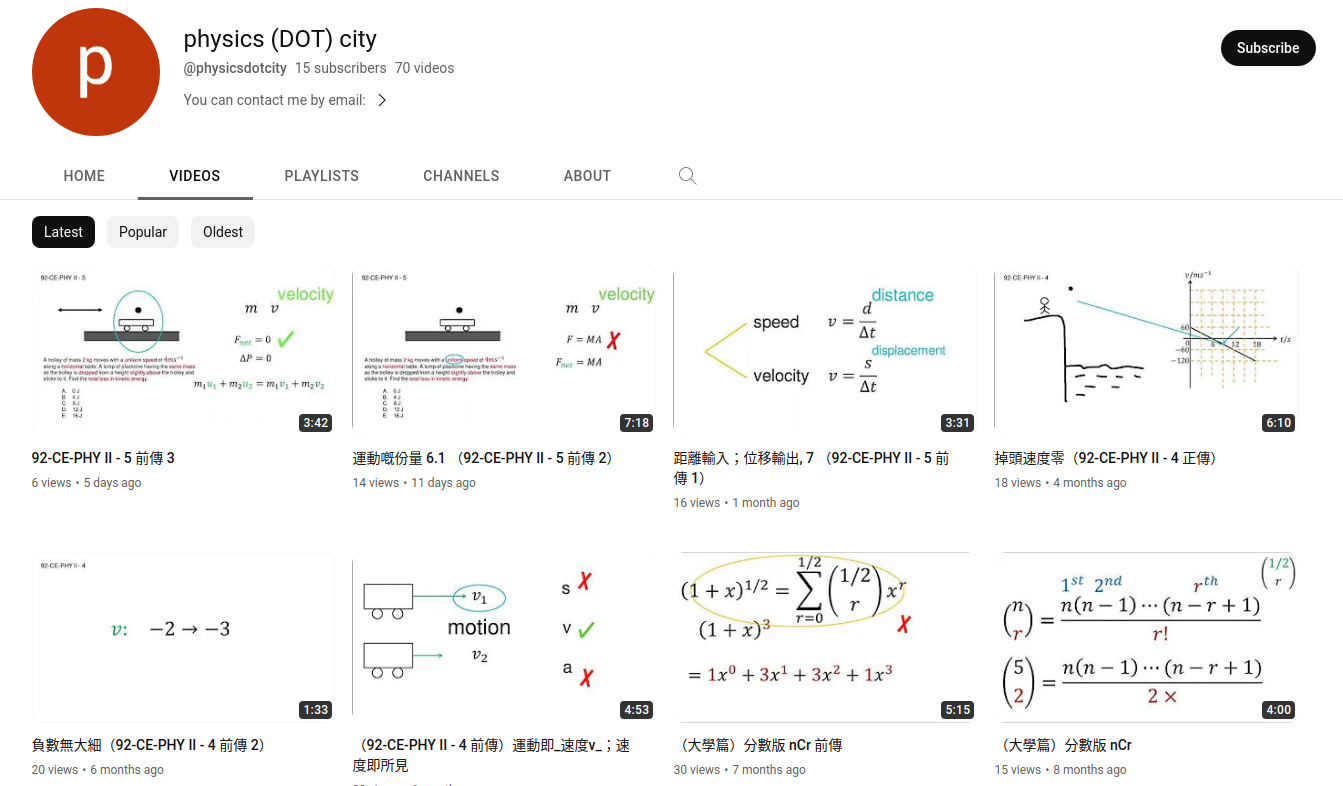
為免 Ken Chan 絕學失傳,在下略盡綿力,製作了力學課程

歡迎免費學習,無限重溫。稍後頻道略有所成時,定必考慮繼續,製作其他課題。

— Me@2024-08-09 01:32:16 PM

.

.

2024.08.09 Friday (c) All rights reserved by ACHK

CSS, 4.1

htmlize, 2.1

.

blockquote {
	font-family: Helvetica;
	font-style: normal;
	color: #4f7499;
	background: #EAEFF3;
	border-left: solid 2px #9ab3cb;
	padding-left: 10px;
	margin-left: 20px;
}

pre {
	white-space: pre-wrap;
	word-wrap; break-word;
}

#infinite-handle {
	display: none;
}

.infinite-scroll #nav-below {
	display: block;
}

.infinite-scroll #content {
	margin-bottom: 0;
}

.wp-caption .wp-caption-text:before {
	display: none;
}

.wp-caption .wp-caption-text {
	text-align: center;
	padding: 5px 7px 0;
}

— Me@2024-08-09 07:00:38 AM

.

.

2024.08.09 Friday (c) All rights reserved by ACHK

Not finding a wife

The key is NOT to find your wife, but to find the mother of your children.

— Me@2024-01-29 01:09:29 PM

.

The crucial goal of finding your wife is not “finding your wife”, but to find the mother of your future children.

— Me@2024-01-30 08:45:36 AM

.

.

2024.08.08 Thursday (c) All rights reserved by ACHK

physics 補邊個好?(陷阱二)

物理私補的好處是,那是一對一的物理補習。但是,如果那位所謂老師,其實不太懂物理,又或者懂物理但不懂教的話,即使物理補習一對一,也根本沒有任何好處。

之前有學生反映,找了很久才找到我,他聽得明白的老師。那就代表,你可能要花多個星期,聽過不同老師的講課,才找到適合你的,物理教學風格。亦即是話,要兩三個月的時間。如果是高中初期還好。如果臨近公開試的話,就十分大鑊了。

.

逆地而處你就會明白,一般情況下,有料到的物理老師,並沒有可能,全職以私人補習為生。

最基本的原因是,每天賺(例如)500元的話,月薪最多只可能有一萬多元,連「衣食住行」中的「住」,也負擔不起。

其次,大部分學生,甚至家長,沒有合約精神,不會守時。

他們不明白,「相約」中的「約」,是指雙方都不會更改,不會所謂的「情況有變,臨時有事,所以取消」。

「約」,就是在時間表中,鎖死一格時間予對方。如果某甲要求我,預留(例如)星期四的下午四至六時給他的話,我就必須排除那格時間的其他可能工作。「那格時間」不只是指「四至六時」,而是還包括「四時前」和「六時後」的時段,因為還有來回的交通。所以,如果對方臨時取消約會的話,我就立刻損失,當日的收入。(如果從來沒有約,那反而不是問題,因為,我自然會一早安排;當日的那格時間,自然會有其他的補習,或其他的工作。)

第三,有部分學生,在表面上沒有原因下,鐵定不肯做功課。

— Me@2024-07-31 12:07:46 PM

.

.

2024.08.07 Wednesday (c) All rights reserved by ACHK

Euler problem 21.1

(defmacro sum (lst)
  `(reduce #'+ ,lst))

(defun proper-divisors (n)
  (when (> n 1)  
    (let ((divisors '())
          (limit (floor (sqrt n))))  
      (loop :for i :from 1 :to limit
            :when (zerop (mod n i))  
              :do (progn
                    (push i divisors)  
                    (when (/= n (floor n i))  
                      (push (floor n i)
                            divisors))))  
      (remove-duplicates (sort divisors #'<)
                         :test
                         #'equal))))

(defmacro sum-proper-divisors (n)
  `(sum (proper-divisors ,n)))

(defun amicable-numbers (limit)
  (let ((amicable-pairs '()))
    (loop :for a :from 2 :below limit
          :do (let* ((b (sum-proper-divisors a))
                     (c (sum-proper-divisors b)))
                (when (and (or (< b a)
                               (>= b limit))
                           (= a c))                      
                  (push a amicable-pairs)                 
                  (when (< b limit)
                    (push b amicable-pairs)))))
    (remove-duplicates amicable-pairs
                       :test
                       #'equal)))

(sum (amicable-numbers 10000))

 
CL-USER> (sum (amicable-numbers 10000))
31626
CL-USER> 

— Me@2024-08-06 03:47:01 PM

.

.

2024.08.06 Tuesday (c) All rights reserved by ACHK

1.9 Abstraction of Path Functions, 3.1

Structure and Interpretation of Classical Mechanics

.

(define ((F->C F) local)
  (->local (time local)
           (F local)
           (+ (((partial 0) F) local)
              (* (((partial 1) F) local)
                 (velocity local)))))

The goal of this post is to explain why the code above can be replaced by the following code:

(define (F->C F)
  (define (f-bar q-prime)
    (define q
      (compose F (Gamma q-prime)))
    (Gamma q))
  (Gamma-bar f-bar))

.

While the input of \displaystyle{f} is a tuple \displaystyle{(t, q, v, \cdots)}, the input of \displaystyle{\bar f} is an abstract path \displaystyle{q}.

\displaystyle{\begin{aligned} \Gamma [q] &= (t, q, v, \cdots) \\ \bar f &= f \circ \Gamma \\ \end{aligned}}

.

Let us define \bar \Gamma as

\displaystyle{\begin{aligned}  f &= \bar \Gamma (\bar f) \\  \end{aligned}}

The difference between \displaystyle{\begin{aligned} \Gamma \end{aligned}} and \displaystyle{\begin{aligned} \bar \Gamma \end{aligned}} is that, in an abstract sense, \Gamma transforms f to \bar f, while \bar \Gamma does the opposite.

The explicit form of \bar \Gamma is provided by

\displaystyle{\begin{aligned}  f (t, q(t), v(t), \cdots, q^{(n)}(t))     &= f(\Gamma[q])(t) \\     \bar \Gamma (\bar f) (t, q(t), v(t), \cdots, q^{(n)}(t))     &= \bar f [q](t) \\     \end{aligned}}

(define ((Gamma-bar f-bar) path-q-local-tuple)
  (let* ((tqva path-q-local-tuple)
         (t (time tqva))         
         (O-tqva (osculating-path tqva)))   
    ((f-bar O-tqva) t)))

Note that \bar f is not defined yet because it can be any path-dependent function.

.

What is \displaystyle{F}?

Equation (1.68):

\displaystyle{\begin{aligned}   L' \circ \Gamma[q'] &= L \circ \Gamma [q] \\   \Gamma[q] &= C \circ \Gamma[q'] \\   L' &= L \circ C \\   \end{aligned}}

While F is a coordinate transformation, C is the corresponding local-tuple transformation.

Equation (1.74):

\displaystyle{\begin{aligned}   \Gamma[q] &= C \circ \Gamma[q'] \\   (t, x, v, \cdots) &= (t, F(t,x'), \partial_0 F(t, x') + \partial_1 F(t, x') v', \cdots) \\    \end{aligned}}

Note that:

1. The input of F is a tuple of a path q'. And the output is a coordinate x (aka q(t)).

2. The symbol q represents not the coordinate of a path, but the path itself. The coordinate of the path q is represented by the symbol q(t).

— Me@2024-08-05 10:09:25 PM

.

.

2024.08.05 Monday (c) All rights reserved by ACHK

Chrono Break

Chrono Trigger 4

.

“Chrono Break” is an action-adventure role-playing game that serves as an unofficial sequel to the beloved classic “Chrono Trigger”. Set in a richly detailed world filled with time travel, it follows a group of characters as they navigate through various timelines to prevent a cataclysmic event that threatens their existence.

The story begins in the year 2300, where a mysterious phenomenon called the “Time Rift” begins to disrupt the flow of time. This anomaly causes historical events to intertwine and creates chaos across different eras. The protagonist, a young hero named Riku, is drawn into this temporal chaos when he discovers a strange artifact that allows him to manipulate time. With the help of allies from different periods, including the brave warrior Alysia from the Middle Ages and the brilliant scientist Kaito from the future, Riku embarks on a quest to uncover the origins of the Time Rift.

As Riku and his friends travel through time, they encounter familiar locations and characters from “Chrono Trigger”, as well as new faces who add depth to the narrative. Each era presents unique challenges, from battling fearsome monsters to solving intricate puzzles that affect the timeline. The group learns that the Time Rift is a result of a powerful entity known as the “Chrono Warden”, who seeks to rewrite history for its own gain.

— AI

.

.

2024.08.05 Monday ACHK

physics 補邊個好?(陷阱一)

前回講到,如果你問我 DSE 物理補習推介,特別是物理補習天王的話,我會說:

補 physics,補 Ken Chan

但是他已退休。所以,上回則提到,如何分辨一位物理老師,是否有料到。簡言之,最好的情況是,你班上有同學因為,補了某位物理老師,而成績(例如)在一個月內,由 40 分躍升至 90 分。那樣,你跟著補該位老師便行。萬一,你沒有那種同學,就唯有用我文中的篩選方法。

但是要留意,你仍然可能遇到,以下的各種困難。

.

大型補習社的風格及氣氛,即風氣,有時令我十分不舒服。當年帶我弟弟去報讀課程時,櫃枱職員推介硬銷,企圖要他一同報讀,其他科目的各個課程。如果沒有大人陪同,中學生自己未必招架得住,職員的洗腦攻勢。

另外,表面上,學費貌似便宜過,一對一的私補。但是,如果你考慮師生比例的話,其實可以視之為昂貴。例如 500 元四堂,師生比例可以是 1:40。而更大鑊的是,所謂的老師,有時只是播錄影帶,沒有真人出現。

在那傳說中的上古時期,即是上世紀的九十年代中,我還是中五時,我會逢星期六,早上八時半去補 Ken Chan。那時,他是真人出現的。

中六時,本想繼續補他,但是沒有。原因是,我在放榜後的暑期見到他時,他好像答了其他同學,沒有開高考課程。還有,僱用他的補習社,被揭發有些分校無牌經營,包括不符合消房條例,導致負責人史sir 被捕。所以,我不敢回該補習社去追問,Ken Chan 究竟有沒有開,高考物理班。

到中七前的那個暑假,在同學的推介下,我開始補了 MC Chan 的物理。(傳聞他是 Ken Chan 的兄長。)初時,雖然課室裡人很多,十分擠擁,但仍是真人任教的。但是後來,卻改為「半真人」,即是有兩個課室,一個有 MC Chan 出現,另一個則直播。每人一個星期去真人課室,下一星期則去直播課室。

到中古時期,即本世紀初,我弟弟去補 Ken Chan 時,課程已不再是,真人任教了。

— Me@2024-07-29 04:14:48 PM

.

.

2024.07.29 Monday (c) All rights reserved by ACHK

反情感勒索 2.4

這段改編自 2021 年 12 月 16 日的對話。

.

你想道德綁架我嗎?

幸好,我沒有什麼道德,可以給你綁架。

我的道德少到,連自己日常生活,也不太夠用。

對於可以避開的人,我廢話小說。對於暫時不可避開的人,我廢話小說。

拒絕人時,一定要絕,因為,拖泥帶水,反而害人害己。

辭職,是不會講真正主要原因的。辭職時所講的原因,通常也只會是禮節式原因,例如 私人原因、升學進修、新發展 等。

別離沒有對錯 要走也解釋不多

— 現代愛情故事

如果辭職可以講原因,一開始就不會辭職,通常;因為那個辭職誘因,一早就可以化解了。

同理,情侶分手如果可以講原因,一早就不會分手。而不同的地方在於,辭職有手續,分手無通知。

不再見,已經是分手。不回應,已經是回應。

— Me@2023-07-26 05:25:08 PM

.

.

2024.08.04 Sunday (c) All rights reserved by ACHK

Zsh, 3

1. Assuming you have already installed the Nix package manager on Ubuntu 22.04 or later, type the following command into the terminal:

nix-env -iA nixpkgs.zsh-autocomplete  

2. Open the Zsh configuration file:

~/.zshrc

Add the following lines to it:

source ~/.nix-profile/share/zsh-autocomplete/zsh-autocomplete.plugin.zsh
 
bindkey -M menuselect '\e' undo

— Me@2024-01-23 08:52:05 AM

.

.

2024.08.01 Thursday (c) All rights reserved by ACHK

3.6 Analytic continuation for gamma function, 6

A First Course in String Theory

.

Residues

The behavior for non-positive \displaystyle{z} is more intricate. Euler’s integral does not converge for \displaystyle{\Re (z)\leq 0}, but the function it defines in the positive complex half-plane has a unique analytic continuation to the negative half-plane. One way to find that analytic continuation is to use Euler’s integral for positive arguments and extend the domain to negative numbers by repeated application of the recurrence formula,

\displaystyle{\Gamma (z)={\frac {\Gamma (z+n+1)}{z(z+1)\cdots (z+n)}}},

choosing \displaystyle{n} such that \displaystyle{z+n} is positive. The product in the denominator is zero when \displaystyle{z} equals any of the integers \displaystyle{0,-1,-2,\ldots}. Thus, the gamma function must be undefined at those points to avoid division by zero; it is a meromorphic function with simple poles at the non-positive integers.

— Wikipedia on Gamma function

.

.

2024.07.30 Tuesday ACHK

Quantum encryption

An important and unique property of quantum key distribution is the ability of the two communicating users to detect the presence of any third party trying to gain knowledge of the key. This results from a fundamental aspect of quantum mechanics: the process of measuring a quantum system in general disturbs the system. A third party trying to eavesdrop on the key must in some way measure it, thus introducing detectable anomalies.

— Wikipedia on Quantum key distribution

.

The common language of quantum mechanics is convenient but not accurate:

Eavesdropping would cause the collapse of the wave function, so Alice and Bob must be aware of it.

The accurate language:

A wave function encodes the probability distribution of various possible experimental outcomes of a system. In other words, the wave function is a property of the system (the experimental setup), encompassing the experimental operations, including measurements.

To eavesdrop, Eve has to add an extra detector to the system. Thus, the system is altered (replaced). So the probability distribution is no longer that of the original system. That is the meaning of “collapse of the wave function”.

— Me@2024-06-19 02:17:35 PM

.

.

2024.07.30 Tuesday (c) All rights reserved by ACHK

Amazing Gags 9

這段改編自 2010 年 4 月 24 日的對話。

.

If you’re good at something, never do it for free.

— The Dark Knight

.

「搞 gag」(弄笑話)要成功的其中一個先決條件是,容許失敗。

不許失敗的話,就沒有人膽敢嘗試。

.

作為聽眾,遇到冷笑話時,合理的反應是,不要笑。

但部分人卻會,立刻大聲指責,彷彿你是他的殺父仇人般。

.

聽眾之中,本身不懂講笑話的人,往往把你,責怪得最重。

.

合情合理之人,不會在別人沒有惡意的情況下,尖酸刻薄。

.

不應對尖酸刻薄的人,主動表達善意。

嘗試搞 gag,是善意的一種。

— Me@2024-07-20 05:54:18 PM

.

.

2024.07.22 Monday (c) All rights reserved by ACHK

World Cup 94, 2

Find the sum of the digits in the number \displaystyle{100!}.

import Data.Char ( digitToInt )

p_20 = sum
       $ map digitToInt
       $ show $ product [1..100]

λ> p_20
648

— Haskell official

— Me@2024-07-17 03:44:42 PM

.

.

2024.07.18 Thursday (c) All rights reserved by ACHK

3 Vector Fields and One-Form Fields, 2.3

Functional Differential Geometry

.

p. 21

3.2

\displaystyle{ \textbf{v}(\text{f})(\textbf{m})} is the direction derivative of the function \displaystyle{\text{f}} at the point \displaystyle{ \textbf{m} }.

Note that it is not the ordinary directional derivative.

3.2.1

Instead, the ordinary directional derivative is

\displaystyle{(Df(x)) \Delta x}

or

\displaystyle{\begin{aligned}  D_{\mathbf{v}}(f)    &= \frac{\left(\delta f\right)_{\mathbf{v}}}{|\mathbf{v}|} &= \left(\nabla f\right) \cdot \hat{\mathbf{v}} \\  \end{aligned}}

3.2.2

The first generalization of directional derivative is replacing \displaystyle{\Delta x}, a vector independent of \displaystyle{x}, with \displaystyle{b(x)}, a vector function of \displaystyle{x}.

3.2.3

The second generalization of directional derivative is replacing \displaystyle{D} or \displaystyle{\nabla} with \displaystyle{\textbf{v}}, which is a vector function chosen by you.

In differential geometry, a vector is an operator that takes directional derivatives of manifold functions at its anchor point.

The directional derivative of a scalar function f with respect to a vector \displaystyle{\mathbf{v}} at a point (e.g., position) \displaystyle{\mathbf{x}} may be denoted by any of the following:

\displaystyle{\begin{aligned}  \nabla _{\mathbf {v} }{f}(\mathbf {x} )   &=f'_{\mathbf {v} }(\mathbf {x} )=D_{\mathbf {v} }f(\mathbf {x} )=Df(\mathbf {x} )(\mathbf {v} ) \\  &=\partial _{\mathbf {v} }f(\mathbf {x} )=\mathbf {v} \cdot {\nabla f(\mathbf {x} )}=\mathbf {v} \cdot {\frac {\partial f(\mathbf {x} )}{\partial \mathbf {x} }}.\end{aligned}}

Let \displaystyle{\textit{M}} be a differentiable manifold and \displaystyle{\mathbf{p}} a point of \displaystyle{\textit{M}}.

Suppose that \displaystyle{f} is a function defined in a neighborhood of \displaystyle{\mathbf{p}}, and differentiable at \displaystyle{\mathbf{p}}.

If \displaystyle{\mathbf{v}} is a tangent vector to \displaystyle{\textit{M}} at \displaystyle{\mathbf{p}}, then the directional derivative of \displaystyle{f} along \displaystyle{\mathbf{v}}, denoted variously as \displaystyle{df(\mathbf{v})} (see Exterior derivative), \displaystyle{\nabla_{\mathbf {v} }f(\mathbf {p} )} (see Covariant derivative), \displaystyle{L_{\mathbf {v} }f(\mathbf {p} )} (see Lie derivative), or \displaystyle{ {\mathbf {v} }_{\mathbf {p} }(f)} (see Tangent space § Definition via derivations), can be defined as follows.

Let \displaystyle{\gamma: [-1, 1] \to M} be a differentiable curve with \displaystyle{\gamma(0) = \mathbf{p}} and \displaystyle{\gamma'(0) = \mathbf{v}}. Then the directional derivative is defined by

\displaystyle{\nabla _{\mathbf {v} }f(\mathbf {p} )=\left.{\frac {d}{d\tau }}f\circ \gamma (\tau )\right|_{\tau =0}.}

This definition can be proven independent of the choice of \displaystyle{\gamma}, provided \displaystyle{\gamma} is selected in the prescribed manner so that \displaystyle{\gamma(0) = \mathbf{p}} and \displaystyle{\gamma'(0) = \mathbf{v}}.

— Wikipedia on Directional derivative

Tangent vectors as directional derivatives

Another way to think about tangent vectors is as directional derivatives. Given a vector \displaystyle{v} in \displaystyle{ \mathbb {R} ^{n}}, one defines the corresponding directional derivative at a point \displaystyle{ x\in \mathbb {R} ^{n}} by

\displaystyle{ \forall f\in {C^{\infty }}(\mathbb {R} ^{n}):\qquad (D_{v}f)(x):=\left.{\frac {\mathrm {d} }{\mathrm {d} {t}}}[f(x+tv)]\right|_{t=0}=\sum _{i=1}^{n}v^{i}{\frac {\partial f}{\partial x^{i}}}(x).}

This map is naturally a derivation at \displaystyle{ x }. Furthermore, every derivation at a point in {\displaystyle \mathbb {R} ^{n}} is of this form. Hence, there is a one-to-one correspondence between vectors (thought of as tangent vectors at a point) and derivations at a point.

— Wikipedia on Tangent space

4. In a more user-friendly language:

\displaystyle{  \begin{aligned}    \textbf{v}(\textbf{f})(\textbf{m})   &= D_b(f)(x) \\  \end{aligned}  }

\displaystyle{  \begin{aligned}      b^i_{\chi, \mathbf{v}} (x)   &= \mathbf{v}(\chi^i) \circ \chi^{-1} (x) \\   &= \mathbf{v}(\chi^i) (\mathbf{m}) \\   &=  D_b(\chi^i \circ \chi^{-1})(x)  \\   &= \left(\nabla (\chi^i \circ \chi^{-1}) \right)\bigg|_x \cdot \vec b\bigg|_x \\    &= \sum_j \frac{\partial}{\partial x^j}(\chi^i \circ \chi^{-1}) \bigg|_x b^j \bigg|_x \\    \end{aligned}  }

where \displaystyle{ x = \chi (\mathbf{m}) } and

\displaystyle{ \begin{aligned}    x^i &= \chi^i (\mathbf{m}) \\      &= \chi^i (\chi^{-1} (\chi (\mathbf{m}))) \\      &= (\chi^i \circ \chi^{-1}) (x) \\  \end{aligned}}

\displaystyle{  \begin{aligned}      b^i_{\chi, \mathbf{v}} (x)   &= \sum_j \frac{\partial}{\partial x^j}(\chi^i \circ \chi^{-1}) \bigg|_x b^j \bigg|_x \\    &= \sum_j \frac{\partial x^i}{\partial x^j} \bigg|_x b^j \bigg|_x \\    &= \sum_j \delta^{ij} b^j \bigg|_x \\    &= b^i(x) \\    \end{aligned}  }

This is a self-consistency check.

— Me@2024-02-03 04:45:17 PM

.

.

2024.07.13 Saturday (c) All rights reserved by ACHK

Posted in FDG

Feynman’s Derivation of the Schrödinger Equation

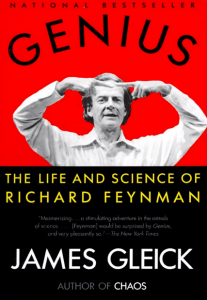
The traditional diffusion equation bore a family resemblance to the standard Schrödinger equation; the crucial difference lay in a single exponent where the quantum mechanical version was an imaginary factor, i. Lacking that i, diffusion was motion without inertia, motion without momentum. Individual molecules of perfume carry inertia, but their aggregate wafting through air, the sum of innumerable random collisions, does not. With the i, quantum mechanics could incorporate inertia, a particle’s memory of its past velocity. The imaginary factor in the exponent mingled velocity and time in the necessary way. In a sense, quantum mechanics was diffusion in imaginary time.

— page 175

— Genius: The Life and Science of Richard Feynman

— James Gleick

.

.

2024.07.10 Wednesday ACHK