Remember, your every action is a seed, a starting point of a causal chain, a small big bang.
— Me@2013-08-28 4:12 PM
.
.
2025.07.20 Sunday (c) All rights reserved by ACHK

Remember, your every action is a seed, a starting point of a causal chain, a small big bang.
— Me@2013-08-28 4:12 PM
.
.
2025.07.20 Sunday (c) All rights reserved by ACHK
注定外外傳 2.3 | Can it be Otherwise? 3.3
.
簡化來說,這次的宏觀狀態和上次相同,不代表微觀狀態和上次一樣。
詳細而言,「同一個微觀狀態」不只是「未有定義」,而是「不可能有,直接的定義」,因為,你試想想,我們怎麼分辨到,不同的「微觀狀態」呢?
只能透過對「宏觀狀態」的「觀察」或「量度」。
換句話說,你只能透過「宏觀狀態」,去定義各個「微觀狀態」。
所以,我們不可能,直接定義「同一個微觀狀態」。
要「同一個狀態」,最多只能定義「同一個宏觀狀態」。但那也只是簡稱,實情是「(其實對應於,多過一個微觀狀態的)同一個宏觀狀態」。
.
所謂的「宏觀狀態」,即是「物理現象」。所謂的「物理現象」,就是從「物理事件」中,可以「觀察」到的感覺,或「量度」到的數據。所謂的「微觀狀態」,即是「物理本體」。所謂的「物理本體」,就是指「物理事件」本身。例如,我看到一個杯子時,透過視覺接收到的杯子影像,就是「杯子現像」。而那些影像的原因來源,即是那個「杯子本身」,就是「杯子本體」。
同一個杯子,可以有不同的現象,例如,我在不用角度看那杯子,就會看在不同的影像。
又例如,即使我看到,一個彩色的杯子時,會接收到一個彩色影像,我的狗在看到那杯子時,只會看到黑白的版本,因為狗是色盲的。(那是簡化的講法,因為狗只是「紅綠色盲」,不是「全色盲」。)
.
「杯子本體」,可以視為「杯子全部」——有關杯子的全部事實。而「杯子現象」,則是「杯子部分」——有關杯子的部分事實。
留意,並沒有所謂的,「我看到杯子本身」和「我看到杯子現象」之分,因為,「我看到杯子」的意思,正正就是指:「我接收到,來自那杯子的影像訊息」。而「色即是空,空即是色」,就是這個意思。
「色」是「顏色影像」,即「現象」也。「空」則是「色」的因——有「顏色影像」之前,就存在的東西,即「本體」也。
正如,電腦「零件」,有分「硬件」和「軟件」。但沒有分「硬件模式」和「軟件模式」,因為,「軟件」正正是,硬件電子的排列模式;「軟件」這個字眼的定義,就是「硬件模式」。這裡,「硬件」對應「本體」,「軟件」對應「現象」。
另一個講法是,「杯子」就是「杯子本身」,而「看到杯子(的感覺)」,就是「杯子現象」。
我只是這個世界,小小的一個角落。這小小的一個角落,卻是我的全部世界。
—
既然,「我看到杯子本身」和「我看到杯子現象」沒有分別,我們為什麼還要分辨釐清,「杯子本身」和「杯子現象」呢?
亦即是話,為什麼「杯子本身」和「杯子現象」,卻會有分別呢?
.
那是為了提醒,還有其他的現象。
例如,剛才提及,同一個杯子,可以有不同的現象——即使我看到一個彩色的杯子時,會接收到一個彩色影像,我的狗在看到那杯子時,只會看到「沒有那麼彩色」的版本,因為,狗是「紅綠色盲」的。
又例如,同一個電腦遊戲,你用不同配備的電腦,會看到不同詳細程度的畫面。
再例如,同一板網頁,你用不同的電腦作業系統,會看到不同的字體。例如,這篇文章,如果你用 Linux 的話,呈現的是階書。但是,其他系統如果沒有該字體,則會顯示其他。
One of the most powerful illusions of the human experience is the illusion that we’re seeing objective reality through our own perceptions. We can only see what we see.
— Christopher Nolan
以下其中三句同義:
1. 小世界,不是大世界。
2. 你的世界,只是你的世界。
3. 你的世界,只是主觀世界,不是客觀世界。
4. 你對客觀世界的感官和認知,只是客觀世界的部分,不是客觀世界的全部。
5. 你的世界,只是世界的現像,不是世界的本體。
其實,五句也同義。
愚蠢的人以為,自己的主觀世界,就是客觀世界;所以,他們不知道,自己的愚蠢。
聰明的人知道,自己的主觀世界,只是客觀世界的,一小部分;所以,他們可以真切感受到,自己的愚蠢。
— Me@2009.09.17
— Me@2023-11-13 12:56:32 PM
— Me@2023-11-24 11:12:39 AM
.
.
2023.11.25 Saturday (c) All rights reserved by ACHK
Eternal return, 3.2 | Can it be Otherwise? 3.2
.
「自由命定問題」的意思是問:
同一個輸入,會否只有唯一的輸出?
簡化地問:
同因是否必同果?
詳細地問:
如果第二次實驗的,所有初始設定,和第一次的完全相同的話,第二次實驗的結果,會不會和第一次的,完全相同呢?
.
自由命定問題,不可能答的主要原因是,並沒有兩個,百分百相同的情境,因為,邏輯上(即是根據定義),「百分百相同的情境」就會有「百分百相同的結果」。「自由命定」(Can it be otherwise?) 這問題,再也沒有意思。
還有,即使你宣稱,第二個情境和第一個「百分百相同」,它們至少時間上不同。如果連時間都相同,那所謂的「第二個情境」,根本是第一個情境,即是從來沒有「第二個情境」。
.
而量子力學中的「疑似一個場境,多個可能結果」的原因是,「全同粒子」沒有客觀的身份,導致沒有辦法,定義到所謂的「同一個場境」,因為,一個宏觀狀態,其實對應於多個微觀狀態。
簡化來說,這次的宏觀狀態和上次相同,不代表微觀狀態和上次一樣。詳細而言,「同一個微觀狀態」不只是「未有定義」,而是「不可能有,直接的定義」,因為,你試想想,我們怎麼分辨到,不同的「微觀狀態」呢?
只能透過對「宏觀狀態」的「觀察」或「量度」。換句話說,你只能透過「宏觀狀態」,去定義各個「微觀狀態」。所以,我們不可能去,直接定義「同一個微觀狀態」。要「同一個狀態」,最多只能定義「同一個宏觀狀態」。但那也只是簡稱,實情是「(其實對應於,多過一個微觀狀態的)同一個宏觀狀態」。
— Me@2015-09-08 04:04:48 PM
— Me@2023-09-13 11:41:57 PM
— Me@2023-11-13 12:56:32 PM
.
.
2023.11.13 Monday (c) All rights reserved by ACHK
Eternal return, 3 | Can it be Otherwise? 3
.
Eternal recurrence is not a useful concept.
If two periods of time are identical in all details, they are actually the same period, not two periods. If two periods of time are not identical in all details, the second period is not an “eternal return” of the first period.
— Me@2013-06-04 01:30:16 AM
.
「自由命定問題」的意思是問:
同一個輸入,會否只有唯一的輸出?
簡化地問:
同因是否必同果?
詳細地問:
如果第二次實驗的,所有初始設定,和第一次的完全相同的話,第二次實驗的結果,會不會和第一次的,完全相同呢?
— Me@2023-09-14 12:43:41 AM
.
.
2023.10.07 Saturday (c) All rights reserved by ACHK
Adaptation
.
No movie can record its whole “the making of”.
Even two mutual movies [that record each other’s “the making of”] cannot work around this.
— Me@2015-10-19 06:13:58 PM
.
.
2023.07.31 Monday (c) All rights reserved by ACHK
原因 ~ 先決條件
理由 ~ 充分條件
— Me@2016-03-31 08:35:43 PM
.
.
2023.05.21 Sunday (c) All rights reserved by ACHK
primes :: [Integer]
primes = 2 : filter (null . tail . primeFactors) [3, 5 ..]

primeFactors :: Integer -> [Integer]
primeFactors n = factor n primes
  where
    factor n (p : ps)
      | p * p > n = [n]
      | n `mod` p == 0 = p : factor (n `div` p) (p : ps)
      | otherwise = factor n ps

groupFactors :: [Integer] -> [[Integer]]
groupFactors = gf []
  where
    gf acc lst
      | null lst = reverse acc
      | null acc = gf [[p,1]] ps
      --
      | p == head (head acc) =
        gf ([p, head (tail (head acc)) + 1]:tail acc) ps
      --
      | otherwise = gf ([p,1]:acc) ps
      where
        p = head lst
        ps = tail lst

nDiv :: Integer -> Integer
nDiv n = product (map ((1+) . head . tail)
                  (groupFactors (primeFactors n)))

fm :: Integer -> Integer -> Integer
fm m n
  | triDiv n > m = n*(n+1) `div` 2
  | otherwise = fm m (n+1)
  where
    triDiv n
      | even n = nDiv (n `div` 2)*nDiv (n+1)
      | otherwise = nDiv n*nDiv ((n+1) `div` 2)
λ> :set +s
λ> fm 500 1
76576500
(0.20 secs, 199,313,728 bytes)
λ>

— Me@2023-05-04 09:51:19 AM
.
.
2023.05.04 Thursday (c) All rights reserved by ACHK
No observer can observe and get all the information of the current state of the whole universe.
Since the definition of the “universe” is “everything”, any observer must be part of the universe. Also, in the universe, any observer has at least one thing it cannot observe directly—itself.
Therefore, no observer can observe the whole universe in all details.
— Me@2022.09.30 07:57:46 PM
.
Can a part of a painting represent all the information of the whole?
No.
(Kn: Yes, if excluding itself.)
That is exactly my point.
.
“Yes only if that part does not contain that part itself” is equivalent to “no”.
— Me@2016-08-20 03:30:26 PM
.
.
2022.10.01 Saturday (c) All rights reserved by ACHK
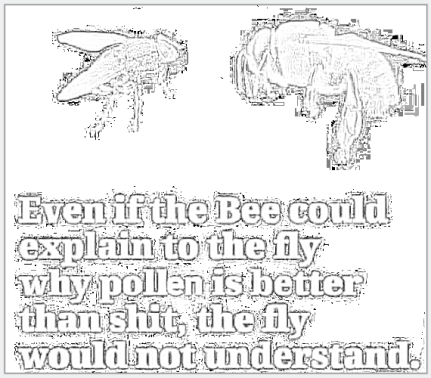
Even if the Bee could explain to the fly why pollen is better than shit, the fly would not understand.
.
.
2022.07.29 Friday ACHK
Black hole information paradox, 2.2.2
.
physical definition
~ define the microscopic events in terms of observable physical phenomena such as the change of readings of the measuring device
~
defineunobservable events in terms of observable events— Me@2022-01-31 08:33:01 AM
.
superposition
~ lack of the existence of measuring device to provide the
physical definitionsfor the (difference between) microscopic events— Me@2022-01-31 08:33:01 AM
— Me@2022-02-12 10:22:09 AM
.
In the EPR experiment, how come the two always correlate if there are no definite states before the measurements?
When you actually know the results of your experiment, it does affect your expectations of the faraway results if there are correlations – and correlations are almost always there iff the two subsystems have interacted or been in contact in the past). — Lubos Motl
Microscopically, there is no time, in the sense that all the (past and future) quantum states have one-one correspondences. All results are deterministic. No causality violation required nor allowed. — Me@2016-10-14 07:55:48 PM
This is called quantum determinism, which may or may not be correct. But quantum determinism, even if true, is not necessary for explaining the EPR experiment, if we understand that:
1. Superposition is mathematical, not physical.
2. “Wave function collapse” is mathematical, not physical. It just means that we have to replace the wave function with another if we replace the system with another.
The system before and after the detectors activated should be regarded as two distinct systems. In other words, when you activate the detectors, you have actually replaced a system-without-detectors with a system-with-detectors.
“Wave function collapse” replaces the pure state wave function with a mixed state wave function. In other words, it replaces the pure state of superposition with a mixed state of eigenstates. In other other words, it replaces quantum probability with classical probability.
Before opening the box, the cat is not in a superposition state. Instead, it is in a mixed state.
The uncertainty is classical probability, which is due to lack of detailed knowledge, not quantum probability, which is due to lack of definition (in terms of physical phenomena difference).
— Me@2022-01-29 10:38:19 PM
— Me@2022-02-12 10:28:57 AM
.
.
2022.02.12 Saturday (c) All rights reserved by ACHK
So in theory, there is no free will, because the future is already fixed, by the physical laws.
.
However, even if we knew the exact physical laws, it would be still logically impossible to get all the data of the present state of the whole universe, because it is logically impossible for any observer to observe itself, with 100% details, directly. For example, no camera can take a picture of itself directly.
So “in practice”, which is actually also “in principle”, there is free will, because logically, no one can predict, with 100% accuracy, your future actions.
.
In one logical sense, the future is already fixed, so there is no free will. In another logical sense, the future is fixed, but no observer can know that “fixed future” with 100% accuracy, so there is free will.
As a result, whether you label your actions are due to “free-will” or “not-free-will” has no real consequence. In other words, whether there is free will or not has no meaningful difference.
The difference that makes no difference makes no difference.
So you can actually transcend the free will problem altogether. You can just ignore it and live your life.
Or, you can somehow capitalize on this freedom of labelling your (future) life as either fixed or free, depending which label is more beneficial for you in a particular situation.
For example, when you are highly under pressure, you know that everything is fixed by the physical laws, from god’s point of view. When you are highly above pressure, you know that you are partially responsible for creating your own reality, because the future is not fixed for any one observer, for there is no “god’s point of view”.
You have the flexibility to label it in one way or another.
— Me@2021-05-07 10:27:04 PM
.
.
2021.05.09 Sunday (c) All rights reserved by ACHK
For example, when you ask “how to be a polite person”, you become a polite person.
In other words, when you realize that you should be a polite person, that polite person is realized at that moment.
.
The ultimate self-fulfilling prophecies:
1. free will or not
2. god or no god
3. afterlife or not
4. future spouse exists or not
.
Why self-fulfilling?
1. free will or not
If we knew the exact physical laws and all the data of the present state of the universe, we would be able to predict, with 100% accuracy, the state of the universe at any future moment.
.
In theory, the exact physical laws exist, whether we know them or not. Also, in theory, all the details of the present state of the universe exist, whether we know them or not.
So in theory, there is no free will, because the future is already fixed, by the physical laws.
.
However, even if we knew the exact physical laws, it would be still logically impossible to get all the data of the present state of the whole universe, because it is logically impossible for any observer to observe itself directly. For example, no camera can take a picture of itself directly.
So “in practice”, which is actually “in theory”, there is free will, because logically, no one can predict, with 100% accuracy, your future actions.
— Me@2021-04-16 04:45:47 PM
.
.
2021.04.16 Friday (c) All rights reserved by ACHK
這段改編自 2010 年 4 月 18 日的對話。
.
不行。雖然尚算準確,但是不夠精采。
還有,「人生攻略理論」令人聯想到很多東西,而大部分也不是,我們那個合體大理論的內容。
.
「緣份攻略」都不行,因為感覺有點怪。
(安:那就不如叫做「緣份理論」。)
「理論」很空泛。不應把「理論」,視為名字的一部分。
(安:不如叫做「超級種子理論」,或者「廣義種子理論」?)
種子論最終定版?
種子論傳 …
種子論 X 傳 …
字母 X 可代表,前中後左中右上下東南西北,例如,種子論前傳、種子論左傳 等等。原本的種子論,就為之正傳,種子正傳。即是好像 Microsoft DirectX 可以代表 Direct3D、DirectDraw、DirectMusic、DirectPlay、DirectSound 等等。.
但是「種子 X 傳」相當「拗口」,讀法不暢順。
(安:無錯,那相當「拗口」。)
大種子論?
(安:我剛才都是想到「大種子論」。)
但是,大的是理論,而不是種子。
種子大論?
(安:但「種子大論」比較奇怪。)
都是「大種子論」比較好一點。還有,遲一些有更大的理論時,可以叫做,巨大種子論、超巨大種子論、特超巨大種子論 等等。
— Me@2021-01-13 04:52:02 PM
.
.
2021.01.15 Friday (c) All rights reserved by ACHK
因果律 2.2
.
這個大統一理論的成員,包括(但不止於):
精簡圖:
種子論
反白論
間書原理
完備知識論自由決定論
它們可以大統一的成因,在於它們除了各個自成一國外,還可以合體理解和應用。
.
「自由意志」問題方面,如果要討論的話,要先釐清「人有沒有自由意志」的意思,因為,它有超過一個常用的詮釋:
.
1. 思:
人可不可以控制到,自己的「思想意志」?
如果可以的話,
2. 因:
人(的自由思想,)可不可以控制到,自己身體的行動?
如果可以的話,
3. 果:
人(的自由行動,)可不可以控制到,自己人生(或者世界歷史)的發展大方向?
.
詳細一點的版本是:
1. 思:
意志有沒有自由?
究竟人的思想是有自由?還是其實,人的思想受制於教育等外在因素,所以都是不由自主的呢?
那就有如機械人的思想般,其實只是根據程式碼來運行。
2. 因:
即使假設意志有自由,人的身體是物體,它的運行仍然,受著物理力學定律所主宰,理應沒有自由。
.
在「Laplace 因果律」的觀點下,兩者其實又沒有分別,因為「意志」都是,受物理定律的支配。「思想」是腦部的狀態,而腦部的生物化學作用,最底層也其實是,由物理定律控制。
.
如果「Laplace 因果律」正確的話,人或者任何其他東西,也沒有自由。
至於「Laplace 因果律」正確與否,和人有自由與否,在我們以前的討論中,已得出了結論:
「自由論」和「決定論」,其實沒有實質上的分別。
所以,我把這個理論,稱為「自由決定論」。
如果對「因果律」和「自由意志」話題有興趣,想知道這結論的理據的話,請在本網誌搜尋「因果律」。
— Me@2020-12-29 05:46:05 PM
.
.
2020.12.29 Tuesday (c) All rights reserved by ACHK
因果律 2.1
.
這個大統一理論的成員,包括(但不止於):
精簡圖:
種子論
反白論
間書原理
完備知識論自由決定論
它們可以大統一的成因,在於它們除了各個自成一國外,還可以合體理解和應用。
.
(問:「種子論」,其實就即是「自由決定論」?)
可以那樣說。但是重點不同。
「種子論」重於討論,人生如何逹到成功。(留意,這裡的「成功」,是在你自己定義下的成功,而不是在世俗標準下。)
「自由決定論」則重於研究,宇宙既然依物理定律運行,那就代表,人的一舉一動,甚至思想意志,在宇宙創生那刻,就已經決定了?
(問:「自由決定論」即是問,世間上,有沒有「自由意志」?)
不太是。
「自由決定論」的重點跟人(或者其他意識體)沒有直接的關係。
「自由決定論」的重點在於研究,「Laplace 因果律」是否正確。
「Laplace 因果律」就是:
「
我們只要掌握某一個時刻,宇宙狀態的所有資料,我們就可以推斷到,宇宙在任何其他時刻的狀態。
」
這個話題中的細節,我們以前已經詳細討論過,所以這裡不再跟進。
「如果『因果律』是正確,人就沒有自由」只是「因果律」的一個例子。而這個例子因為直接和人相關,所以,人們特別重視。但是,即使那樣,那仍不是「因果律」的重點。
亦即是話,「自由意志」問題,只是「因果律」問題的支節。
.
(另一話題:)
「自由意志」問題方面,如果要討論的話,要先釐清「人有沒有自由意志」的意思,因為,它有超過一個常用的詮釋:
.
1. 思:
人可不可以控制到,自己的「思想意志」?
如果可以的話,
2. 因:
人(的自由思想,)可不可以控制到,自己身體的行動?
如果可以的話,
3. 果:
人(的自由行動,)可不可以控制到,自己人生(或者世界歷史)的發展大方向?
— Me@2020-12-11 06:43:58 PM
.
.
2020.12.11 Friday (c) All rights reserved by ACHK
這段改編自 2010 年 4 月 18 日的對話。
.
你只能控制因,不能控制果。事情結果,除了受你的因以外,還受千百萬樣其他因素影響。所以,人生的大目標之中,很多也只有極細的成功機會率。
你唯一可以做的,就是透過嘗試掌握,最多的自然定律(道理)和具體資訊(世情/情報),去把成功的機會率,稍為提高一點。但記住,只可以提高一點,不會很多。
或者說,從來沒有必定成功的途徑,只有保證失敗的方法。而保證失敗的主要方法有:
懂道理但缺乏足夠情報
刪除必敗之道,就有成功之機。
這個大統一理論的成員,包括(但不止於):
精簡圖:
種子論
反白論
間書原理
完備知識論自由決定論
它們可以大統一的成因,在於它們除了各個自成一國外,還可以合體理解和應用。
而道理和情報之中,較為常用的,有「反白論」和「間書原理」。
「反白論」的意思是,現時的地球人間,極多的情況下,名義與實情都是相反的。
反白論 ~ 名實時常相反論
例如,真正的有利健康的食品,例如蘋果,你不會刻意標籤它,為「健康食品」。市面上,刻意標籤為「健康食品」的,通常也是人工製品,營養價値不及水果高,有時甚至有害。
又例如,小學畢業和中學畢業時,紀念冊也會寫「友誼永固」,正正是友誼不會永固,通常。長大後,仍然有聯絡的兒時同學,極端接近零。從來沒有「石頭永固」的口號,因為,石頭本身就永固。
再例如,通常國家名越長,包含越多形容詞,那個國家就越危險。國名中的形容詞,往往正正就是,那個國家沒有的東西。
As a rule of thumb, the more qualifiers there are before the name of a country, the more corrupt the rulers. A country called The Socialist People’s Democratic Republic of X is probably the last place in the world you’d want to live.
–- Paul Graham
又再例如,為什麼結婚時會「山盟海誓」?
正正是因為愛情關係,可說是眾多感情關係中,最不可靠的一種;正正是因為誓詞中的承諾,很多人也不能達到。不信的話,你可以查看,離婚率的高低。
又再又例如,
我認為,對我們來說,一個人,一個黨,一個軍隊,或者一個學校,如若不被敵人反對,那就不好了,那一定是同敵人同流合污了。如若被敵人反對,那就好了,那就證明我們同敵人劃清界線了。如若敵人起勁地反對我們,把我們說得一塌糊塗,一無是處,那就更好了,那就證明我們不但同敵人劃清了界線,而且證明我們的工作是很有成績的了。
「反白論」的應用在於,掌握以後,大大減少了,你被世人欺騙得到的比例。
而更上一層樓話,你更可以反世人之言而行。例如,你選擇工作時,再不會為了一個職位的名氣大而選它,因為「名氣大」通常代表「收入少」或者「不快樂」。否則,為什麼一份工作需要用「名氣大」作賣點呢?
你不會再考慮,一份工作的名氣大小。反而,你會先考慮其短期收入和長遠收入,再考慮自己的興趣。
— Me@2020-03-19 09:34:39 PM
.
.
2020.03.21 Saturday (c) All rights reserved by ACHK
這段改編自 2010 年 4 月 18 日的對話。
.
你可以花一生的時間,去令到自己受歡迎;但是,你的喪禮將會有多少人出席,還要視乎當日的天氣。
.
萬事俱備,只欠東風時,就應該立刻離開,讓東風做事,不要阻礙東風。
亦即是話,一件事情的發展結果,受眾多因素影響。有些你控制得到,有些你控制不到。你既要盡力處理,你控制得到的部分,亦同時要盡力去忽略,你控制不到的部分。
千萬不要干涉,大自然的內政,因為,那只會弄巧反拙。
例如,如果你想受人歡迎,你可以做的,就是認真工作,善待自已,以誠待人等。最終會不會受歡迎,那不在你控制範圍。
試想想,如果你企圖保證,自己受歡迎的話,情形會怎樣?
情形就是,你會不斷地提醒他人,你自己的存在。那只會為他人,帶來極大的滋擾。那反而會令你討厭。
原理上,你就應該化成磁鐵,盡其在我地,增加自身的吸引力。重點是,你只可以吸引,而不能拉扯。
正如磁鐵一樣,它只能吸引磁性物質。其他東西,並不會受其吸引。
題外話:而更重要的問題是,為什麼要追求「受歡迎」呢?「受歡迎」的好處,真的大於壞處嗎?
而「不要干涉大自然的內政」,並不代表,「種子論」是「被動」、「消極」的。或者說,那是有意義的「被動」和有策略的「消極」。
那並不是負面意思下的被動消極,原因是「種子論」的行動三部曲,其實也相當上進積極。
第一部,要盡你自己的能力,獲取最多的情報,有關哪裡的土壤,最有機會讓農作物茁壯成長。然後,在那些範圍播種。沒有種子,就不可能有果實。
第二部,有種子,亦不一定會果實。所以,你要積極不做事,積極去等待。除了定期的灌溉和施肥等工序外,並沒有任何行動,令你可以保證某單一棵植物,一定開花結果。
第三部,而要訓練到自已,習慣在適當的地方和時間,去「積極不做事,積極去等待」的技巧是,先做其他東西,同時在其他土壤播種。
而這正正回應了第一部:正正是因為,在某一指定地方有成果的機會極細,你要在最多的土壤,灑下最多的機遇種子;而底線是,不要多到自己管理不到。
.
一件事情的發展結果,受眾多因素影響。有些你控制得到,有些你控制不到。你既要盡力處理,你控制得到的部分,亦同時要盡力去忽略,你控制不到的部分。
While we are free to choose our actions, we are not free to choose the consequences of those actions. Consequences are governed by natural law.
— The 7 Habits of Highly Effective People
— Stephen R. Covey
那只是理論比喻。執行「種子論」的真正難度在於,有時,在事情完結前,很難去分清該事件中的哪些部分,是「可控部分」,而哪些部分,卻是「不可控部分」。
亦即是話,「謀事在人,成事在天」之中,哪些部分而要由「你」去「謀」,而哪些地方是由「天」去「成」,事前不一定知道。
所以,那不會有公式答案,只能靠自己或他人的學術知識和實際經驗。
Grant me the serenity to accept the things I cannot change,
the courage to change the things I can change,
and the wisdom to distinguish the two.
「經驗」的近義詞,是「錯誤」。它們不同義的地方,在於「經驗」可以累積,「錯誤」不一定可以累積。
「種子論」的重點,並不是給予你,一條必勝的方程式。
「種子論」的重點是,令你知道,無論如何,你也會遇到無數次的失敗;那是正常不過的事。「種子論」的重點是,令你不再害怕失敗,從而,你會勇於嘗試,敢於超大量地犯錯。
「種子論」的重點是,重複犯同一個錯誤本身,並不能提高成功的機會率。
「種子論」所要求的「不斷犯錯」是,每次也是「新的錯誤」。「新錯誤」的意思,並不只是相對於你來說是「新」,而是相對全人類來說,都是「新」。
別人犯過的錯誤,你也不可以再犯。
一千萬次的失敗,可以兌換一次的成功。
而一次的成功,卻可以兌換一千萬次的應用。
— Me@2020-02-24 10:52:08 PM
.
.
2020.02.24 Monday (c) All rights reserved by ACHK
Just as in the definition of a function in mathematics, two x values can map to the same y value, but one x value cannot map to two y values; the future is unique in classical physics.
In quantum mechanics, the uniqueness is not of the measurement results, but of the set of probabilities of the results.
— Me@2018-02-03 11:29:18 AM
.
With respected to a known state, the future is unique in classical physics.
In quantum mechanics, the set of probabilities is encoded in the wave function.
— Me@2020-02-21 06:25:52 PM
.
.
2020.02.22 Saturday (c) All rights reserved by ACHK
這段改編自 2010 年 4 月 18 日的對話。
.
還有,「人生攻略理論」令人聯想到很多東西,而大部分也不是,我們那個合體大理論的內容。
.
「緣份攻略」都不行,因為感覺有點怪。
(安:那就不如叫做「緣份理論」。)
「理論」很空泛。不應把「理論」,視為名字的一部分。
.
不如就直接收做「機械人生論」啦,因為那個大統一理論,其實就即是「人生攻略」。
這個大統一理論的成員,包括(但不止於):
精簡圖:
種子論
反白論
完備知識論自由決定論
它們可以大統一的成因,在於它們除了各個自成一國外,還可以合體理解和應用。
.
詳細圖:
種子論 可遇不可求
你只能控制因,不能控制果。事情結果,除了受你的因以外,還受千百萬樣其他因素影響。所以,人生的大目標之中,很多也只有極細的成功機會率。
第一方面,如果你很努力做事,事情仍不能如你所願的話,不要覺得很奇怪。
第二方面,做事時,不要過份用力之外,亦不要在不適當的地方用力。
比喻說,你向心儀示愛後,就只能等待她的答覆,讓她決定,接不接受你的愛意。
示愛以後,並沒有任何東西你可以做,從而控制到她去喜歡你,因為,那是她的自由。
你唯一可以做的是,遠在示愛之前,就積極提升自己的外貌和人格等,從而提高,她喜歡你的機會率。
在適當的地方用力以後,要懂得「放手」,讓事情自己發展。
把手緊握 什麼都沒有
把手放開 你得到一切
萬事俱備,只欠東風時,就應該立刻離開,讓東風做事,不要阻礙東風。
亦即是話,一件事情的發展結果,受眾多因素影響。有些你控制得到,有些你控制不到。你既要盡力處理,你控制得到的部分,亦同時要盡力去忽略,你控制不到的部分。
千萬不要干涉,大自然的內政,因為,那只會弄巧反拙。
— Me@2020-02-15 07:17:00 AM
.
.
2020.02.15 Saturday (c) All rights reserved by ACHK
這段改編自 2010 年 4 月 18 日的對話。
.
如果要把,我們討論過的理論,例如,自由決定論、反白論 和 種子論 等,像合體機械人般的形式,砌成一個大理論的話,你覺得那個大理論,名字應該是什麼?
那個大理論,必須有一個正式名字,以後討論問題需要它時,才容易提及。
(安:除了創作那個大理論的名字外,還有什麼話題?)
你想到那個大理論名字後,自然會引起很多新話題。
.
不過,我們討論的東西,太過廣泛,很難用一個名字,統攝全部。
.
不如直接收做「機械人論」?
(安:不行。我都想過這個名字。但它非常誤導。「合體機械人」只是比喻。整個理論和機械人無關。)
好。我們再一次釐清,現在的問題:
我們討論過的「自由決定論」、「種子論」和「完備知識論」(亦可名「完備人生論」),可不可以用一個名字,就捕捉到它們的精粹?
「副作用機械人」?
(安:不如直接用你的名字,命名那個理論。)
唔得喎。我的名字,要留待用於,更加偉大的東西上。
可以可以叫做「果實理論」?
「種子論」是起點,「果實論」是終點。然後,每個果實內,其實又有很多新種子。
.
「緣份管理學」?
(安:我覺得「管理學」好像令個理論降級了一點,因為一般而言,「管理學」並不是,太高深的學問。)
那怎麼辦?
「緣份機械人」?
(安:叫做「人生攻略理論」?)
不行。雖然尚算準確,但是不夠精采。
還有,「人生攻略理論」令人聯想到很多東西,而大部分也不是,我們那個合體大理論的內容。
.
「緣份攻略」都不行,因為感覺有點怪。
(安:那就不如叫做「緣份理論」。)
「理論」很空泛。不應把「理論」,視為名字的一部分。
— Me@2020-01-29 12:23:38 AM
.
.
2020.01.30 Thursday (c) All rights reserved by ACHK
 Physics Town
You must be logged in to post a comment.