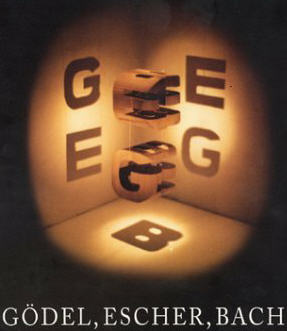
Godel, Escher, Bach

Douglas Hofstadter’s Godel, Escher, Bach uses self-referencing mathematical (formal language) and English (natural language) sentences, pictures (M.C. Escher’s dragon for example), and music (Bach’s fugues) to convey the concept and its recursive nature.

— Wikipedia on Self-reference

In response to confusion over the book’s theme, Hofstadter has emphasized that GEB is not about mathematics, art, and music but rather about how cognition and thinking emerge from well-hidden neurological mechanisms. In the book, he presents an analogy about how the individual neurons of the brain coordinate to create a unified sense of a coherent mind by comparing it to the social organization displayed in a colony of ants.

— Wikipedia on Godel, Escher, Bach

2012.05.23 Wednesday ACHK

The Incredible Hulk

Marvel’s The Avengers (2012 movie): What did the Hulk mean when he said his secret was that he was always angry?

It seemed that early in the movie, he was not able to control himself when he turned into the Hulk. Yet, he seemed to be able to transform at will and also listen to orders or operate as part of a team in the later part of the movie.
 

Mark Hughes, Screenwriter, Forbes Blogger

If Banner had to just avoid getting angry in order to not be the Hulk, he’d never succeed, because of course it’s probably almost impossible for the vast majority of people to really just stop themselves from getting angry. But what do we do instead? We can’t avoid being angry, but we learn to control our TEMPER and we can control how we RESPOND to anger.

In the previous solo Hulk film, it ends with Banner learning that the key is less about the anger itself, than the literal physical reactions caused by the anger. If he can keep his heart rate down and his metabolism from responding to the anger and pain, then he can prevent changing into the Hulk. He maintains a constant state of anger at his situation, and at the state of the world, and at the people responsible for it, as a way to keep the emotional status constant and thus allow him to ignore controlling his emotions so he can instead focus his efforts merely on controlling his physiological responses to the anger.

With anger as a constant state, his body adapts, it returns to a moderated physical state most of the time, so anger itself won’t be a trigger. Only when he allows the anger to go unchecked and gives in to his body’s “desire”/urge to change, does he become the Hulk — unless he is too overwhelmed by physical stress to hold it back, like when he was severely injured early in the film on the Helicarrier. Otherwise, he can change into the Hulk at will because he’s already always angry, and need only let the change take place.

http://www.quora.com/Marvels-The-Avengers-2012-movie/What-did-the-Hulk-mean-when-he-said-his-secret-was-that-he-was-always-angry/answer/Mark-Hughes-1

2012.05.12 Saturday ACHK

Meta 3

… the people who made money from the gold rush were not the gold miners. It was guys named Levi Strauss and Crocker, and folks who ran banks, and people who sold jeans, and sold picks and axes.

I think ultimately in the long term that the money that will get made in Minecraft will not be about Minecraft, but will be about the services and products that get introduced into it. And so that’s what’s most interesting to me about Minecraft, is that the ecosystem, it’s almost an American history lesson.

— Rich Hilleman

— Getting EA Ready for the Future

— Brandon Sheffield

— Gamasutra

2012.04.11 Wednesday ACHK

Quantum cosmology

… the universe is the sum total of all that is in existence. Physically, a (physical) observer outside of the universe would require the breaking of gauge invariance, and a concomitant alteration in the mathematical structure of the theory. Similarly, RQM conceptually forbids the possibility of an external observer. Since the assignment of a quantum state requires at least two “objects” (system and observer), which must both be physical systems, there is no meaning in speaking of the “state” of the entire universe.

This is because this state would have to be ascribed to a correlation between the universe and some other physical observer, but this observer in turn would have to form part of the universe, and as was discussed above, it is impossible for an object to give a complete specification of itself. Following the idea of relational networks above, an RQM-oriented cosmology would have to account for the universe as a set of partial systems providing descriptions of one another. The exact nature of such a construction remains an open question.

— Wikipedia on Relational quantum mechanics

2012.03.27 Tuesday ACHK

Meta-company

Meta 2

“You know what’s great about the YC network? It gives the benefit of being part of a large company without being part of a big company,” Graham says. “The problem with doing a startup–even though it’s better in almost every other respect–is that you don’t have the resources of a big company to draw on. It’s very lonely; you have no one to give you advice or help you out. In a big company, you might be horribly constrained, but there are like 1,000 other people you can go to to deal with any number of problems. Now [with YC] you have 1,000 people you can go to to deal with problems, and you don’t have all the restrictions of a big company.”

— Paul Graham: Why Y Combinator Replaces The Traditional Corporation

— Austin Carr

2012.02.29 Wednesday ACHK

Meta-teacher

Meta 1.2 | Recursion 9.2

如何拯救眾生 3

.

Now, the common paradigm is that the teacher-student ratio is critical — fewer students means higher-quality teaching. But if you turn your students into teachers, you gain leverage. You move the fulcrum over.

– The 8th Habit p. 32, by Stephen Covey

.

.

.

2008.10.24 Friday ACHK

Lisp macros 2.2

I think one of the problems with Lisp is that it is too powerful. It has so much meta ability that it allows people to invent their own little worlds, and it takes a while to figure out each person’s little world (SoftwareGivesUsGodLikePowers).

— Lisp is Too Powerful

2012.02.19 Sunday ACHK

Verification principle, 2

Verification- and falsification-principles

The statements “statements are meaningless unless they can be empirically verified” and “statements are meaningless unless they can be empirically falsified” are both claimed to be self-refuting on the basis that they can neither be empirically verified nor falsified. 

— Wikipedia on Self-refuting idea

Verification principle: That meaningful statements should be analytic, verifiable or falsifiable

Falsifiability: The possibility that an assertion may be disproved

— Wikipedia on Verification theory

Strong verification principle (aka verification principle) may or may not be self-refuting, depending on whether your regard it as an analytic statement or not. It can be regarded as an analytic statement (aka tautological statement) in a sense that verification principle defines what “meaningful” means, distinguishing meaningful statement from meaningless one. It is related to the definitions of “analytic statement” and “synthetic statement”.

Weak verification principle (aka confirmation principle) is not self-refuting.

Falsification principle is not self-refuting. Falsification principle is about science statements. Itself is not a science statement. Instead, it is part of the definition of “science statements” (aka synthetic statements). So it should not be applied to itself.

— Me@2011.10.21

2011.10.21 Friday (c) All rights reserved by ACHK

Autological

1. An adjective is autological if and only if it describes itself. For example “short” is autological, since the word “short” is short. “English,” “unhyphenated” and “pentasyllabic” are also autological.
  
2. An adjective is heterological if it does not describe itself. Hence “long” is a heterological word, as are “abbreviated” and “monosyllabic.”

  
Is “autological” autological?

It can be chosen consistently to be either:

    * if we say that “autological” is autological, and then ask if it applies to itself, then yes, it does, and thus is autological;
    * if we say that “autological” is not autological, and then ask if it applies to itself, then no, it does not, and thus is not autological.

This is the opposite of the situation for heterological: while “heterological” logically cannot be autological or heterological, “autological” can be either.

In logical terms, the situation for “autological” is:

    “autological” is autological if and only if “autological” is autological
    A if and only if A, a tautology

while the situation for “heterological” is:

    “heterological” is heterological if and only if “heterological” is autological
    A if and only if not A, a contradiction.

— Wikipedia on Grelling–Nelson paradox

2011.02.24 Thursday ACHK

Metamathematics

Richard’s paradox (Richard 1905) concerning certain ‘definitions’ of real numbers in the English language is an example of the sort of contradictions which can easily occur if one fails to distinguish between mathematics and metamathematics.

— Wikipedia on Metamathematics

2010.05.31 Monday ACHK

Multiple time dimensions

Two dimensional time 6.1

.

Physics

Special relativity describes spacetime as a manifold whose metric tensor has a negative eigenvalue. This corresponds to the existence of a “time-like” direction. A metric with multiple negative eigenvalues would correspondingly imply several timelike directions, i.e. multiple time dimensions, but there is no consensus regarding the relationship of these extra “times” to time as conventionally understood.

Philosophy

An Experiment with Time by J.W. Dunne (1927) describes an ontology in which there is an infinite hierarchy of conscious minds, each with its own dimension of time and able to view events in lower time dimensions from outside. His theory was often criticised as exhibiting an unnecessary infinite regress.

— Wikipedia on Multiple time dimensions

.

.

2010.02.11 Thursday ACHK

Yin and Yang

Principles

Everything can be described as either yin or yang.

1. Yin and yang are opposites.

Everything has its opposite—although this is never absolute, only comparative. No one thing is completely yin or completely yang. Each contains the seed of its opposite. For example, cold can turn into hot; “what goes up must come down”.

2. Yin and yang are interdependent.

One cannot exist without the other. For example, day cannot exist without night.

3. Yin and yang can be further subdivided into yin and yang.

Any yin or yang aspect can be further subdivided into yin and yang. For example, temperature can be seen as either hot or cold. However, hot can be further divided into warm or burning; cold into cool or icy.

4. Yin and yang consume and support each other.

Yin and yang are usually held in balance—as one increases, the other decreases. However, imbalances can occur. There are four possible imbalances: Excess yin, excess yang, yin deficiency, yang deficiency.

5. Yin and yang can transform into one another.

At a particular stage, yin can transform into yang and vice versa. For example, night changes into day; warmth cools; life changes to death.

6. Part of Yin is in Yang and part of Yang is in Yin.

The dots in each serve as a reminder that there are always traces of one in the other. For example, humans will always be both good and evil, never completely one or the other.

— Wikipedia

.

.

2007.10.27 Saturday CHK2