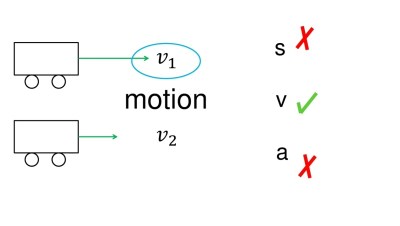
@dialectphilosophy, 1.6

Comments on Dialect’s Newton vs. Mach: The Bucket Experiment

1.1 In dialectphilosophy, the author claimed that acceleration is not really absolute, because measuring its value within a physical system actually requires your prior knowledge about the world and the initial calibration of the accelerometer.

While the point is correct, it is irrelevant here, because it is not what the original “acceleration is absolute” refers to.

In other words, the statement “acceleration is absolute” is with respect to Galilean transformation. It is not with respect to every kind of transformation. Confusing these two meanings is a major bug of @dialectphilosophy.

1.2 Actually, calibration is a process that lets you define what “acceleration is zero” means in terms of physical phenomenon. In other words, you decide under what condition that you should set the accelerometer reading to zero.

1.3 Note that it is always the case that you have to define the value of a physical quantity in terms of a state of the measuring device. That is exactly what “calibration” means.

1.4 More fundamentally, it is just the normal process of defining new words. We define new words either in terms of other words or in terms of physical phenomena.

2. Even though the value of acceleration, and thus also the answer to “whether the acceleration is zero”, is relative to the accelerometer calibration, the answer to “whether the acceleration is increasing, decreasing, or constant” is not.

— Me@2023-08-07 05:56:31 AM

.

.

2024.02.20 Tuesday (c) All rights reserved by ACHK

@dialectphilosophy, 1.5

1. Velocity is by definition relative because displacement is by definition relative.

 
\displaystyle{  \begin{aligned}  v &= \frac{s}{\Delta t} \\   s &= x_2 - x_1 \\   \end{aligned}  }
 

2. Even for either coordinate (x_1 or x_2), its value is relative because it is defined with respect to an origin chosen by you.

3.1 Furthermore, even for the origin itself, it is relative in a sense. When you choose a point as the origin of the coordinate system, you have to choose a static point. However, “whether a point is static or not” is subjective for different observers.

3.2 In other words, to be an origin, it has to be the same physical location. However, whether the physical location is the “same” could be up to debate.

— Me@2024-02-03 01:43:32 PM

.

.

2024.02.03 Saturday (c) All rights reserved by ACHK

@dialectphilosophy, 1.4

Velocity is relative in the following sense:

Subjective value of an objective velocity changes under Galilean transformation. Different inertial observers would see different velocity values.

Acceleration is absolute in the following sense:

Subjective value of an objective accelerative remains unchanged under Galilean transformation. Different inertial observers would see identical acceleration values.

The proof:

\displaystyle{a' = \frac{dv'}{dt} = \frac{d}{dt} (v+v_0) = a}

In other words, the statement “acceleration is absolute” is with respect to Galilean transformation. It is not with respect to every kind of transformation. Confusing these two meanings is a major bug of @dialectphilosophy.

.

Note that Galilean transformation, like many other “transformations”, is conceptual, linguistic, mathematical, logical, coordinate, subjective, but not objective, nor physical, because the two observers are seeing the same underlying physical event.

— Me@2024-01-23 12:12:23 PM

.

.

2024.01.24 Wednesday (c) All rights reserved by ACHK

What is absolute is the change of shape

@dialectphilosophy, 1.3.4

.

The key point is that the observer within the car can see the separation changes among some objects, including the car itself, within the car.

Besides seeing the separation changes, the observer can also feel the acceleration directly within his body. The feeling of force is also due to the separation changes, but among points of his body.

How come a free falling frame is equivalent to an inertia frame? In other words, if acceleration is really absolute, how come a free falling observer cannot feel the acceleration?

Short answer: Acceleration is absolute in general, but not in all cases. What is absolute are the particles’ positions relative to each other in a physical system.

Long answer:

For two free falling objects, if they start to fall at the same time, they have equal initial velocities. Then, according to the equation

s = ut + \frac{1}{2}at^2,

the displacements of them are always the same. So their separation is always constant.

For the two objects, their displacements are

\begin{aligned}  s_1 &= u_1 t_1 + \frac{1}{2} a_1 t_1^2 \\  s_2 &= u_2 t_2 + \frac{1}{2} a_2 t_2^2 \\  \end{aligned}

If u_1 = u_2, t_1 = t_2, and a_1 = a_2, then s_1 = s_2. As a result, their separation remains unchanged.

Note that the separation would remain unchanged only if

1. the acceleration is uniform (in space) so that a_1 = a_2 always; and

2. both initial velocities have an identical value, i.e. u_1 = u_2.

So what really is absolute is not acceleration, but the separation changes among points seen by the observer within the physical system. Let us label “the separations among points” as “the spatial configuration”, or as an even simpler term: “the shape of the physical system”.

— Me@2023-12-06 11:06:23 AM

— Me@2023-12-24 05:58:54 PM

.

.

2024.01.10 Wednesday (c) All rights reserved by ACHK

@dialectphilosophy, 1.3.3

That is what “acceleration is absolute” means. The observer can notice different phenomena, compared with the no-acceleration case, even without seeing outside the car window.

The additional meaning of “acceleration is absolute” is that we can deduce the acceleration value by measuring v_{2c}(0), v_{2c}(t), and t. And, unlike velocity values, this acceleration value is identical for any two observers related by a Galilean transformation. (They are called inertial observers.)

.

To see a more direct consequence of accelerating the car, we can consider an even simpler case where v_{2c}=0. Then we split the case into two, one with acceleration and one without.

In the no acceleration case, the particle 2 keeps co-moving with the car at the same velocity. In this case, the distance between particle 2 and a point of the car is always the same, no matter what the car’s velocity is. So it is impossible to deduce that velocity by observing only the distance between any two points within the car.

The car velocity value observed is different for different observers, depending on each observer’s velocity. That is what “velocity is relative” means.

However, if the car accelerates, although for an observer co-moving with the car, what he sees is not the car accelerating, but the particle 2 accelerates in the opposite direction; he can measure the acceleration based on the separations (between points within the car), the separation changes, and rate of separation changes; and he will get an acceleration value of the same magnitude.

.

The key point is that the observer within the car can see the separation changes among some objects, including the car itself, within the car.

— Me@2023-12-06 11:06:23 AM

— Me@2023-12-24 05:58:54 PM

.

.

2023.12.26 Tuesday (c) All rights reserved by ACHK

@dialectphilosophy, 1.3.2

He can deduce the relative velocity v_2 - v_1 by the separations x_2(t) - x_1(t) and x_2(0) - x_1(0). However, he still cannot deduce v_2 nor v_1 unless he is able to look outside the car window. Thus, he cannot deduce the car speed v just by observing the positions and velocities of the objects inside the car.

.

For simplicity, assume object 1 is actually a point of the car itself. So v_1 is actually the speed of the car, v. Then the calculation

\displaystyle{  \begin{aligned}  &x_2(t) - x_1(t) \\  &= \Bigl( x_2(0) + v_2 t \Bigr) - \Bigl(x_1(0) + v_1 t \Bigr) \\  &= \Bigl( x_2(0) - x_1(0) \Bigr) + \Bigl( v_2 - v_1 \Bigr) t \\  \end{aligned}}

becomes

\displaystyle{  \begin{aligned}  &x_2(t) - x(t) \\  &= \Bigl( x_2(0) - x(0) \Bigr) + \Bigl( v_2 - v \Bigr) t \\  \end{aligned}}

where x is a point of the car.

In this case, x_{2c} = x_2(t) - x(t) becomes the position of object 2 relative to car; and v_{2c} = v_2 - v becomes the velocity of object 2 relative to the car. The equation can be simplified to

\displaystyle{  \begin{aligned}  x_{2c}(t) &= x_{2c}(0) + v_{2c} t \\  \end{aligned}}

.

If the car has acceleration, the story is totally different. In short, for the observer inside the car, the path of each particle is not a straight line anymore. In long, the previous calculation becomes

\displaystyle{  \begin{aligned}  &x_2(t) - x(t) \\   &= \Bigl( x_2(0) + v_2 t - 1/2 a t^2 \Bigr) - \Bigl(x(0) + v t - 1/2 a t^2 \Bigr) \\  &= \Bigl( x_2(0) - x(0) \Bigr) + \Bigl( v_2 - v \Bigr) t \\  \end{aligned}}

where a is the acceleration of the car. Here, we assume that v_1, v_2, and a are all pointing in the same direction.

Although the result is the same as before:

\displaystyle{  \begin{aligned}  x_{2c}(t) &= x_{2c}(0) + v_{2c} t, \\  \end{aligned}}

the velocity v_{2c} is no longer a constant; it would keep decreasing.

In the no acceleration case, even if the particle velocity and the car velocity are not in parallel, the observer will see a straight path. However, in the accelerated case where the acceleration and velocity directions are not in parallel, the path of the particle will no longer be a straight line.

That is what “acceleration is absolute” means. The observer can notice different phenomena, compared with the no-acceleration case, even without seeing outside the car window.

The additional meaning of “acceleration is absolute” is that we deduce the acceleration value by measuring v_{2c}(0), v_{2c}(t), and t. And, unlike velocity values, this acceleration value is identical for any two observers related by a Galilean transformation. (They are called inertial observers.)

— Me@2023-12-06 11:06:23 AM

.

.

2023.12.16 Saturday (c) All rights reserved by ACHK

@dialectphilosophy, 1.3.1

As long as object 1 and object 2 have the same velocity-relative-to-the-ground as that of the car, \displaystyle{v}, i.e.

\displaystyle{v_1=v_2=v},

no matter what the value of \displaystyle{v} is, the distance between object 1 and object 2 is always the same. In other words, you cannot deduce the value of the \displaystyle{v} by observing the separation changes between any two objects/points within the car.

.

Even in another case where \displaystyle{v_2 \ne v_1},

the separation between the 2 objects is

\displaystyle{  \begin{aligned}  &x_2(t) - x_1(t) \\  &= \Bigl( x_2(0) + v_2 t \Bigr) - \Bigl(x_1(0) + v_1 t \Bigr) \\  &= \Bigl( x_2(0) - x_1(0) \Bigr) + \Bigl( v_2 - v_1 \Bigr) t \\  \end{aligned}}

In other words, the separation \displaystyle{(x_2(t) - x_1(t))} depends only on the initial separation \displaystyle{(x_2(0) - x_1(0))} and the velocity of object 2 relative to the object 1, \displaystyle{(v_2 - v_1)}.

Let this relative velocity be \displaystyle{v_{21}}:

\displaystyle{  \begin{aligned}  v_{21} &= v_2 - v_1 \\   \end{aligned}}

Although the value of either v_1 or v_2 depends on the observer’s own velocity, v_{21} does not. In other words, although either v_1 or v_2 would have a different value under Galilean transformation, v_{21} would stay the same.

\displaystyle{  \begin{aligned}  v_{21}'   &= v_2' - v_1' \\   &= (v_2 + V) - (v_1 + V) \\   &= v_2 - v_1 \\   &= v_{21} \\   \end{aligned}}

The observer can directly see are positions x_1(0), x_2(0), x_1(t), and x_2(t). With them and the time measured t, he can deduce the value of v_{21}.

He can deduce the relative velocity v_2 - v_1 by the separations x_2(t) - x_1(t) and x_2(0) - x_1(0). However, he still cannot deduce v_2 nor v_1 unless he is able to look outside the car window. Thus, he cannot deduce the car speed v just by observing the positions and velocities of the objects inside the car.

.

For simplicity, assume object 1 is actually a point of the car itself. So v_1 is actually the speed of the car, v. Then the calculation

\displaystyle{  \begin{aligned}  &x_2(t) - x_1(t) \\  &= \Bigl( x_2(0) + v_2 t \Bigr) - \Bigl(x_1(0) + v_1 t \Bigr) \\  &= \Bigl( x_2(0) - x_1(0) \Bigr) + \Bigl( v_2 - v_1 \Bigr) t \\  \end{aligned}}

becomes

— Me@2023-12-06 11:06:23 AM

.

.

2023.12.06 Wednesday (c) All rights reserved by ACHK

@dialectphilosophy, 1.2

. . .

  • The meaning of “velocity is relative” is:

For example, within a car, you cannot know its velocity relative to the ground without seeing outside. In other words,

You cannot know the velocity of A (car) relative to the B (ground) without seeing B (outside).

It is because any two individual objects within the car, if both initially at rest relative to the car, have a constant separation. Also, any individual objects inside the car and any point of the car itself has a constant separation. And here is the proof:

The separation between any 2 objects within the car is

\displaystyle{  \begin{aligned}  &x_2(t) - x_1(t) \\  \end{aligned}}

\displaystyle{  \begin{aligned}  &= \Bigl( x_2(0) + v_2 t \Bigr) - \Bigl(x_1(0) + v_1 t \Bigr) \\  \end{aligned}},

where \displaystyle{v_1} and \displaystyle{v_2} are velocities with respect to the ground of object 1 and object 2 respectively. If the two velocities have the same value,

\displaystyle{  \begin{aligned}  &x_2(t) - x_1(t) \\  \end{aligned}}

\displaystyle{  \begin{aligned}  &= x_2(0) - x_1(0) \\  \end{aligned}}

As long as object 1 and object 2 have the same velocity-relative-to-the-ground as that of the car, \displaystyle{v}, i.e.

\displaystyle{v_1=v_2=v},

no matter what value \displaystyle{v} has, the distance between object 1 and object 2 is always constant. In other words, you cannot deduce the value of the \displaystyle{v} by observing the separation changes between any two objects/points within the car.

Even in another case where \displaystyle{v_1 \ne v_2},

— Me@2023-08-07 05:56:31 AM

.

.

2023.09.24 Sunday (c) All rights reserved by ACHK

@dialectphilosophy, 1.1

This post is a debug of dialectphilosophy‘s discussion of relativity.

  • The word “motion” in physics context should mean only velocity, not displacement, nor acceleration.

  • Therefore “motion is relative” should only mean “velocity is relative”. Einstein’s goal to prove that “all motion derivatives, including acceleration, are relative” is silly.

  • Velocity and acceleration are independent variables. “Whether velocity is relative or not” is not relevant to “whether acceleration is relative or not“.

In other words, you cannot use the value of velocity at a moment to derive the acceleration value at that moment. Fundamentally, it is due to fact that v and \Delta v are independent.

— Me@2023-08-07 05:56:31 AM

.

.

2023.09.04 Monday (c) All rights reserved by ACHK