Cumulative concept of time | 累積時間觀
.
.
Wrong: past –> present –> future
.
.
Right:
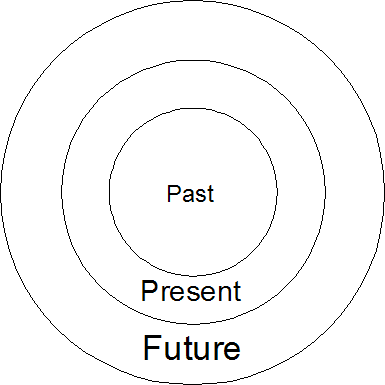
.
.
– Me, Inspired by Richard Koch’s The 80/20 Principle
.
.
.
2008.11.11 Tuesday (c) All rights reserved by ACHK

Cumulative concept of time | 累積時間觀
.
.
Wrong: past –> present –> future
.
.
Right:
.
.
– Me, Inspired by Richard Koch’s The 80/20 Principle
.
.
.
2008.11.11 Tuesday (c) All rights reserved by ACHK
In quantum field theory, Grassmann numbers are the “classical analogues” of anticommuting operators. They are used to define the path integrals of fermionic fields.
— Wikipedia on Grassmann number
2013.07.31 Wednesday ACHK
… T-duality interchanges the usual Neumann boundary conditions with Dirichlet boundary conditions …
— Wikipedia on D-brane
2013.07.30 Tuesday ACHK
We can consider the existence of D-branes to be a consequence of the symmetry of T-duality.
— String Theory Demystified, p.165
— David McMahon
2013.07.27 Saturday ACHK
Brian Greene continues with all the delusions and delusions, infrequently spiced with a correct proposition. The Big Bang created the arrow of time (the latter has nothing to do with the laws of physics), holy cow. “We don’t know why the Universe started in a low-entropy state,” holy cow. We perfectly know why it did. If it started with a state of a high entropy, we could always ask “what was before that”. The only thing that prevents us from going before a moment is that the moment has the minimal mathematically possible value of the entropy, namely zero.
— The Fabric of the Cosmos II
— Lubos Motl
2013.07.25 Thursday ACHK
Open strings and D-branes
T-duality acting on D-branes changes their dimension by +1 or -1.
— Wikipedia on T-duality
2013.07.24 Wednesday ACHK
And listen to your customers.
— Eric S. Raymond
At any rate, I learned the lesson. When one discovers something significant, it is best to publish it promptly and not wait to incorporate it into some grander scheme.
— John A. Wheeler
2013.07.21 Sunday ACHK
And as we have explained many times, the results of this inference – the retrodictions – always depend on our priors. So the knowledge of the present is enough to calculate the future (classically) or to predict the unique probabilities of various states in the future (quantum mechanically). But it is simply never enough to calculate the unique state or unique probabilities of various states in the past.
The reason has been explained many times. But we can say that at least in the macroscopic context (when some microscopic detailed information is being omitted, e.g. because it’s unmeasurable), different initial states “A,B” in the past may evolve into the same final state “C” in the future.
— Logical arrow of time and terminology
— Lubos Motl
2013.07.20 Saturday ACHK
upgrade, downgrade, left-grade, right-grade
— Me@2013-07-09 11:30:15 AM
In case you cannot upgrade your life right now, but do not want to downgrade, you can try left-grade or right-grade.
— Me@2013-07-15 02:33:03 PM
2013.07.15 Monday (c) All rights reserved by ACHK
Two dimensional time 5 | 二次元時間 5
You are the main author of your future.
In a special sense, the real-present is the meta-time of the potential future timelines, selecting the future among multiple possible timelines.
— Me@2013-07-11 3:48 PM
2013.07.15 Monday (c) All rights reserved by ACHK
Myth: The breakdown of the usual geometric intuition near the Planck scale – sometimes nicknamed the “minimum length” – implies that the length, area, and other geometric observables have to possess a discrete spectrum.
Reality: This implication is incorrect. String theory is a clear counterexample: distances shorter than the Planck scale (and, perturbatively, even the string scale) cannot be probed because there exist no probes that could distinguish them. Consequently, the scattering amplitudes become very soft near the Planck scale and the divergences disappear.
However, there is no discreteness of geometric quantities – such as the radii of compact circles in spacetime. And general “intervals” or “surfaces” inside the spacetime can’t even be localized with the Planckian precision which is also why their proper lengths and areas, assuming their better-than-Planckian accuracy, are not even well-defined observables in string theory: what can’t be measured operationally often can’t be defined theoretically, either. ;-)
— Myths about the minimal length
— Lubos Motl
2013.07.14 Sunday ACHK
Paradox 5.5 | Meta-time 4.5 | Cumulative concept of time, 13.5 | Two dimensional time 4.4 | 二次元時間 4.4
To be logically consistent WITHIN the movie’s story, Young Joe (in the year 2044) should not be able to influence Old Joe, who had time-travelled to the year 2044 from the year 2074,because that Old Joe is from another timeline. The proof is that Young Joe’s experience in the year 2044 is different from Old Joe’s experience in the year 2044 when he was young.
They are not the same person, nor the same person at different ages within the same timeline. At most, they are different versions of the “same” person from two different timelines (aka “parallel universes” or “histories”).
Young Joe’s changes should affect the same-timeline-Old-Joe, but not any Old Joe’s from any other timelines. So the Old Joe within the movie should not have been affected when Young Joe hurt himself.
Also, the changes of the same-timeline-Old-Joe due to the actions of Young Joe should be seen only by the author (meta-time), but not by Young Joe until he has become that Old Joe 30 years later.
The author unintentionally, or intentionally, has confused two story timelines. Moreover, the author unintentionally, or intentionally, has confused the story-time and its meta-time.
— Me@2013-07-05 10:32 PM
2013.07.11 Thursday (c) All rights reserved by ACHK
Paradox 5.4 | Meta-time 4.4 | Cumulative concept of time, 13.4 | Two dimensional time 4.3 | 二次元時間 4.3
In a single-mutable-timeline time travel story, the two dimensional time is not due to the internal causal structure of the story. Instead, it is due to the author’s timeline (aka meta-time). The author’s timeline is the second time dimension (aka independent direction).
The single-mutable-timeline model of time travel is not logically consistent within the story. If it is “mutable”, it is not “single”.
The single-mutable-timeline model of time travel is logically consistent only outside the story, from the perspective of the story’s author.
— Me@2013-07-02 3:47 PM
2013.07.09 Tuesday (c) All rights reserved by ACHK
Paradox 5.3 | Meta-time 4.3 | Cumulative concept of time, 13.3 | Two dimensional time 4.2 | 二次元時間 4.2
In the movie Looper, Young Joe (in the year 2044) influences Old Joe (in the year 2074) in the sense that Young Joe’s every action affects the state of Old Joe, because Old Joe is Young Joe’s future self.
For example, after Young Joe had hurt his own arm, the corresponding wound also appeared on Old Joe’s arm, even though Old Joe had already time-travelled back to the year 2044.
All of Young Joe’s actions are the causes of Old Joe’s state. Young Joe is in the past of Old Joe.
Old Joe (2074-Joe) = [ …, Young Joe (2044-Joe), … ]
B = [ …, A, … ]
However, Old Joe (2074-Joe) had time-travelled back to the year 2044, meeting the Young Joe.
So, some of Old Joe’s actions would affect Young Joe’s decisions on his own actions. In this sense, Old Joe also influences Young Joe indirectly. Some of Old Joe’s actions are the causes of Young Joe’s state. Part of Old Joe is also in the past of Young Joe.
Young Joe (2044-Joe) = [ …, Old Joe (2074-Joe), … ]
A = [ …, B, … ]
However, it is logically impossible to have both
B is in the past of A
and
A is in the past of B
just as it is logically almost impossible to have both
D is a part of C
and
C is a part of D
If you insist that it is the case, the only possibility is that
C = D
In this analogy, neither C nor D is really a “part” of another. In the time travel case, neither A nor B is really in the past of another. In other words, A (Young Joe) and B (Old Joe) have no time relationship. Neither’s actions are the causes of the state of another.
The real causes of Young Joe or Old Joe’s states are actually not within the movie story’s timeline. The real causes are the decisions of the author of the story.
— Me@2013-07-03 6:19 PM
2013.07.08 Monday (c) All rights reserved by ACHK
Paradox 5.2 | Meta-time 4.2 | Cumulative concept of time, 13.2 | Two dimensional time 4.1 | 二次元時間 4.1
In a “if and only if” case, there is no time.
If A is a necessary condition of B, we say “A is a cause of B“. In other words, A is in the past of B.
However, in some time travel story, it is “possible” to have both
A is a cause of B
(A is a necessary condition of B)
(B -> A)
and
B is a cause of A
(B is also a necessary condition of A)
(A -> B)
In this case, A and B are just equivalent.
(A B)
Neither is in the past of another. A and B have no causal relationship. In this sense, there is no time.
— Me@2013-07-03 6:19 PM
2013.07.05 Friday (c) All rights reserved by ACHK
Since a general wave (or wavelike phenomenon) need not embody the causal flow of any physical effects, there is obviously there is no upper limit on the possible phase velocity of a wave. However, even for a “genuine” physical wave, i.e., a chain of sequentially dependent events, the phase velocity does not necessarily correspond to the speed at which energy or information is propagating. This is partly a semantical issue, because in order to actually convey information, a signal cannot be a simple periodic wave, so we must consider non-periodic signals, making the notion of “phase” somewhat ambiguous. If the wave profile never exactly repeats itself, then arguably the “period” of the signal must be the entire signal. On this basis we might say that the velocity of the signal is unambiguously equal to the “phase velocity”, but in this context the phase velocity could only be defined as the speed of the leading (or trailing) edge of the overall signal.
— Phase, Group, and Signal Velocity
— mathpages
2013.07.02 Tuesday ACHK
The second-order correlations and linear responses of various physical systems have a fundamental relation, formulated as fluctuation-dissipation theorem.
— Professor Renbao Liu
While the fluctuation-dissipation theorem provides a general relation between the response of equilibrium systems to small external perturbations and their spontaneous fluctuations, no general relation is known for systems out of equilibrium.
— Wikipedia on Fluctuation-dissipation theorem
2013.07.01 Monday ACHK
Cumulative concept of time, 15
In 1895, in his novel, The Time Machine, H.G. Wells wrote, “There is no difference between time and any of the three dimensions of space except that our consciousness moves along it.”
— Wikipedia on Spacetime
Consciousness “moves” from the past to the future because consciousness is a kind of reflection.
To be conscious, one has to access its own states. But only the past states are available. Accessing one’s own now-here state is logically impossible, because that creates a metadox (paradox).
— Me@2013-06-26 02:28:51 PM
We can remember the past but not the future because the past is part of the future; the whole contains its parts, but not vice versa.
— Me@2011.08.21
2013.06.29 Saturday (c) All rights reserved by ACHK
[The fluctuation-dissipation theorem (FDT) is a] fundamental result in statistical physics which links microscopic (thermal) fluctuations with the macroscopic property that creates a drag force on a particle in a medium.
— by Zap
— Thu May 09 2002 at 16:48:10
— Everything2
The fluctuation-dissipation theorem (FDT) is a powerful tool in statistical physics for predicting the behavior of non-equilibrium thermodynamical systems. These systems involve the irreversible dissipation of energy into heat from their reversible thermal fluctuations at thermodynamic equilibrium.
— Wikipedia on Fluctuation-dissipation Theorem
2013.06.28 Friday ACHK
“The past cannot be changed” is a tautology, because “cannot be changed” is included in the meaning of the word “past“.
Similarly, “the future is not fixed” is also a tautology.
Anything you cannot change is within your past.
Anything you can change is within your future.
— Me@2013-06-23 3:40 PM
— Me@2013-06-26 10:40 AM
2013.06.26 Wednesday (c) All rights reserved by ACHK
 Physics Town
You must be logged in to post a comment.