Research is directionless, whereas development has a specific goal.
— Ken Thompson
2013.02.15 Friday ACHK

Research is directionless, whereas development has a specific goal.
— Ken Thompson
2013.02.15 Friday ACHK
Due to the Principle of Equivalence gravitational effects are locally indistinguishable from inertial effects, …
— Wikipedia on Frame-dragging
2013.02.12 Tuesday ACHK
An object cannot change another without being changed, because the object’s identity is partially defined and determined by its environment.
— Me@2013.02.01
2013.02.11 Monday (c) All rights reserved by ACHK
Rotational frame-dragging (the Lense–Thirring effect) appears in the general principle of relativity and similar theories in the vicinity of rotating massive objects. Under the Lense–Thirring effect, the frame of reference in which a clock ticks the fastest is one which is revolving around the object as viewed by a distant observer.
This also means that light traveling in the direction of rotation of the object will move past the massive object faster than light moving against the rotation, as seen by a distant observer. It is now the best known effect, partly thanks to the Gravity Probe B experiment.
Qualitatively, frame-dragging can be viewed as the gravitational analog of electromagnetic induction.
— Wikipedia on Frame-dragging
2013.02.09 Saturday ACHK
 |
| This is a file from the Wikimedia Commons. |
2013.02.07 Thursday ACHK
A classical state is the most quantum state, because once position is definite, the momentum uncertainty is infinite.
— Quantum Mechanics 2009
— LIU Renbao
2013.02.05 Tuesday (c) All rights reserved by ACHK
A unit is the definition of “one” in a particular context.
— Me@2013.02.02
universe ~ take everything as one
— Me@2013.02.04
2013.02.04 Monday (c) All rights reserved by ACHK
over ~ finished ~ transcended
— Me@2013-02-01 01:54:02 PM
Finishing is one of the two methods of transcending. For example, once you have earned enough money, you would never have to worry about money anymore.
Finishing is more time-consuming and should be avoided if possible. But sometimes, it is necessary.
— Me@2013-02-03 02:02:07 PM
2013.02.04 Monday (c) All rights reserved by ACHK
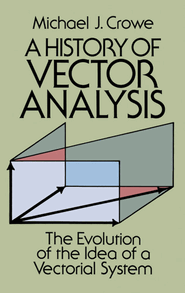
A History of Vector Analysis: The Evolution of the Idea of a Vectorial System
— (Dover Books on Mathematics)
— by Michael J. Crowe
Summary of book
The book has eight chapters: the first on the origins of vector analysis including Ancient Greek and 16th and 17th century influences; the second on the 19th century William Rowan Hamilton and quaternions; the third on other 19th and 18th century vectorial systems; the fourth on the general interest in the 19th century on vectorial systems including analysis of journal publications as well as sections on major figures and their views (e.g., Peter Guthrie Tait as an advocate of Quaternions and James Clerk Maxwell as a critic of Quaternions); the fifth on Josiah Willard Gibbs and Oliver Heaviside and their development of a modern system of vector analysis.
— Wikipedia on A History of Vector Analysis
2013.02.02 Saturday ACHK
No-cloning in a classical context
There is a classical analogue to the quantum no-cloning theorem, which we might state as follows: given only the result of one flip of a (possibly biased) coin, we cannot simulate a second, independent toss of the same coin. The proof of this statement uses the linearity of classical probability, and has exactly the same structure as the proof of the quantum no-cloning theorem.
Thus if we wish to claim that no-cloning is a uniquely quantum result, some care is necessary in stating the theorem. One way of restricting the result to quantum mechanics is to restrict the states to pure states, where a pure state is defined to be one that is not a convex combination of other states. The classical pure states are pairwise orthogonal, but quantum pure states are not.
— Wikipedia on No-cloning theorem
2013.01.30 Wednesday ACHK
You should not apply a single-particle wavefunction to Schrodinger’s cat. Instead, you should either use classical physics or use a wavefunction for all the particles of the cat.
— Me@2013-01-23 10:25:00 AM
The uncertainty in Schrodinger’s cat’s life or death problem is classical uncertainty, not quantum uncertainty. For an observer outside the box, the cat is in a mixed state, not just a superposition of quantum eigenstates. The probability in a mixed state is classical, not quantum.
— Me@2013-01-27 09:59:13 AM
2013.01.27 Sunday (c) All rights reserved by ACHK
Is Energy Conserved in General Relativity?
In special cases, yes. In general — it depends on what you mean by “energy”, and what you mean by “conserved”.
…
We will not delve into definitions of energy in general relativity such as the hamiltonian (amusingly, the energy of a closed universe always works out to zero according to this definition), various kinds of energy one hopes to obtain by “deparametrizing” Einstein’s equations, or “quasilocal energy”. There’s quite a bit to say about this sort of thing! Indeed, the issue of energy in general relativity has a lot to do with the notorious “problem of time” in quantum gravity. . . but that’s another can of worms.
— Original by Michael Weiss and John Baez
2013.01.26 Saturday ACHK
an eigenstate = a microscopic “definite” state = a microscopic-classical state = a microscopic state corresponding to a macroscopic state
a microscopic state = a quantum state = an eigenstate or a superposition of eigenstates
A superposition state is not corresponding to any particular macroscopic state.
a macroscopic state = a definite state = a classical state
A macroscopic-classical state, in turn, is a superposition of a lot of microscopic states. A classical state is a superposition of a lot of quantum states.
— Me@2013-01-22 09:26:31
2013.01.23 Wednesday (c) All rights reserved by ACHK
On the other hand, he must make sure that the splitting of the worlds occurs as soon as decoherence is over. But the “moment” when decoherence is over isn’t sharply defined. Decoherence is never “absolute”. Decoherence is a continuous process that becomes “almost totally complete” after a certain time scale but it is never complete.
— Hugh Everett’s many worlds interpretation of QM
— Lubos Motl
2013.01.22 Tuesday ACHK
多重小宇宙 1.2 | 二次元時間 2.6 | Dimension 1.3.6 | Two dimensional time 2.6 | A little bit of yourself, 2 | 心靈互聯網 2 | Mind Internet 2
這段改編自 2010 年 4 月 3 日的對話。
但是,記住,那只能作比喻,而並不是實情,因為所有的「主觀時間線」,都會同時影響和受制於同一條「客觀時間線」。任何兩個人,即使從不相遇,兩條「主觀時間線」永不相交,他們的人生歷程,也不可能百分百互不相干。任何一條「主觀時間線」,都不如我所講的「平行宇宙」一般,有機會獨立存在。
不過,你這個講法雖然不是鉅細無遺,但是極度有用,因為它帶出了一個超級重點。現實世界的時間,雖然只有一個次元,但那一個次元,就已經足夠難明了。
剛才我把「一次元時間」講成一條「時間線」或者「因果鏈」,只是為了方便簡化。實情是,「時間」是一個「因果網絡」。意思是,「因」和「果」並不是一一對應。一個「因」,可以引發多個「果」;而一個「果」,又可以來自多個「因」。比喻說,一個學生,會有很多老師;而一個老師,又會有很多學生。「一因多果」和「一果多因」,可以統稱為「多重對應」。
你「現實版二次元主觀時間」的講法,雖然不是分毫不差,但是可信可用,因為,現實世界的「因」和「果」,是「多重對應」的。
— Me@2013.01.21
時間者
因果網絡也
— Me@2007.09.17
2013.01.21 Monday (c) All rights reserved by ACHK
二次元時間 2.5 | Dimension 1.3.5 | Two dimensional time 2.5 | 孖生宇宙 2.5
這段改編自 2010 年 4 月 3 日的對話。
(安:你剛才提到:
「
所以,我剛才視「多重宇宙標籤」為「第二個時間」次元,是建基於「平行宇宙機」的假設。那個科幻故事的主角,發明了「平行宇宙機」,令到自己可以,由原本的宇宙(甲),走到另一個宇宙(乙)行事。那樣,「宇宙甲」的歷史,就可以透過主角,影響到「宇宙乙」的演化,反之亦然。
」
依你這個講法,除了在科幻小說外,日常現實生活中 —— 如果用比喻 —— 都會有「二次元時間」的現象。)
什麼意思?
(安:那是我將今天討論過的句子,重新組合後的化學作用,奇幻想法:
1. 一個宇宙,有一個「時間次元」,即是有一條「時間線」。「時間線」又可以稱為「因果鏈」。
2. 宇宙的次元數目是「三加一」,即是「『三次元空間』加『一次元時間』」。
3. 我剛才視「多重宇宙標籤」為「第二個時間」次元,是建基於「平行宇宙機」的假設。那個科幻故事的主角,發明了「平行宇宙機」,令到自己可以,由原本的宇宙(甲),走到另一個宇宙(乙)行事。那樣,「宇宙甲」的歷史,就可以透過主角,影響到「宇宙乙」的演化,反之亦然。
雖然,這個宇宙,客觀的時間次元只有一個,即是「客觀時間線」只有一條;但是,這個宇宙中的每一個人,其實各自都有一條「主觀時間線」,因為每人都有自己的歷史發展進程。例如,如果甲乙二人,老死不相往來,他們的「主觀時間線」就永不相交。他們各自的「因果鏈」,就可以視為兩個互不相干的微型「宇宙」,簡稱「平行小宇宙」。
但是,如果甲乙相遇,而相處起來,他們每人的說話和行動,就會影響到對方未來的人生演化。「因」和「果」,未必再局限於同一個人,同一條「主觀時間線」上出現。原本的「平行小宇宙」,不再完全「平行」。所以,要改稱為「多重小宇宙」。
那樣,要指清一件事件時,除了要指出它發生的時間 —— 例如「2013 年 1 月 14 日 5 時 20 分」—— 外 ,還要講清楚,它發生在哪一個「小宇宙」的「2013 年 1 月 14 日 5 時 20 分」。換句話說,你要講清楚,哪個人做了哪件事(因),而導致另一個人去做哪件事(果)。原本的時間標籤 —— 哪時 —— 是「第一個時間次元」;而多重宇宙的標籤 —— 哪人 —— 則可以視為「第二個時間次元」。
例如,醫生甲在 2013 年 1 月 14 日,開了藥給病人乙。病人乙於一星期後,2013 年 1 月 21 日痊癒:
… –> (2013 年 1 月 14 日,醫生甲)開藥 –> (導致)(2013 年 1 月 21 日,病人乙)痊癒 –> …
)
可以這樣說。但是,記住,那只能作比喻,而並不是實情,因為所有的「主觀時間線」,都會同時影響和受制於同一條「客觀時間線」。任何兩個人,即使從不相遇,兩條「主觀時間線」永不相交,他們的人生歷程,也不可能百分百互不相干。任何一條「主觀時間線」,都不如我所講的「平行宇宙」一般,有機會獨立存在。
— Me@2013.01.19
2013.01.19 Saturday (c) All rights reserved by ACHK
The modern picture paints the vacuum as “something in between” the ancient pictures in which the objects may influence others “directly”; and the picture that requires a “material in between” for the interactions to occur. Moreover, quantum field theory shows that every field force has a particle (quantum of the field such as the photon) and every particle is associated with a field that influences the interactions between other particles (e.g. because of virtual electrons, quanta of the Dirac field).
— All interactions in the Universe
— Lubos Motl
2013.01.18 Friday ACHK
Looper, 2.2 | 二次元時間 2.4 | Dimension 1.3.4 | Two dimensional time 2.4 | 孖生宇宙 2.4
這段改編自 2010 年 4 月 3 日的對話。
而《Looper》作者自己的時間線,則可以視為《Looper》故事本身的「第三個時間次元」。一般而言,由構思故事到完成劇本,通常也不會一筆過,而會反覆修改。換而言之,那是一個演變的過程:
《Looper》故事版本一 –>(影響)《Looper》故事版本二 –>(影響)《Looper》故事版本三 –> … …
製在《Looper》這部電影時,作者很多時會和製作人員討論劇情。指清故事中的事件時,作者就需要講明,他所討論的那個事件,發生在「哪一個版本」中的「哪一個平行宇宙」中的「哪一點時間」,例如:
(故事版本二,宇宙三,2017 年 5 月 10 日)
亦即是話,作者需要有三個時間坐標數字,才可以「設置」,或者「定位」一個事件。
— Me@2013.01.18
2013.01.18 Friday (c) All rights reserved by ACHK
Single-world interpretation, 7.4
…
What if I have a microscopic measuring device, B, as a “quantum observer”?
If a particle A is in a superposition of eigenstates, another particle B, as a micro-observer, can also be in a superposition of eigenstates, before or after the observation.
An observation on A by B is an interaction between A and B.
If after the observation/interaction, B is in a superposition, what would B see? Would it see A as in a superposition? Or would it see A as in one of the eigenstates?
It depends on whether you regard individual eigenstates of the resulting B as individual particles “B1, B2, …” in multiple “worlds”, or you regard the superposition of all eigenstates of the resulting B as one single particle in this single universe. In other words, it depends on how you use the label “B”.
The identification of particle B as the superposition of all its eigenstates is more reasonable, because that is compatible with the meaning of the word “observer” in ordinary quantum mechanics. In ordinary quantum mechanics, an observer is a measuring device. A measuring device is a macroscopic object, following classical physical laws. If we have to express the classical laws in terms of quantum mechanics, we say that each classical state of that macroscopic object is a superposition of a lot of quantum states of a lot of the constituent particles.
Classical objects follow the Principle of Least Action, which is due to the superposition of a lot of microstates of the particles. If there is no quantum superposition, there is no Principle of Least Action. Classical mechanics does not work.
— Me@2013.01.14
2013.01.17 Thursday (c) All rights reserved by ACHK
In both social and natural sciences, the body of positive knowledge grows by the failure of a tentative hypothesis to predict phenomena the hypothesis professes to explain; by the patching up of that hypothesis until someone suggests a new hypothesis that more elegantly or simply embodies the troublesome phenomena, and so on ad infinitum.
— Inflation and Unemployment
— Nobel Memorial Lecture, December 13, 1976
— Milton Friedman
2013.01.17 Thursday ACHK
 Physics Town
You must be logged in to post a comment.