Spinors, 2

Spinors are objects with a spinor index and in some very particular sense, a spinor index is exactly one-half of a vector index. So the generalized tensors may have either an integral number of indices or they may also have a half-integral number of indices! In a very clever sense, a spinor is a square root of a vector in the same sense as a vector is a square root of a tensor with two indices. How is it possible that we may break letters (indices) into pairs of letters?

— Why are there spinors?

— Lubos Motl

2012.07.30 Monday ACHK

Wheeler–DeWitt equation, 2

This wave function contains all of the information about the geometry and matter content of the universe.

In fact, the principle of general covariance in general relativity implies that global evolution per se does not exist; the time t is just a label we assign to one of the coordinate axes. Thus, what we think about as time evolution of any physical system is just a gauge transformation, similar to that of QED induced by U(1) local gauge transformation , where plays the role of local time.

— Wikipedia on Wheeler–DeWitt equation

2012.07.29 Sunday ACHK

Weinberg–Witten theorem

In theoretical physics, the Weinberg–Witten theorem (WW), proved by Steven Weinberg and Edward Witten, states that massless particles (either composite or elementary) with spin j > 1/2 cannot carry a Lorentz-covariant current, while massless particles with spin j > 1 cannot carry a Lorentz-covariant stress-energy. The theorem is usually interpreted to mean that the graviton (j = 2) cannot be a composite particle in a relativistic quantum field theory.

Theories where the theorem is inapplicable

Superstring theory

Superstring theory defined over a background metric (possibly with some fluxes) over a 10D space which is the product of a flat 4D Minkowski space and a compact 6D space has a massless graviton in its spectrum. This is an emergent particle coming from the vibrations of a superstring.

— Wikipedia on Weinberg–Witten theorem

2012.07.27 Friday ACHK

Spontaneous symmetry breaking

Physicists use the term “spontaneous symmetry breaking” when any one solution of a symmetric problem is not symmetrical, but the whole set of them is. This is precisely what happens with the quintic, or even the quadratic equation.

— January 10, 2004

— This Week’s Finds in Mathematical Physics (Week 201)

— John Baez

2012.07.26 Thursday ACHK

Grassmann, 3

The motivation of Grassmann algebra is

to re-use the boson formulae in fermion calculations

by re-interpretating the symbols as Grassmann variables.

— Me@2012.03.06

2012.07.25 Wednesday (c) All rights reserved by ACHK

Anthropic principle, 3

The correct version of anthropic principle should be called the anti-anthropic principle, or the law of large numbers:

given a large enough sample size, the probability of a sample fulfilling your requirements is close to 1.

— Me@2012.03.06

2012.07.23 Monday (c) All rights reserved by ACHK

Newton’s Third Law

Newton used the third law to derive the law of conservation of momentum; however from a deeper perspective, conservation of momentum is the more fundamental idea (derived via Noether’s theorem from Galilean invariance), and holds in cases where Newton’s third law appears to fail, for instance when force fields as well as particles carry momentum, and in quantum mechanics.

— Wikipedia on Newton’s laws of motion

2012.07.18 Wednesday ACHK

Permutation City

Permutation City is a 1994 science fiction novel by Greg Egan that explores many concepts, including quantum ontology, via various philosophical aspects of artificial life and simulated reality.

— Wikipedia on Permutation City

2012.07.10 Tuesday ACHK

Number theory

Lately James Dolan and I have been studying number theory. I used to hate this subject: it seemed like a massive waste of time. Newspapers, magazines and even lots of math books seem to celebrate the idea of people slaving away for centuries on puzzles whose only virtue is that they’re easy to state but hard to solve.

Sure, it’s noble to seek knowledge for its own sake. But working on a math problem just because it’s hard is like trying to drill a hole in a concrete wall with your nose, just to prove you can! If you succeed, I’ll be impressed – but I’ll still wonder why you didn’t put all that energy into something more interesting.

Now my attitude has changed, because I’m beginning to see that behind these silly hard problems there lurks an actual theory, full of deep ideas and interesting links to other branches of mathematics, including mathematical physics.

— January 10, 2004

— This Week’s Finds in Mathematical Physics (Week 201)

— John Baez

2012.07.08 Sunday ACHK

Analytic continuation, 4

In complex analysis, a branch of mathematics, analytic continuation is a technique to extend the domain of a given analytic function. Analytic continuation often succeeds in defining further values of a function, for example in a new region where an infinite series representation in terms of which it is initially defined becomes divergent.

— Wikipedia on Analytic continuation

2012.06.22 Friday ACHK

Mass in Relativity, 2

Defining mass in general relativity: concepts and obstacles

Generalizing this definition to general relativity, however, is problematic; in fact, it turns out to be impossible to find a general definition for a system’s total mass (or energy). The main reason for this is that “gravitational field energy” is not a part of the energy-momentum tensor; instead, what might be identified as the contribution of the gravitational field to a total energy is part of the Einstein tensor on the other side of Einstein’s equation (and, as such, a consequence of these equations’ non-linearity).

While in certain situation it is possible to rewrite the equations so that part of the “gravitational energy” now stands alongside the other source terms in the form of the Stress-energy-momentum pseudotensor, this separation is not true for all observers, and there is no general definition for obtaining it.

— Wikipedia on Mass in general relativity

2012.06.17 Sunday ACHK

Mass in Relativity

Concisely, the mass of a system in special relativity is the norm of its energy-momentum four vector.

Note that mass is computed as the length of the energy-momentum four vector, which can be thought of as the energy and momentum of the system “at infinity”.

Note that in General Relativity, gravity is caused not by mass, but by the stress-energy tensor. Thus, saying that a moving particle has “more gravity” does not imply that the particle has “more mass”. It only implies that the moving particle has “more energy”.

Because General Relativity is a diffeomorphism invariant theory, it has an infinite continuous group of symmetries rather than a finite-parameter group of symmetries, and hence has the wrong group structure to guarantee a conserved energy.

Noether’s theorem has been extremely influential in inspiring and unifying various ideas of mass, system energy, and system momentum in General Relativity.

— Wikipedia on Mass in general relativity

2012.06.16 Saturday ACHK

Relativity

The theory appeared to me then, and it still does, the greatest feat of human thinking about nature, the most amazing combination of philosophical penetration, physical intuition, and mathematical skill…  It appealed to me like a great work of art …

— Max Born

2012.06.14 Thursday ACHK

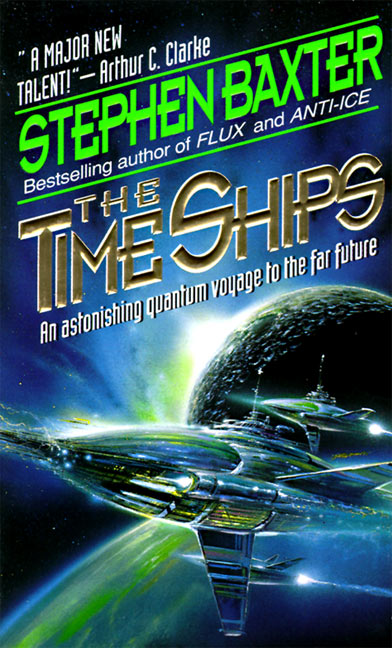
The Time Ships

The Time Ships is a 1995 science fiction novel by Stephen Baxter. A sequel to The Time Machine by H. G. Wells, it was officially authorized by the Wells estate to mark the centenary of the original’s publication. It won the John W. Campbell Memorial Award and the Philip K. Dick Award in 1996, as well as the British Science Fiction Association Award in 1995. It was also nominated for the Hugo, Clarke, and Locus Awards in 1996.

— Wikipedia on The Time Ships

2012.06.13 Wednesday ACHK

Information lost, 3.2

Information conservation

There is another very subtle law of physics that may be even more fundamental than energy conservation.

It’s sometimes called reversibility, but let’s just call it information conservation.

Information conservation implies that if you know the present with perfect precision, you can predict the future for all time.

But that’s only half of it. It also says that if you know the present, you can be absolutely sure of the past. It goes in both directions.

— The Black Hole War, p.87

— Leonard Susskind

2012.06.12 Tuesday ACHK

Emergent space and emergent time

General relativity has taught us that space and time should not be thought of as a static arena for other phenomena. Instead, they are dynamical players: the curvature of space and time tells matter how it should move, and matter influences spacetime’s curvature. But the lesson of quantum gravity and string theory in particular is more far-reaching: space and time do not have to exist at the very beginning – they are kind of illusions. Moreover, there can be many different illusionary geometries that emerge if we look at the same physical system.

Quantum mechanics guarantees that the concept of a completely smooth geometry is incompatible with quantum mechanics that make things fluctuate. But string theory goes much further. Geometric descriptions, such as general relativity, are only approximations valid at very long distances. At very short distances, comparable to the “length of the string” (string scale) or “the smallest meaningful black hole” (the Planck scale), physics does not admit a simple description in terms of usual geometry. Geometry is generalized to something much more grandiose, and the difference between geometry and matter disappears – this is the content of unification of gravity with other forces and matter.

— Emergent space and emergent time

— Lubos Motl

2012.06.01 Friday ACHK