Hadron

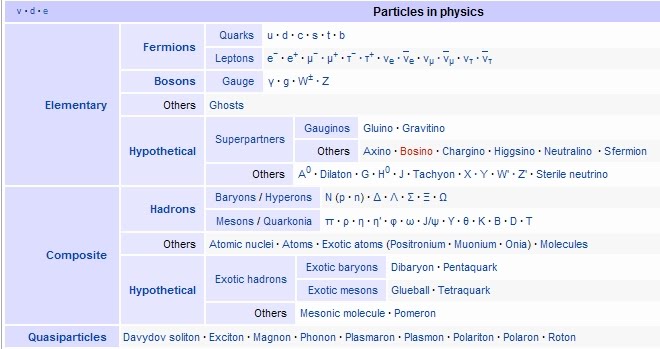
In particle physics, a hadron (pronounced /?hadr?n/, from the Greek: ?δρ??, hadros, “stout, thick”) is a composite particle made of quarks held together by the strong force (similarly to how atoms and molecules are held together by the electromagnetic force). Hadrons are categorized into two families: baryons (made of three quarks), and mesons (made of one quark and one antiquark).

Note that the mass of a hadron has very little to do with the mass of its valence quarks; rather, due to mass–energy equivalence, most of the mass comes from the large amount of energy associated with the strong interaction.

— Wikipedia on Hadron

2010.07.22 Thursday ACHK
M-theory 3

In late 2007, Bagger and Lambert set off renewed interest in M-theory with the discovery of a candidate Lagrangian description of coincident M2-branes, based on a non-associative generalization of Lie Algebra, Nambu 3-algebra or Filippov 3-algebra. Practitioners hope the Bagger-Lambert-Gustavsson action will provide the long-sought microscopic description of M-theory.

— Wikipedia on M-theory

2010.07.20 Tuesday ACHK

Open strings and closed strings

Superstring theory 4

String theory includes both open strings, which have two distinct endpoints, and closed strings making a complete loop. The two types of string behave in slightly different ways, yielding two different spectra. For example, in most string theories, one of the closed string modes is the graviton, and one of the open string modes is the photon. Because the two ends of an open string can always meet and connect, forming a closed string, there are no string theories without closed strings.

— Wikipedia on String theory

2010.07.19 Monday ACHK

Strangeness

In particle physics, strangeness S is a property of particles, expressed as a quantum number, for describing decay of particles in strong and electromagnetic reactions, which occur in a short period of time. The strangeness of a particle is defined as:

where represents the number of strange quarks (s) and represents the number of strange antiquarks .

— Wikipedia on Strangeness

2010.07.18 Sunday ACHK

Superstring theory 3

Superstring theory is an attempt to explain all of the particles and fundamental forces of nature in one theory by modelling them as vibrations of tiny supersymmetric strings. Superstring theory is a shorthand for supersymmetric string theory because unlike bosonic string theory, it is the version of string theory that incorporates fermions and supersymmetry. Here, the word “super” has the meaning of super-symmetry.

— Wikipedia on Superstring theory

2010.07.17 Saturday ACHK

Superstring theory 2

Number of superstring theories

Theoretical physicists were troubled by the existence of five separate string theories. …

Please note that the number of superstring theories given above is only a high-level classification; the actual number of mathematically distinct theories which are compatible with observation and would therefore have to be examined to find the one that correctly describes nature is currently believed to be at least 10^500 (a one with five hundred zeroes).

— Wikipedia on Superstring theory

2010.07.16 Friday ACHK

Quotient space

In topology and related areas of mathematics, a quotient space (also called an identification space) is, intuitively speaking, the result of identifying or “gluing together” certain points of a given space. The points to be identified are specified by an equivalence relation. This is commonly done in order to construct new spaces from given ones.

— Wikipedia on Quotient space

2010.07.11 Sunday ACHK

Regge theory

In quantum physics, Regge theory is the study of the analytic properties of scattering as a function of angular momentum, where the angular momentum is not restricted to be an integer but is allowed to take any complex value. The nonrelativistic theory was developed by Tullio Regge in 1957.

— Wikipedia on Regge theory

2010.07.10 Saturday ACHK

Mesons and baryons

In particle physics, mesons are subatomic particles composed of one quark and one antiquark. They are part of the hadron particle family — particles made of quarks. The other members of the hadron family are the baryons — subatomic particles composed of three quarks. The main difference between mesons and baryons is that mesons are bosons while baryons are fermions …

— Wikipedia on Meson

2010.07.08 Thursday ACHK

Knots

Now the role played by knots in fundamental physics seems so important that we might even guess that the reason space has three dimensions is that it is the only number of dimensions within which you can tie knots in strings.

— Event-Symmetric Space-Time

— P. Gibbs

2010.07.07 Wednesday ACHK

網誌結構

天界

物理

人間

— Me@2010.07.05

Physics 連接天界與人間.

–- Me@2009.10.17

2010.07.06 Tuesday (c) All rights reserved by ACHK

Rejecta Mathematica

Rejecta Mathematica is an online journal for publishing papers that have been rejected by other mathematics journals such as Annals of Mathematics. Each paper is accompanied by an open letter describing why the paper was rejected, how the topic has been developed since and why it is worthy of publication.

— Wikipedia on Rejecta Mathematica

2010.07.05 Monday ACHK

事業愛情觀

任何學問或專業,如果要有成就的話,就要全天候想著它。

You brain has to be alway-on.

假如,我的學問專業是「物理」。如果要有成就的話,就要全天候想著它。

「全天候想著『物理』」的意思並不是指,在所有時間的任何一秒中,都在「研習物理」。「全天候想著『物理』」的意思是,即使我一天只有 4 小時是,直接用來「研習物理」的,我的整個生活都會以「物理」為重心:我的日程表(schedule)中的其他東西,都會圍繞住「物理」來運行。

假如,我的學問專業是「寫作」。如果要有成就的話,就要全天候想著它。

「全天候想著『寫作』」的意思並不是指,在每天的 24 小時中,也在「寫作」。「全天候想著『寫作』」的意思是,即使我一天只有 1 小時是,直接用來「寫作」的,我的整個生活都會以「寫作」為核心:其餘的 23 小時,我都會打開腦中的「靈感天線」。每逢「接收」到「新創見」時,我都會立刻寫下,因為靈感可能瞬間即逝。

比喻說,假如,我結了婚的話,我會全天候想著我的妻子。

「全天候想著妻子」的意思並不是指,在每天的 24 小時中,也會見到她,也會和她在一起。「全天候想著妻子」的意思是,我的整個生活都會,以我的妻子為中心:做(幾乎)任何決定時,也會先考慮她的感受。

— Me@2010.07.04

.

.

2010.07.04 Sunday (c) All rights reserved by ACHK

Negative specific heat

In fact, it’s typical for a gravitationally bound system to have a negative specific heat. Imagine a satellite so low that it starts running into the earth’s atmosphere and spiralling down. As it loses energy, it gets hotter, and finally burns up!

— Can Gravity Decrease Entropy?

— John Baez

2010.07.04 Sunday ACHK

The virial theorem

Suppose you have a finite collection of point particles interacting gravitationally via good old Newtonian mechanics. And suppose that:

1. The time averages of the total kinetic energy and the total potential energy are well-defined.
2. The positions and velocities of the particles are bounded for all time.

Then we have

T = -V/2

where T is the time average of the total kinetic energy, and V is the time average of the total potential energy.

— The Virial Theorem Made Easy, John Baez

2010.07.03 Saturday ACHK

Fermions and bosons

The theorem lays out two possibilities. Some particles change phase by +1 when you rotate one by 360° or switch two of them. These are called bosons. They include photons, the W and Z boson, and gluons. Others change phase by -1 when you rotate one by 360° or switch two of them. These are called fermions. They include protons, neutrons, electrons and neutrinos.

— Spin, Statistics, CPT and All That Jazz

— John Baez

2010.07.02 Friday ACHK

S-duality

In theoretical physics, S-duality (also a strong-weak duality) is an equivalence of two quantum field theories, string theories, or M-theory. An S-duality transformation maps the states and vacua with coupling constant g in one theory to states and vacua with coupling constant 1 / g in the dual theory. This has permitted the use of perturbation theory, normally useful only for “weakly coupled” theories with g less than 1, to also describe the “strongly coupled” (g greater than 1) regimes of string theory, by mapping them onto dual, weakly coupled regimes.

— Wikipedia on S-duality

2010.07.01 Thursday ACHK

Superstring theory

It wasn’t clear how relevant this is to the physics of our particular universe, but at the end of the talk Dijkgraaf urged us not to worry about that too much: after all, the math is so pretty in its own right. Insofar as I’m a physicist this makes me unhappy – but in my other persona, as a mathematician, it makes sense.

— John Baez

2010.06.29 Tuesday ACHK

Cosmic string

String theory and cosmic strings

There is no direct connection between string theory and the theory of cosmic strings (the names were chosen independently by analogy with ordinary string).

However, work in string theory revived interest in cosmic strings in the early 2000s. In 2002 Henry Tye and collaborators observed the production of cosmic strings during the last stages of brane inflation. It was also pointed out by string theorist Joseph Polchinski that the expanding Universe could have stretched a “fundamental” string (the sort which superstring theory considers) until it was of intergalactic size. Such a stretched string would exhibit many of the properties of the old “cosmic” string variety, making the older calculations useful again. Furthermore, modern superstring theories offer other objects which could feasibly resemble cosmic strings, such as highly elongated one-dimensional D-branes (known as “D-strings”). As theorist Tom Kibble remarks, “string theory cosmologists have discovered cosmic strings lurking everywhere in the undergrowth”. Older proposals for detecting cosmic strings could now be used to investigate superstring theory.

— Wikipedia on Cosmic string

2010.06.28 Monday ACHK