Cumulative concept of time | 累積時間觀
.
.
Wrong: past –> present –> future
.
.
Right:
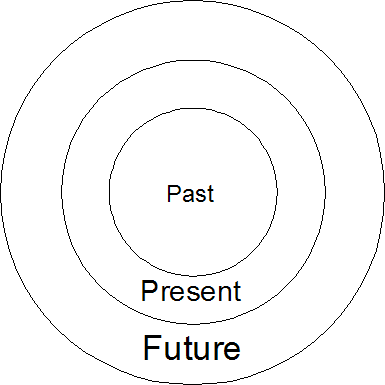
.
.
– Me, Inspired by Richard Koch’s The 80/20 Principle
.
.
.
2008.11.11 Tuesday (c) All rights reserved by ACHK

Cumulative concept of time | 累積時間觀
.
.
Wrong: past –> present –> future
.
.
Right:
.
.
– Me, Inspired by Richard Koch’s The 80/20 Principle
.
.
.
2008.11.11 Tuesday (c) All rights reserved by ACHK
Paradox 5.5 | Meta-time 4.5 | Cumulative concept of time, 13.5 | Two dimensional time 4.4 | 二次元時間 4.4
To be logically consistent WITHIN the movie’s story, Young Joe (in the year 2044) should not be able to influence Old Joe, who had time-travelled to the year 2044 from the year 2074,because that Old Joe is from another timeline. The proof is that Young Joe’s experience in the year 2044 is different from Old Joe’s experience in the year 2044 when he was young.
They are not the same person, nor the same person at different ages within the same timeline. At most, they are different versions of the “same” person from two different timelines (aka “parallel universes” or “histories”).
Young Joe’s changes should affect the same-timeline-Old-Joe, but not any Old Joe’s from any other timelines. So the Old Joe within the movie should not have been affected when Young Joe hurt himself.
Also, the changes of the same-timeline-Old-Joe due to the actions of Young Joe should be seen only by the author (meta-time), but not by Young Joe until he has become that Old Joe 30 years later.
The author unintentionally, or intentionally, has confused two story timelines. Moreover, the author unintentionally, or intentionally, has confused the story-time and its meta-time.
— Me@2013-07-05 10:32 PM
2013.07.11 Thursday (c) All rights reserved by ACHK
Paradox 5.4 | Meta-time 4.4 | Cumulative concept of time, 13.4 | Two dimensional time 4.3 | 二次元時間 4.3
In a single-mutable-timeline time travel story, the two dimensional time is not due to the internal causal structure of the story. Instead, it is due to the author’s timeline (aka meta-time). The author’s timeline is the second time dimension (aka independent direction).
The single-mutable-timeline model of time travel is not logically consistent within the story. If it is “mutable”, it is not “single”.
The single-mutable-timeline model of time travel is logically consistent only outside the story, from the perspective of the story’s author.
— Me@2013-07-02 3:47 PM
2013.07.09 Tuesday (c) All rights reserved by ACHK
Paradox 5.3 | Meta-time 4.3 | Cumulative concept of time, 13.3 | Two dimensional time 4.2 | 二次元時間 4.2
In the movie Looper, Young Joe (in the year 2044) influences Old Joe (in the year 2074) in the sense that Young Joe’s every action affects the state of Old Joe, because Old Joe is Young Joe’s future self.
For example, after Young Joe had hurt his own arm, the corresponding wound also appeared on Old Joe’s arm, even though Old Joe had already time-travelled back to the year 2044.
All of Young Joe’s actions are the causes of Old Joe’s state. Young Joe is in the past of Old Joe.
Old Joe (2074-Joe) = [ …, Young Joe (2044-Joe), … ]
B = [ …, A, … ]
However, Old Joe (2074-Joe) had time-travelled back to the year 2044, meeting the Young Joe.
So, some of Old Joe’s actions would affect Young Joe’s decisions on his own actions. In this sense, Old Joe also influences Young Joe indirectly. Some of Old Joe’s actions are the causes of Young Joe’s state. Part of Old Joe is also in the past of Young Joe.
Young Joe (2044-Joe) = [ …, Old Joe (2074-Joe), … ]
A = [ …, B, … ]
However, it is logically impossible to have both
B is in the past of A
and
A is in the past of B
just as it is logically almost impossible to have both
D is a part of C
and
C is a part of D
If you insist that it is the case, the only possibility is that
C = D
In this analogy, neither C nor D is really a “part” of another. In the time travel case, neither A nor B is really in the past of another. In other words, A (Young Joe) and B (Old Joe) have no time relationship. Neither’s actions are the causes of the state of another.
The real causes of Young Joe or Old Joe’s states are actually not within the movie story’s timeline. The real causes are the decisions of the author of the story.
— Me@2013-07-03 6:19 PM
2013.07.08 Monday (c) All rights reserved by ACHK
Paradox 5.2 | Meta-time 4.2 | Cumulative concept of time, 13.2 | Two dimensional time 4.1 | 二次元時間 4.1
In a “if and only if” case, there is no time.
If A is a necessary condition of B, we say “A is a cause of B“. In other words, A is in the past of B.
However, in some time travel story, it is “possible” to have both
A is a cause of B
(A is a necessary condition of B)
(B -> A)
and
B is a cause of A
(B is also a necessary condition of A)
(A -> B)
In this case, A and B are just equivalent.
(A B)
Neither is in the past of another. A and B have no causal relationship. In this sense, there is no time.
— Me@2013-07-03 6:19 PM
2013.07.05 Friday (c) All rights reserved by ACHK
Cumulative concept of time, 15
In 1895, in his novel, The Time Machine, H.G. Wells wrote, “There is no difference between time and any of the three dimensions of space except that our consciousness moves along it.”
— Wikipedia on Spacetime
Consciousness “moves” from the past to the future because consciousness is a kind of reflection.
To be conscious, one has to access its own states. But only the past states are available. Accessing one’s own now-here state is logically impossible, because that creates a metadox (paradox).
— Me@2013-06-26 02:28:51 PM
We can remember the past but not the future because the past is part of the future; the whole contains its parts, but not vice versa.
— Me@2011.08.21
2013.06.29 Saturday (c) All rights reserved by ACHK
backward compatible
~ cumulative
~ able to access the past
— Me@2013-05-23 08:35:10 PM
2013.05.25 Saturday (c) All rights reserved by ACHK
cause
~ necessary condition
~ part of
Event A is a cause of event B
= Event A is a necessary condition of event B
= Event A is part of event B
We can remember the past but not the future because the past is part of the future; the whole contains its parts, but not vice versa.
— Me@2011.08.21
2013.05.19 Sunday (c) All rights reserved by ACHK
二次元時間 3
儲存 save
~ 累積 accumulate
cumulative
~ timeless
~ lasting 待久
~ transcend time
— Me@2013.02.09
If you keep doing timeless things, every event exists not just at a particular point on your timeline. Instead, it exists on the whole timeline.
In a sense, you are living a two-dimensional history, because you are not just considering the progress along the timeline, but also the progress of the whole timeline itself.
— Me@2013.02.11
2013.02.11 Monday (c) All rights reserved by ACHK
Meta-time 4 | Cumulative concept of time, 13
The grandfather paradox has this structure:
Your-2012-self = [ …, your-2002-self, … ]
B = [ …, A, … ]
If your-2012-self can go back to, such as, year 2001,
Your-2002-self = [ …, your-2012-self, … ]
A = [ …, B, … ]
Unless A = B, it is logical impossible to have both “A is part of B” and “B is part of A“.
— Me@2012.04.02
2012.10.24 Wednesday (c) All rights reserved by ACHK
Cumulative
可累積的
— Me@2012.06.25
2012.07.02 Monday (c) All rights reserved by ACHK
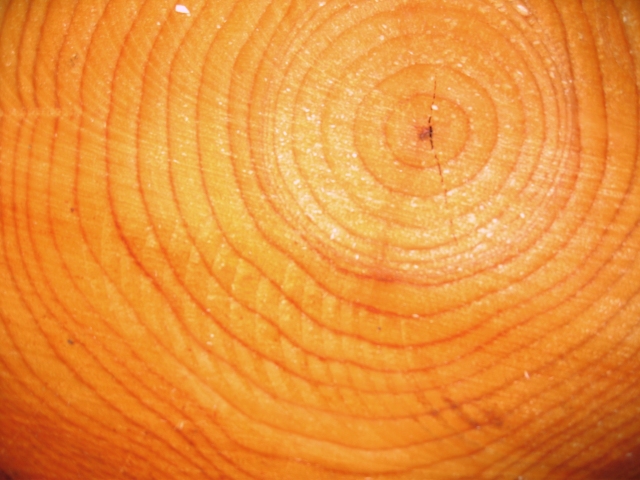
年輪 | 年年齡 8 | Cumulative concept of time, 12
The younger tree is still here, for it is inner part of the present tree.
 |
| This file is licensed under the Creative Commons Attribution 2.0 Generic license. Author: Lawrence Murray from Perth, Australia |
present-self of the tree = younger-self of the tree + the outer layers [1]
— Me@2011.09.10
[1] This is not scientifically accurate. But it is a good analogy for illustrating the cumulative nature of time.
2011.09.11 Sunday (c) All rights reserved by ACHK
Cumulative concept of time, 11
「夕陽無限好 只是近黃昏」是一句重言句(tautology)。
例如,如果我每個月的收入都多於支出的話,我臨過身前的財產,一定會是我一生中最多的。
— Me@2011.08.21
— Me@2011.09.01
2011.09.01 Thursday (c) All rights reserved by ACHK
時光機 3
Cumulative concept of time, 10
You can travel to the future since your future-self contains your present-self:
you travel to the future as long as you, somehow, do not change your present-self.
However, you cannot travel to the past, because by definition, your past-self does not contain your present-self:
your present-self is neither part of the past, nor part of your past-self.
— Me@2011.08.20
2011.08.21 Sunday (c) All rights reserved by ACHK
Cumulative concept of time, 9
一般人的「時間觀」是錯的。他們以為一日的時間只有一日。他們以為一日的時間只有一日的資源。他們以為每一日都是平等的。
為什麼這類想法是錯的呢?
舉例來說,假設我十天前開始寫網誌,而我每日寫一篇文章。那樣,我每日的網誌,並不是只有一篇文章。我每日的網誌,並不是只有當天的那一篇文章。
我昨日的網誌,並不是只有昨日的文章。我今日的網誌,並不是只有今日的文章。我明日的網誌,並不是只有明日的文章。
實情是,我昨日的網誌,有十篇文章。我今日的網誌,有十一篇文章。我明日的網誌,有十二篇文章。
我每日的網誌,都包含了當天和之前所寫的所有文章。
(安:正正是因為這樣,透過「時間旅行」回到過去,從而改變歷史,是邏輯上不可能的。)
— Me@2011.08.20
2011.08.20 Saturday (c) All rights reserved by ACHK
Cumulative concept of time, 8
Since my present-self have the memory of my younger self, my younger self is part of my present-self.
1. What is the meaning of the “same” file?
If two files contain exactly the same data, they are the “same” file.
2. Memory is the definition of identity.
Since I have the memory of my younger self, I am the same person as my younger self. Moreover, since I have more memory than my younger self, I am more than my younger self. My younger self is part of me.
3. If I am a book, my younger self is like the one with fewer chapters:
younger self ~ chapter 1,2,3
older self ~ chapter 1,2,3,4,5,6
— Me@2011.07.10
— Me@2011.08.04
2011.08.04 Thursday (c) All rights reserved by ACHK
事件實在論 | Cumulative concept of time, 7
Event realism is due to
the past the necessary condition for the present, which is due to
1. events are changes of states, and
2. present = the summation of all past events.
— Me@2011.07.06
— Me@2011.08.01
2011.08.01 Monday (c) All rights reserved by ACHK
Why is the past the necessary condition for the present?
1 = {1}, 2 = {1,2}, …
one = {first}, two = {first, second}, …
e.g. a necessary condition of having 3 apples is having 2 apples.
— Me@2011.07.05
— Me@2011.07.29
2011.07.29 Friday (c) All rights reserved by ACHK
“Tomorrow” has two possible meanings,
e.g. “tomorrow’s blog” can refer to
the blog posts written on tomorrow
or
the total blog posts you have tomorrow.
— Me@2011.07.05
2011.07.27 Wednesday (c) All rights reserved by ACHK
先決條件 3
past = the necessary conditions of present
because
present = the summation of all past events
— Me@2011.06.19
2011.07.11 Monday (c) All rights reserved by ACHK
 Physics Town
You must be logged in to post a comment.