Cumulative concept of time | 累積時間觀
.
.
Wrong: past –> present –> future
.
.
Right:
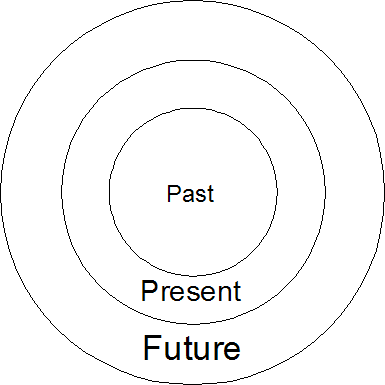
.
.
– Me, Inspired by Richard Koch’s The 80/20 Principle
.
.
.
2008.11.11 Tuesday (c) All rights reserved by ACHK

Cumulative concept of time | 累積時間觀
.
.
Wrong: past –> present –> future
.
.
Right:
.
.
– Me, Inspired by Richard Koch’s The 80/20 Principle
.
.
.
2008.11.11 Tuesday (c) All rights reserved by ACHK
Meaningful 12.4 | 惜此際 4 | A. J. Ayer, 2.2
這段改編自 2010 年 4 月 3 日的對話。
(安:那我自己的存在呢?為什麼「自己存在」,好過「自己不存在」?)
那是一個奇怪的問題。那亦是一個「不成問題」的問題,因為,「自己」並沒有所謂「存在不存在」。意思是,「你的存在」並不是「你的性質」。
「性質」的意思是,你可以利用它,來把人群分成兩組。例如,「輕盈」是一個性質。所以,你可以把人群分成兩組:一組是「輕盈」的人,另一組是「不輕盈」的人。
但是,你可不可以假設,「存在」是一個「性質」呢?亦即是話,你可不可以把人群分成兩組:一組是「存在」的人,而另一組是「不存在」的人呢?
「你的存在」,並不是「你的性質」,而是其他東西的性質。準確一點講,「你的存在」,是「你環境的性質」。例如,你在學校參加課外活動,加入了足球學會,但沒有加入籃球學會。那樣,「你的存在」就是足球學會的性質,而不是籃球學會性質。
「性質」的意思是,你可以利用它,來把人群分成兩組。因為你不可以用「存在」和「不存在」,把人群分成兩組,所以一個人的存在,並不是那個人自己的性質。
但是,某個人的存在與否,可以把學校中的課外活動學會,分成兩組。例如,我們可以把所有學會分成兩組:一組是「有你」加入的學會,另一組是「沒有你」的學會。在這個上文下理之下,「你的存在」就是課外活動學會的性質。
記住,「你的存在」,並不是「你的性質」。
剛才提到,「你的體重」是「你的性質」。所以,你可以考慮一下,究竟「輕盈」一點會好一點,還是「豐滿」一點會更健康?
但是,因為「你的存在」,並不是「你的性質」,所以,「究竟『自己存在』對我來說好一點,還是『自己不存在』可以為我刪除痛苦」這個問題,根本沒有任何形式的意思。
例如,你可以問,一般來說,「輕盈」的人還是「豐滿」的人,會快樂一點?
但是,如果你問:
「
平均而言,究竟『存在的人』,還是『不存在的人』,會快樂一點?
」,
我就根本完全不知你在說什麼。「不存在的人」,還算是「人」嗎?「不存在的東西」,還算是「東西」嗎?既然「不存在」,又何來「快不快樂」呢?
自殺的人,至少犯了兩大錯誤。而這個邏輯錯誤,就是第一個。
他們以為,自殺以後,自己就不再存在,所以可以減輕痛苦,增加快樂。但是,如果真的「不再存在」,就沒有所謂的「增加快樂」。換而言之,自殺以後,即使假設自己不再存在,也沒有「減輕痛苦」的功效。只有「存在的人」或者「存在的意識體」,才有能力和有機會,減輕自己的痛苦。
第二個錯誤是,自殺的人以為,自殺以後,自己就不再存在。那是不一定的。
有時,他們又會以為,即使意識仍然繼續存在,他們也可以成功逃避到現世的痛苦。但是,那亦是沒有根據的。如果現世是痛苦的,你憑什麼可以假設,下一個世界是快樂的呢?
或者,「下一世」比「現世」,更加光怪陸離。
比喻說,逃學的年青人,以為輟學可以刪除讀書的痛苦。但是,他們不知道的是,「輟學」的後果是,要「上班」養活自己。對於一個年青人來說,「上班的痛苦」,往往大於「上學的痛苦」。
相反,如果那位年青人正常地完成學業,他反而可以大大減輕,未來上班的痛苦。
— Me@2013.07.28
2013.07.28 Sunday (c) All rights reserved by ACHK
Brian Greene continues with all the delusions and delusions, infrequently spiced with a correct proposition. The Big Bang created the arrow of time (the latter has nothing to do with the laws of physics), holy cow. “We don’t know why the Universe started in a low-entropy state,” holy cow. We perfectly know why it did. If it started with a state of a high entropy, we could always ask “what was before that”. The only thing that prevents us from going before a moment is that the moment has the minimal mathematically possible value of the entropy, namely zero.
— The Fabric of the Cosmos II
— Lubos Motl
2013.07.25 Thursday ACHK
Meaningful 12.3
這段改編自 2010 年 4 月 3 日的對話。
(安:但是,我又可以追問,為什麼「存在」好過「不存在」?)
那不是一定的。那要視乎上文下理而定。
你只可以說,「好東西存在」,好過「好東西不存在」;而「壞東西不存在」,好過「壞東西存在」。那都是重言句。
例如,銀包(錢包)中的金錢,對你來說是好東西。所以,「金錢存在於你的銀包之內」,相對於你而言,好過「金錢不存在於你的銀包之中」。
又例如,銀包中的蟑螂,對你來說是壞東西。所以,「蟑螂不存在於你的銀包之內」,相對於你而言,好過「蟑螂存在於你的銀包之中」。
(安:那我自己的存在呢?為什麼「自己存在」,好過「自己不存在」?)
那是一個奇怪的問題。那亦是一個「不成問題」的問題,因為,「自己」並沒有所謂「存在不存在」。意思是,「你的存在」並不是「你的性質」。
「性質」的意思是,你可以利用它,來把人群分成兩組。例如,「輕盈」是一個性質。所以,你可以把人群分成兩組:一組是「輕盈」的人,另一組是「不輕盈」的人。
但是,你可不可以假設,「存在」是一個「性質」呢?亦即是話,你可不可以把人群分成兩組:一組是「存在」的人,而另一組是「不存在」的人呢?
— Me@2013.07.24
2013.07.25 Thursday (c) All rights reserved by ACHK
Meaningful 12.2
這段改編自 2010 年 4 月 3 日的對話。
你這個問題可以改為:
「
為什麼「不進則退」?
難道「原地踏步」,就不可「繼續存在」嗎?
」
「不斷存在」,並不是一個單一事件;「不斷存在」,是一個不斷的過程。
你要維持「現狀」,就要不斷有「維持」的動作。主要的原因是,即使你不變,你的環境會變。你要「維持現狀」,你就要隨著你的環境,作出相應的變化。「維持現狀」,是一個「苦心經營」的過程。
例如,如果你的目標是「體重不變」,「絕食」並不能令你如願以償,因為,即使你不再進食,你的身體仍會不斷消耗能量。不再進食,只會令你體重遞減。
達至「體重不變」的正確方法是,定時適量進食。
— Me@2013.07.23
2013.07.23 Tuesday (c) All rights reserved by ACHK
Meaningful 12
這段改編自 2010 年 4 月 3 日的對話。
(安:為什麼必須要有一個「無限旅程」,人才會感到「有意義」?
或者說,為什麼一件事有「下一步」還不夠,而一定要「不斷地」有下一步,人才會感到真正的快樂?)
「有限價值」會帶來短暫的開心;「永恆價值」則會引發長久的幸福。
一件事如果有無限個「下一步」,那就代表「那件事」本身,可以長存於時間之中,不會消失。
一件事如果沒有起碼一個「無限旅程」,你的「機會成本評價系統」,自然會令你沒有心機、提不起勁,因為「那件事」早晚會消失;而你付出的努力,亦注定要白費。
有意義
~ (不斷地)有下一步
~ 可保存
~ 可繼續存在
~ 可儲存於時間之中
— Me@2013.07.21
2013.07.21 Sunday (c) All rights reserved by ACHK
And as we have explained many times, the results of this inference – the retrodictions – always depend on our priors. So the knowledge of the present is enough to calculate the future (classically) or to predict the unique probabilities of various states in the future (quantum mechanically). But it is simply never enough to calculate the unique state or unique probabilities of various states in the past.
The reason has been explained many times. But we can say that at least in the macroscopic context (when some microscopic detailed information is being omitted, e.g. because it’s unmeasurable), different initial states “A,B” in the past may evolve into the same final state “C” in the future.
— Logical arrow of time and terminology
— Lubos Motl
2013.07.20 Saturday ACHK
upgrade, downgrade, left-grade, right-grade
— Me@2013-07-09 11:30:15 AM
In case you cannot upgrade your life right now, but do not want to downgrade, you can try left-grade or right-grade.
— Me@2013-07-15 02:33:03 PM
2013.07.15 Monday (c) All rights reserved by ACHK
Two dimensional time 5 | 二次元時間 5
You are the main author of your future.
In a special sense, the real-present is the meta-time of the potential future timelines, selecting the future among multiple possible timelines.
— Me@2013-07-11 3:48 PM
2013.07.15 Monday (c) All rights reserved by ACHK
Paradox 5.5 | Meta-time 4.5 | Cumulative concept of time, 13.5 | Two dimensional time 4.4 | 二次元時間 4.4
To be logically consistent WITHIN the movie’s story, Young Joe (in the year 2044) should not be able to influence Old Joe, who had time-travelled to the year 2044 from the year 2074,because that Old Joe is from another timeline. The proof is that Young Joe’s experience in the year 2044 is different from Old Joe’s experience in the year 2044 when he was young.
They are not the same person, nor the same person at different ages within the same timeline. At most, they are different versions of the “same” person from two different timelines (aka “parallel universes” or “histories”).
Young Joe’s changes should affect the same-timeline-Old-Joe, but not any Old Joe’s from any other timelines. So the Old Joe within the movie should not have been affected when Young Joe hurt himself.
Also, the changes of the same-timeline-Old-Joe due to the actions of Young Joe should be seen only by the author (meta-time), but not by Young Joe until he has become that Old Joe 30 years later.
The author unintentionally, or intentionally, has confused two story timelines. Moreover, the author unintentionally, or intentionally, has confused the story-time and its meta-time.
— Me@2013-07-05 10:32 PM
2013.07.11 Thursday (c) All rights reserved by ACHK
Paradox 5.4 | Meta-time 4.4 | Cumulative concept of time, 13.4 | Two dimensional time 4.3 | 二次元時間 4.3
In a single-mutable-timeline time travel story, the two dimensional time is not due to the internal causal structure of the story. Instead, it is due to the author’s timeline (aka meta-time). The author’s timeline is the second time dimension (aka independent direction).
The single-mutable-timeline model of time travel is not logically consistent within the story. If it is “mutable”, it is not “single”.
The single-mutable-timeline model of time travel is logically consistent only outside the story, from the perspective of the story’s author.
— Me@2013-07-02 3:47 PM
2013.07.09 Tuesday (c) All rights reserved by ACHK
Paradox 5.3 | Meta-time 4.3 | Cumulative concept of time, 13.3 | Two dimensional time 4.2 | 二次元時間 4.2
In the movie Looper, Young Joe (in the year 2044) influences Old Joe (in the year 2074) in the sense that Young Joe’s every action affects the state of Old Joe, because Old Joe is Young Joe’s future self.
For example, after Young Joe had hurt his own arm, the corresponding wound also appeared on Old Joe’s arm, even though Old Joe had already time-travelled back to the year 2044.
All of Young Joe’s actions are the causes of Old Joe’s state. Young Joe is in the past of Old Joe.
Old Joe (2074-Joe) = [ …, Young Joe (2044-Joe), … ]
B = [ …, A, … ]
However, Old Joe (2074-Joe) had time-travelled back to the year 2044, meeting the Young Joe.
So, some of Old Joe’s actions would affect Young Joe’s decisions on his own actions. In this sense, Old Joe also influences Young Joe indirectly. Some of Old Joe’s actions are the causes of Young Joe’s state. Part of Old Joe is also in the past of Young Joe.
Young Joe (2044-Joe) = [ …, Old Joe (2074-Joe), … ]
A = [ …, B, … ]
However, it is logically impossible to have both
B is in the past of A
and
A is in the past of B
just as it is logically almost impossible to have both
D is a part of C
and
C is a part of D
If you insist that it is the case, the only possibility is that
C = D
In this analogy, neither C nor D is really a “part” of another. In the time travel case, neither A nor B is really in the past of another. In other words, A (Young Joe) and B (Old Joe) have no time relationship. Neither’s actions are the causes of the state of another.
The real causes of Young Joe or Old Joe’s states are actually not within the movie story’s timeline. The real causes are the decisions of the author of the story.
— Me@2013-07-03 6:19 PM
2013.07.08 Monday (c) All rights reserved by ACHK
Paradox 5.2 | Meta-time 4.2 | Cumulative concept of time, 13.2 | Two dimensional time 4.1 | 二次元時間 4.1
In a “if and only if” case, there is no time.
If A is a necessary condition of B, we say “A is a cause of B“. In other words, A is in the past of B.
However, in some time travel story, it is “possible” to have both
A is a cause of B
(A is a necessary condition of B)
(B -> A)
and
B is a cause of A
(B is also a necessary condition of A)
(A -> B)
In this case, A and B are just equivalent.
(A B)
Neither is in the past of another. A and B have no causal relationship. In this sense, there is no time.
— Me@2013-07-03 6:19 PM
2013.07.05 Friday (c) All rights reserved by ACHK
尋找下一步 1.5 | Meaningful 11.5
這段改編自 2010 年 4 月 3 日的對話。
所以,理論上,你心中的「機會成本評價系統」,應該會為了賺錢,令你有心機、提起勁,去從事你日常的工作事務。
記住,「金錢」可以連接起「現實」和「理想」,有時。即使你的「現實」和「理想」,沒有自然直接的因果關係,在部分情況下,你仍可以透過「金錢」,人工搭建。
而實際上,你卻在上班時間中,長期處於失落無奈的狀態。那就代表了,你的「工作內部」和「理想生活」兩團因果網絡,真的相差大遠,金錢也於事無補。你處於那樣的境況,有幾種可能的原因:
1. 你的那份工作的薪金太少,對生活的影響力不夠。
2. 你的薪金太多,早早過了你的生活安全線和舒適線,對生活的革命性不足。
相反,如果你現在的財政正處於「目標臨界線」,即是僅僅不夠一點金錢,去達成你的目標,你賺錢的動機,自然嚴重增加。
例如,假設你現在很想有自己的房子。但是,還差一點點金錢才購買得起。而你又發現,你上司對你有一定程度的賞識;只要你在上班時,努力一點處理工作事務,就可以大大提升,升職加薪的機會率。再加上,那潛在的加薪幅度,原來足以令你,由買不起房子的凡人,進化成買得起房子的天神。那樣,你上班的意欲,自然光速增長。
— Me@2013.07.03
2013.07.03 Wednesday (c) All rights reserved by ACHK
Punishment 3 | 以直報怨 3 | Regret 3
sincere apology
~ declaration of change of identity
~ declaration of not inheriting your previous evil self(s)
~ declaration of cutting the evil causal chain
— Me@2013-06-30 6:13 PM
2013.07.02 Tuesday (c) All rights reserved by ACHK
尋找下一步 1.4 | Meaningful 11.4
這段改編自 2010 年 4 月 3 日的對話。
在個人無盡問題之中,金錢困難是典型的一個。所以,單單是賺錢本身,就已經是一個上佳的「長久娛樂」,雖然未至於是「無限旅程」。
而且,金錢還有一個驚奇有趣的特性。金錢是因果網絡的人工連接線,簡稱「時空膠紙」。明明原本沒有瓜葛的兩團因果網絡,如果可以用金錢連接,兩者就可以變成帶一點關係。
例如,你剛才埋怨:
「
我現在的那份工作,內容沒有什麼意義;好像在不斷大規模地,浪費著自己的生命似的。
」
意思是,你現時職位的工作內容,對人對己都沒有什麼大用,可有可無。你的工作對改善世界的影響力十分有限,甚至有時是負數。換句話說,你的「工作內部」和你的「理想生活」這兩個因果網絡,貌似互不相干。
但是,那不會是實情,因為,雖然你工作的性質無聊,但是它會為你帶來收入。透過你工作所賺來的金錢,你既可以提升自己的生活質素,又可以幫助別人,改善地球。換而言之,你的「工作內部」和你的「理想生活」這兩個因果網絡,因為「金錢」這種「時空膠紙」,人工地連接起來。
所以,理論上,你心中的「機會成本評價系統」,應該會為了賺錢,令你有心機、提起勁,去從事你日常的工作事務。
記住,「金錢」可以連接起「現實」和「理想」,有時。即使你的「現實」和「理想」,沒有自然直接的因果關係,在部分情況下,你仍可以透過「金錢」,人工搭建。
…
— Me@2013.06.30
2013.06.30 Sunday (c) All rights reserved by ACHK
Cumulative concept of time, 15
In 1895, in his novel, The Time Machine, H.G. Wells wrote, “There is no difference between time and any of the three dimensions of space except that our consciousness moves along it.”
— Wikipedia on Spacetime
Consciousness “moves” from the past to the future because consciousness is a kind of reflection.
To be conscious, one has to access its own states. But only the past states are available. Accessing one’s own now-here state is logically impossible, because that creates a metadox (paradox).
— Me@2013-06-26 02:28:51 PM
We can remember the past but not the future because the past is part of the future; the whole contains its parts, but not vice versa.
— Me@2011.08.21
2013.06.29 Saturday (c) All rights reserved by ACHK
凝固了的「過程」,為之「結果」,簡稱「功」。
保存不到過程,為之「無功而還」。
— Me@2013-06-27 05:47:53 PM
2013.06.29 Saturday (c) All rights reserved by ACHK
“The past cannot be changed” is a tautology, because “cannot be changed” is included in the meaning of the word “past“.
Similarly, “the future is not fixed” is also a tautology.
Anything you cannot change is within your past.
Anything you can change is within your future.
— Me@2013-06-23 3:40 PM
— Me@2013-06-26 10:40 AM
2013.06.26 Wednesday (c) All rights reserved by ACHK
Copy Me, 4
Being conscious is being able to form memories.
forming memories
~ forming an identity
~ forming a causal chain of thoughts
To form memories, one needs to access and then store its own states.
But due to metadox (paradox), no one, or no single part of the brain, can access its own now-here state directly.
That is why different parts of the brain have to communicate and coordinate in order to be conscious.
— Me@2013-05-30 1:47 PM
2013.06.23 Sunday (c) All rights reserved by ACHK
 Physics Town
You must be logged in to post a comment.