Monty Hall problem 1.3

Frequency probability and Bayesian probability, 3.1

機會率哲學 3.1

這段改編自 2010 年 4 月 3 日的對話。

除了錯誤使用「機會均等假設」外,思考「蒙提霍爾問題」時,另一個典型錯誤是,一般人不明顯知道,各道門的中獎機會率,在遊戲中途可能有變,即使房車和山羊的位置,都維持原本。

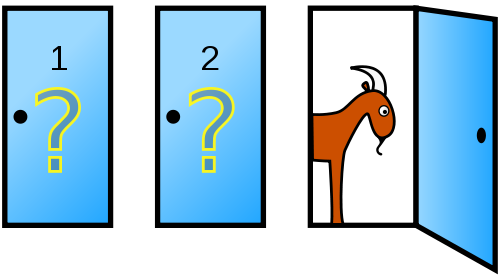
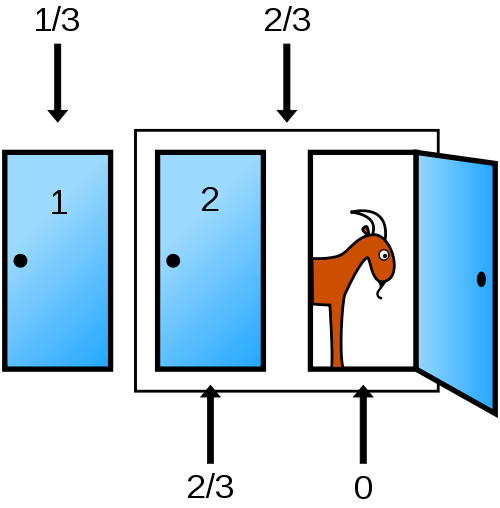
「機會率」除了描述客觀的物理系統外,還會反映觀察者的主觀知識狀態。換句話說,隨著那位遊戲參賽者,對他所觀察的系統,獲得多一點資料,各個機會率就會有變。例如,第三道門原本的中獎機會,相對於參賽者來說,是三分之一。但是,當主持人打開了它,導致參賽者知道「門後是山羊」後,相對於參賽者來說,第三道門中獎機會率,就立刻變成零。

This is a public domain image.

即使外在客觀的系統沒有變,只要觀察者對該系統的主觀知識,有所增加,事件各個可能結果,所對應的機會率,就要全部重新運算。

同理,雖然根據題目的假設,原初每道門的中獎機會均等,都是三分之一,但是,因為參賽者在中途,獲得了多一點資料,餘下兩道門中獎的機會率,未必仍然和對方相同。   

This is a public domain image.

而正確的答案是,餘下的兩道門中獎機會,不再均等。原本的被選的那一道,中獎的機會是三分之一;另一道門中獎的機會,則變成了三分之二。

This is a public domain image.

— Me@2012.11.21

2012.11.21 Wednesday (c) All rights reserved by ACHK

機會率悲劇 1.2

Monty Hall problem 1.2

這段改編自 2010 年 4 月 3 日的對話。

.

「機會均等假設」如果胡亂使用,會得到很多荒唐的結論。例如,小明跟媽媽說:「在這次考試,我的成績有兩個可能。要麼我考到全班第一,要麼我考不到全班第一。所以,今次我有一半的機會,考到全班第一。」

媽媽回答:「荒謬!」

小明再解釋:「『考到全班第一』和『考不到全班第一』已經窮盡了,這次考試結果的所有可能。你不會想像到,有第三個情況出現。」

那樣,小明的媽媽,應該如何反駁他呢?

只有兩個可能的結果,並不代表各自的機會率是二分之一。除非題目假設,又或者有以往的實驗數據支持,例如小明在以往的考試中,平次每兩次中,就會有一次考第一;否則,你不能自己假設,機會率會平均分配於各個可能性。

而這個「故亂假設機會均等」的思考錯誤,往往形成塵世間很多悲劇,例如選錯配偶和選錯事業。「我加入這一行,要麼成功,要麼失敗。所以,我成功的機會有一半。」那即使不是顯意識的思考,大概也會是潛意識的想法。

這個錯誤來自,不必要地選擇無知。正當的做法是,先做功課,先做好資料搜集。以自己當時可以得到,最多和最準確的資訊,去評價自己,加入某一行時,成功和失敗的機會率,各佔多少。即使那個機會率不會十分詳細,例如「成功的機會是 57%」,你也至少要有個大概,知道成功的機會較大,還是失敗。如果成功的機會較大,是約略大多少呢?是不是大到,值得你投資未來五年的人生,去作嘗試呢?

雖然,那也不保證一定成功,但是至起碼,即使錯了,也可以問心無愧。而且,如果你是在做足功課的情況下失敗,你吸收到的知識經驗,將會是最豐富的。那將大大提高你,未來成功的機會率。

— Me@2012.11.19

.

.

2012.11.19 Monday (c) All rights reserved by ACHK

EPR paradox, 5

One important question raised by this ambiguity is whether Einstein’s theory of relativity is compatible with the experimental results demonstrating nonlocality. Relativistic quantum field theory requires interactions to propagate at speeds less than or equal to the speed of light, so “quantum entanglement” cannot be used for faster-than-light-speed propagation of matter, energy, or information.

Measurements of one particle will be correlated with measurements on the other particle, but this is only known after the experiment is performed and notes are compared, therefore there is no way to actually send information faster than the speed of light.

On the other hand, relativity predicts causal ambiguities will result from the nonlocal interaction. In terms of the EPR experiment, in some reference frames measurement of photon A will cause the wave function to collapse, but in other reference frames the measurement of photon B will cause the collapse.

— 02:57, 16 June 2012

— Wikipedia on Action at a distance (physics)

Correlation does not imply causation.

If two events A and B have no causal relationship, they can have different time orders in different frames of reference. In some frames, A happened at a time earlier than B. In some other frames, B happened at a time earlier than A.

However, if they have causal relationship, their time order is the same with respect to any frame of reference.

— Me@2012-11-18 10:44:59 PM

2012.11.19 Monday (c) All rights reserved by ACHK

機會率悲劇 1.1

Monty Hall problem 1.1

這段改編自 2010 年 4 月 3 日的對話。

(安:「蒙提霍爾問題」(Monty Hall problem)十分有趣。有趣的地方在於,一方面,大部分人都會答錯;另一方面,即使知道了答案及其運算方法,大部分人都仍然接受不到,因為答案嚴重違反一般人的直覺。甚至,很多受過「機會率」正式訓練的人士,都誤墮這個「機會率陷阱」。

「蒙提霍爾問題」的劇情是,有關一個「開門抽獎遊戲」。遊戲的大局是,在一位遊戲參加者的面前,會有三扇門。其中一扇門的後面,有一輛名貴房車。另外兩扇間後面,各有一隻山羊。

首先,主持人會叫那位參賽者,選擇其中一扇門。然後,主持人會打開那一扇門。遊戲的規則是,如果門後的是名貴房車,參賽者就可以得到它。

「蒙提霍爾問題」的第一個假設是,三扇門「門後有房車」的機會均等。換句話說,無論參賽者選擇哪一扇門,中獎的機會,同是三分之一。

「蒙提霍爾問題」的第二個假設是,參賽者選了一扇門後,主持人在第一步,不會打開那扇門,反而,會先打開另外兩扇門的其中一扇。然後,大家會發現,開了的門後面,有一隻山羊。亦即是話,房車位於未開的兩扇門的其中一扇後面。這時,主持人會給予參賽者,一次重新選擇的機會。那位參賽者可以維持選擇,或者改為要另一扇門。

「蒙提霍爾問題」是,這個情況下,參賽者應否改變選擇?又或者說,參賽者如果改變選擇,可不可以提高他中獎的機會率呢?

This is a public domain image.

In search of a new car, the player picks a door, say 1. 
The game host then opens one of the other doors, say 3, 
to reveal a goat and offers to let the player pick door 2 instead of door 1.

— Wikipedia on Monty Hall problem

一般人的想法是,既然選兩扇門中的任何一個,機會都是二分之一,即使轉換選擇,也不會增加勝算。

但是,答案竟然不是那樣。原來,維持選擇的中獎機會,只有三分之一。改變選擇的中獎機會,卻有三分之二。)

這個結果震撼的地方在於,它違反人們一個根深柢固,但通常也錯的直覺。大部人也以為,各個可能結果的機會均等。如果一件事只有兩個可能的結果,每個結果的機會率,就一定是二分之一。這個「機會均等假設」大錯特錯。

— Me@2012.11.18

2012.11.18 Sunday (c) All rights reserved by ACHK
Noether’s theorem

Symmetry and conservation

… all conserved quantities come from symmetries in our universe. Because the laws of physics are the same no matter what direction you look in, angular momentum is conserved. Because they’re the same whether you move left or right, regular momentum is conserved. Because they’re the same now as they will be later in time, energy is conserved. Energy and momentum conservation come from two separate symmetries; …

— This work is licensed under a Creative Commons Attribution-ShareAlike 3.0 Unported License.

— Physics Stack Exchange

— Colin Fredericks

That is, conservation of momentum is a consequence of the fact that the laws of physics do not depend on position; this is a special case of Noether’s theorem.

— Wikipedia on Momentum

2012.11.17 Saturday ACHK

機會率哲學 2.7.2

The problem of induction 1.7.2 | Paradox 7.2

這段改編自 2010 年 4 月 3 日的對話。

(安:但是,你不能不考慮「機會率」。

例如,你發覺一粒骰子,一百次之中,全部一百次都是擲到「一」。那樣,你會認為,那一粒骰子不正常,不是公平的。你歸納到的規律是,那粒骰子次次也會擲到「一」。所以,你會預測,下次擲骰子的結果都是「一」。正如,因為以往的每天,太陽都由東邊升起,你自然會預期,明天都是那樣。這是一個「完全有規律」的例子。

又例如,你發覺一粒骰子,一百次之中,有九十次都是擲到「一」。你會覺得,「擲到一」的機會率,遠高於其他五個數字。你歸納到的規律是,那粒骰子傾向擲到「一」。所以,你會預測,下次擲骰子的結果都是「一」。這是一個「既不是完全沒有規律,亦不是完全有規律」的例子。一方面,這個事件並不是「完全不可預測」的,因為你相當有信心,骰子會擲到「一」。另一方面,這個事件亦不是「完全可預測」的,因為你的信心並不至於大到,願意用整副身家到擔保。

再例如,你發覺一粒骰子,一百次之中,有大概十六次是擲到「一」,而其他數字的出現次數,也是差不多。那樣,你會認為,那一粒骰子是正常公平的。這是一個「完全沒有規律」的例子。因為骰子對那六個數字,無所偏好,導致你「完全不可預測」,下一次會擲到哪一個數字。

但是,從另一層次看,「無所偏好」即是「隨機」。那樣,你就可以使用「機會率法則」。雖然你不可以預測,下一次會擲到哪一個數字,但是你可以宣稱,下一次擲到任何一個數字的機會率,都是六分之一。換句話說,如果你把骰子擲很多次,每個數字出現的次數,都會佔全部次數的大概六分之一。)

你的意思是,個別事件「完全不可預測」的話,即是在「個別事件層次」,完全沒有規律。那樣,如果提高一個層次,改為觀察「大量個別事件」,就反而會有明顯的規律。完全沒有規律的個別事件,即是「隨機事件」。既為「隨機事件」,就可以用「機會率」去處理。

又或者說,如果個別事件完全沒有「必然定律」,集體事件就會遵守「概然定律」。「概然」即是「大概而然」,亦即「集體而言」。「概然定律」,亦稱「機會率法則」。

— Me@2012.11.17

2012.11.17 Saturday (c) All rights reserved by ACHK
Single-world interpretation, 6.2.2

Information lost, 5

In the Many-worlds interpretation (MWI), when we say that “a + b” collapses to “a”, there is a shift of definition of “you”.

MWI is in one sense correct: choice b version of you still exists. But the trick is that he is not in another universe. He is in the environment of this universe.

And perhaps in reverse, you are also part of the environment of him.

— Me@2011.11.20

This environment theory is not totally accurate. For example, in the photon double slit experiment, during the wave function collapse, 

sqrt(2) | left > + sqrt(2) | right >

–> | left >    ,

| right > as the unchosen choice, or the lost information, goes to the environment.      

However, the macroscopic reality of | photon goes left > requires not only the state of the photon but also the state of its environment, including the lost information | right >_micro. Just the lost information itself is not enough to form a macroscopic reality.

— Me@2012.04.03

2012.11.16 Friday (c) All rights reserved by ACHK

歸納筆記 2.2

這段改編自 2010 年 6 月 8 日的對話。

試想想,如果你有在臨考前背誦「魔記筆記」,又怎可能在考試時「臨場遺忘」,內裡記載的常用技巧呢?

你們可能會問:「又怎可能在半小時內,把『魔法筆記』的所有內容,都閱讀一次呢?」

你留意,你現在手上的「魔法筆記」,並不是「真身」,而只是第一個版本。如果你跟足「魔法筆記方法」的劇情,臨考試前「魔法筆記」,一定會很薄。「魔法筆記」的原意,是把課程內容的(例如)四百頁,歸納成二百頁,成為第一個版本。然後,再把那二百頁,歸納成一百頁,成為第二版,如此類推。臨考試前的「魔法筆記」,應該只有少於五十頁。

另外,保證準時的唯一方法,就是大大提早到達。考試當日,正常人也會十分緊張,會提早出門,以防有突發交通事故。如果行程順利,你會在早於開考前的一個小時,就到達試場。所以,可用於背誦筆記的時間,通常也不只半小時那麼少。 

— Me@2012.11.16

2012.11.16 Friday (c) All rights reserved by ACHK

Philosophical Investigations

Relation to the Tractatus

According to the standard reading, in the Philosophical Investigations Wittgenstein repudiates many of his own earlier views, expressed in the Tractatus Logico-Philosophicus. The Tractatus, as Bertrand Russell saw it (though it should be noted that Wittgenstein took strong exception to Russell’s reading), had been an attempt to set out a logically perfect language, building on Russell’s own work. In the years between the two works Wittgenstein came to reject the idea that underpinned logical atomism, that there were ultimate “simples” from which a language should, or even could, be constructed.

In remark #23 of Philosophical Investigations he points out that the practice of human language is more complex than the simplified views of language that have been held by those who seek to explain or simulate human language by means of a formal system. It would be a disastrous mistake, according to Wittgenstein, to see language as being in any way analogous to formal logic.

Instead, language has many context-sensitive expressions, such as indexicals.

— Wikipedia on Philosophical Investigations

2012.11.16 Friday ACHK

機會率哲學 2.7.1

The problem of induction 1.7.1 | Paradox 7.1

這段改編自 2010 年 4 月 3 日的對話。

(安:Hans Reichenbach 講法的下半段是,如果自然現象根本沒有規律可言,就不會有任何方法,可以找到任何規律。那樣,即使找不到規律,也不是「歸納法」有錯。

這裡我不明白的地方是,何謂「完全沒有規律」呢?

我彷彿想像不到,有一個情況,可以真的「完全沒有規律」。)

你的意思是,「完全沒有規律」本身,都可以視為一個「規律」?

(安:大概是。)

那樣不行。有沒有「規律」,不純粹是感覺。你不可以隨便標籤,因為我們正在討論的「規律」,有明確意思。「有規律」是指「可預測」。如果一件事件是「不可預測的」,你就不可以宣稱它「有規律」。

(安:但是,你不能不考慮「機會率」。)

— Me@2012.11.15

2012.11.15 Thursday (c) All rights reserved by ACHK

Trans-Planckian problem

Mute Hole 2

The trans-Planckian problem can be conveniently considered in the framework of sonic black holes, condensed matter systems which can be described in a similar way as real black holes. In these systems, the analogue of the Planck scale is the interatomic scale, where the continuum description loses its validity. One can study whether in these systems the analogous process to Hawking radiation still occurs despite the short-scale cutoff represented by the interatomic distance.

— Wikipedia on Trans-Planckian problem

2012.11.14 Wednesday ACHK

Freefall

.

* We’re in a freefall into future. We don’t know where we’re going. This are changing so fast, and always when you’re going through a long tunnel, anxiety comes along. And all you have to do to transform your hell into a paradise is to turn your fall into a voluntary act. It’s a very interesting shift of perspective and that’s all it is… joyful participation in the sorrows and everything changes.

.

— Joseph Campbell

.

.

.

2009.05.15 Friday ACHK

歸納筆記 2.1

這段改編自 2010 年 6 月 8 日的對話。

這個方法,只作「娛樂」之用。考試時,就應該用剛才的速成方法,以節省時間。又或者,兩個方法也用,以作驗算。

(HYC:但是,這一題我只會想到正常的,慢一點的方法。)

那你又毋須要求,自己會發明到那個速成方法。你現在試試用一次,然後把它記載於「魔法筆記」之中,考試時就自然會記得,因為根據「魔法筆記」的設計,你除了在平日要背誦外,在臨考試前的半小時,還要高速瀏覽一次,提一提醒自己。

(CYW:但是,我一到考試臨場緊張時,很多時也會忘記,必須的技巧。有沒有方法可以記得呢?)

我不斷推介的「魔法筆記」方法,正正是要徹底解決這個問題。而這個方法的重點是,必須有系統地,長期反覆背誦,考試必須的知識和技巧。試想想,如果你有在臨考前背誦「魔記筆記」,又怎可能在考試時「臨場遺忘」,內裡記載的常用技巧呢?

你們可能會問:「又怎可能在半小時內,把『魔法筆記』的所有內容,都閱讀一次呢?」

— Me@2012.11.13

2012.11.14 Wednesday (c) All rights reserved by ACHK