Euler Formula

Exponential, 2
 

a^x

general exponential increase ~ the effects are cumulative
 
e^x

natural exponential increase ~ every step has immediate and cumulative effects

— Me@2014-10-29 04:44:51 PM
 

exponent growth

e^x = \lim_{n \to \infty} \left(1 + \frac{x}{n}\right)^n

~ compound interest effects with infinitesimal time intervals
 

multiply -1

~ rotate to the opposite direction

(rotate the position vector of a number on the real number line to the opposite direction)

~ rotate 180 degrees
 

multiply i

~ rotate to the perpendicular direction

~ rotate 90 degrees
 

For example, the complex number (3, 0) times i equals (0, 3):

3 \times i = 3 i
(3, 0) (0, 1) = (0, 3)
 

multiplying i

~ change the direction to the one perpendicular to the current moving direction

(current moving direction ~ the direction of a number’s position vector)
 

exponential growth with an imaginary amount

e^{i \theta} = \lim_{n \to \infty} \left( 1 + \frac{i \theta}{n} \right)^n

~ change the direction to the one perpendicular to the current moving direction continuously

~ rotate \theta radians

— Me@2016-06-05 04:04:13 PM


2016.06.08 Wednesday (c) All rights reserved by ACHK

天空堤壩 5

.

友情方面,你可以選擇,只要對方的優點;
愛情方面,你不可以選擇,不要對方的缺點。

.

.

.

.

.

.

.

.

.

.

.

.

.

.

.

友情方面,你可以選擇,只要對方最好的優點;
愛情方面,你不可以選擇,不要對方最差的缺點。

— Me@2010.06.01

.

.

.

2010.06.03 Thursday (c) ACHK

注定外傳 2.7

Can it be Otherwise? 2.7

之前提過:

如果沒有『注定』(物理等自然定律),人或其他生命體,就根本不可能有『自由意志』。

例如,你想拿起一隻茶杯。因為你有自由意志,所以可以由腦部下指令,訊號由神經線傳達到手部,拿起茶杯。手部正正是因為是『注定』的,即是受制於自然定律,才保證必會執行,腦部的指令。

試想想,如果手部未必根據自然定律來行事,它就不一定會執行,你心中的目標。那樣,你(腦部)反而就沒有自由意志,因為手部的動作根本是隨機的,不一定會把你(例如『拿起茶杯』)的意志,化成現實。

如果所有東西也是注定的,你就沒有自由。如果所有東西也是隨機(不注定)的,你也沒有自由。

(問:那即是話,如果人或其他生命體有自由,現實就是部分注定、部分不注定。

另一個可能是,任誰也沒有自由,所有東西也是注定。)

其實還有第三個可能是,任誰也沒有自由,所有東西也是隨機的。

(問:那樣,現實是三者中的哪一個?)

之前已經討論過,不再詳談:

只要答到這個問題,你就會知道,某一件事件是否「注定」,或者「必然」。

但是,這個問題的答案,取決於「相同」的意思;而兩個情境「是否相同」,又取決於「相對於哪個『觀測準確度』而言」。

換句話說,某一件事件是否「必然」,不會是絕對的;而是相對於某個「觀測準確度」而言。

現在不如沿著另一個方向研究:

第一個可能是「人有自由」。

第二和第三個可能也是「人沒有自由」,只是原因不同(完全相反)。

有沒有自由,對你的生活有什麼影響?

還是,無論有沒有自由,你的生活其實沒有差別?

— Me@2016-05-30 10:28:37 AM

2016.05.30 Monday (c) All rights reserved by ACHK

Quantum entanglement 3

Nature never forgets about any correlations: …

— Lubos Motl

entanglement ~ correlation ~ book-keeping

— Me@2012-04-11 12:10:08 AM

2016.05.20 Friday (c) All rights reserved by ACHK

注定外傳 2.6

Can it be Otherwise? 2.6 | The Beginning of Time, 7.3

還有,「宇宙」這個詞語,其實分析下去,是不合法的,因為「宇宙」的意思,就是「所有事物」。

而「所有」這個詞語的意思,是相對的,因為「所有」,即是「百分之一百」。

在沒有一個基數時,講「百分之一百」,其實不會知道,是指多少數量。同理,在沒有上文下理時,講「所有」,其實不太知道,是指什麼意思。例如,「所有人」即是有「多少人」呢?

沒有明確的上文下理,「所有人」自然沒有明確的意思。

詳情請參閱,我以往有關「所有」的文章,例如:

相反,如果有明確的上文下理,就自然有明確的意思。例如,『三十元中的百分之一百』,就很明顯是指,那三十元。

又例如,『這間屋的所有人』,都有明確的意思,因為有明確的範圍;有範圍,就可點人數:

凡是在這間屋內遇到的人,包括你自己,你都記下名字,直到在這間屋,再不找到新的人為止。那樣,你就可以得到,有齊『這間屋所有人』的名單。

『所有』,就是『場所之有』。

沒有明確的場所,就不知所「有」何物。

— Me@2016-05-18 11:40:31 AM

2016.05.18 Wednesday (c) All rights reserved by ACHK

Gradient 1.2

Distance vs Displacement, 2

.

The physical reason of “the magnitude of the gradient vector represents the spatial rate of change” of a scalar field is that \displaystyle{\frac{\partial f}{\partial x}} represents the spatial rate of change of a scalar field along the \displaystyle{x} direction.

Directional derivative has exactly the same meaning except that its direction may not be along any one of the coordinate axes.

— Me@2016-02-06 07:23:32 AM

.

Assume that \displaystyle{\delta x} represents a displacement from point 1 to point 2 along the \displaystyle{x} direction and \displaystyle{\delta y} represents a displacement from point 2 to point 3 along the \displaystyle{y} direction.

Denote “the value of the vector field” as “height”. Then

the height difference between point 3 and point 1

= the height difference between point 2 and point 1

+ the height difference between point 3 and point 2

.

That is the exact reason that the change of the \displaystyle{f} due to the displacement \displaystyle{\mathbf{v}} is

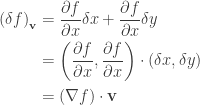
\displaystyle{    \begin{aligned}    \left(\delta f\right)_{\mathbf{v}}    &= \frac{\partial f}{\partial x} \delta x + \frac{\partial f}{\partial x} \delta y \\  &= \left(\frac{\partial f}{\partial x}, \frac{\partial f}{\partial x}\right) \cdot (\delta x, \delta y) \\  &= \left(\nabla f\right) \cdot \mathbf{v} \\    \end{aligned}}

The “height difference” does not care about the cause or process that introduces that height change.

— Me@2016-04-21 11:16:06 PM

.

.

2016.05.01 Sunday (c) All rights reserved by ACHK

A state of confusion, 2

algorias 1117 days ago

An incredibly accurate depiction of research in any theoretical field, I’d say. Compound that with the fact that during your education you’re mostly presented with texts that summarize decades or more of research into a scant few pages as if the people involved had just flowed naturally from one idea to the next, from a problem statement to the incredibly complex idea that unlocks the proof.

When it’s finally your turn to try your hand at actual research, it turns out that your contributions are barely a couple of side notes on a restricted subset of a problem in the hope that someone will use that information to find out something that is actually relevant in practice.

Rather than turning me off from academia, it makes me marvel at the tower of minuscule pebbles upon which our modern civilization rests. One day, I might get to place a few more of them on top.

— Hacker News

2016.04.12 Tuesday ACHK

注定外傳 2.5

Can it be Otherwise? 2.5 | The Beginning of Time, 7.2

所以,討論任何問題,例如「某一件是否注定」時,即使有「推斷到時間起點」的企圖,也沒有可能做到,除非能夠把「量子力學」和「廣義相對論」合體。

我們至多只能追溯到,「普朗克時間」完結的那一刻,然後講一句:「再之前的,沒有資料」。

4. 即使可以追溯到「時間的起點」(第一因),所謂的「可以」,只是宏觀而言,決不會細節到可以推斷到,你有沒有自由,明天七時起牀。

(問:如果因果環環緊扣,即使細節不完全知道,至少理論上,我們可以知道,如果「第一因」本身有自由,那其他個別事件,就有可能有(來自「第一因」的)自由;如果連「第一因」也沒有自由,那其他個別事件,都一律沒有自由。

這裡「因果環環緊扣」的意思是,不會有「同因不同果」的情況;每一件事情,都被之前的原因所注定。)

那會引起一些,奇怪的句子。你不會知道,那些句子是,什麼意思。例如:

「第一因有自由。」

「第一因」根據定義,是沒有原因的。亦即是話,「時間的起點」,再沒有「之前」。而「有自由」,就即是「有其他可能性」。所以,「第一因有自由」的意思是,

「第一因還有其他的可能性。」

但是,既然「第一因」本身沒有原因,誰有那個自由呢?理論上,誰可以引發到,「第一因」的其他可能呢?

根本沒有誰,可以決定到「時間的起點」是怎樣的,因為,根本沒有誰,可以存在於,「時間起點」之前,因為,「時間的起點」,根本沒有「之前」。「時間起點之前」,就有如「北極點的北面」一樣,沒有意思。

考慮一件事有沒有自由,是要以該件事為「結果」,看看該件事的「原因」,然後,推論或驗證,有沒有可能,有「同因不同果」的情況。

但是,「於時間起點發生的第一件事」(第一因),本身沒有原因。那樣,你就不能以「第一因」這件事為「結果」,看看它的「原因」,然後,推論或驗證,有沒有可能,有「同因不同果」的情況。

所以,「第一因本身,有沒有自由」這問題,根本沒有意義。

(問:如果有「造物主」,祂不就是那個誰,可以從宇宙之初的不同可能性中,選擇一個去實現嗎?)  

那只是因為你,一時忘記了,「宇宙」這個詞語的意思是「所有東西」。所以,如果「造物主」存在,祂也是「宇宙」的一部分。

那樣,我們又要再討論,「造物主」有沒有自由。如果「造物主」就是「第一因」的話,根據剛才的解說,「造物主(第一因)本身,有沒有自由」這問題,根本沒有意義。

再者,即使你故意忽略「第一因有沒有自由」這問題,我亦可以質疑,

「因果是否真的『環環緊扣』,有沒有可能,有『同因不同果』的情況?」

那要再詳細研究,而剛才我們已經討論過了,請回顧。

— Me@2016-03-15 08:43:58 AM

2016.03.31 Thursday (c) All rights reserved by ACHK

Gradient

Assume \displaystyle{(x, y)} represents the position of an object and \displaystyle{f(x,y)} is a scalar field on the \displaystyle{x}\displaystyle{y} plane. Then \displaystyle{\frac{\partial f}{\partial x}} represents the change of \displaystyle{f} per unit length along the positive \displaystyle{x} direction. In other words, it is the spatial rate of change of \displaystyle{f} along the \displaystyle{x} direction.

Similarly, derivative \displaystyle{\frac{\partial f}{\partial y}} represents the spatial rate of change of \displaystyle{f} along the \displaystyle{y} direction.

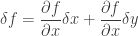
For an arbitrary direction, due to the nature of displacement, the change of \displaystyle{f} is \displaystyle{\delta f = \frac{\partial f}{\partial x} \delta x + \frac{\partial f}{\partial x} \delta y} when the object has finished moving \displaystyle{\delta x} in \displaystyle{x} direction and then \displaystyle{\delta y} in \displaystyle{y} direction.

Then, the spatial rate of change of \displaystyle{f} is

\displaystyle{   \begin{aligned}   &\frac{\delta f}{\sqrt{(\delta x)^2 + (\delta y)^2}} \\  &= \frac{\partial f}{\partial x} \frac{\delta x}{\sqrt{(\delta x)^2 + (\delta y)^2}}  + \frac{\partial f}{\partial x} \frac{\delta y}{\sqrt{(\delta x)^2 + (\delta y)^2}} \\  \end{aligned} }

.

For simplicity, denote the resultant displacement as \displaystyle{\mathbf{v}}:

\displaystyle{\mathbf{v} = (\delta x, \delta y)}

and define \displaystyle{\nabla f(x)} as

\displaystyle{\left( \frac{\partial f}{\partial x}, \frac{\partial f}{\partial y} \right)}

Then, the change of the \displaystyle{f} due to the displacement \displaystyle{\mathbf{v}} is

\displaystyle{\begin{aligned}  \left(\delta f\right)_{\mathbf{v}}  &= \frac{\partial f}{\partial x} \delta x + \frac{\partial f}{\partial x} \delta y \\  &= \left(\frac{\partial f}{\partial x}, \frac{\partial f}{\partial x}\right) \cdot (\delta x, \delta y) \\  &= \left(\nabla f\right) \cdot \mathbf{v} \\  \end{aligned}}

.

So the spatial rate of change \displaystyle{f} along the direction of the vector \displaystyle{\mathbf{v}} is

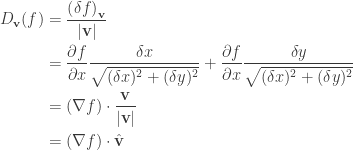
\displaystyle{\begin{aligned}  D_{\mathbf{v}}(f)  &= \frac{\left(\delta f\right)_{\mathbf{v}}}{|\mathbf{v}|} \\  &= \frac{\partial f}{\partial x} \frac{\delta x}{\sqrt{(\delta x)^2 + (\delta y)^2}}  + \frac{\partial f}{\partial x} \frac{\delta y}{\sqrt{(\delta x)^2 + (\delta y)^2}} \\  &= \left(\nabla f\right) \cdot \frac{\mathbf{v}}{|\mathbf{v}|} \\  &= \left(\nabla f\right) \cdot \hat{\mathbf{v}} \\  \end{aligned}}

\displaystyle{D_{\mathbf{v}}(f)} is called directional derivative.

— Me@2016-02-06 09:49:22 PM

.

This is the reason that \displaystyle{\nabla f} is in the steepest direction.

If \displaystyle{\hat{\mathbf{v}}} is chosen to be parallel to \displaystyle{\nabla f}, the directional derivative \displaystyle{\left(\nabla f\right) \cdot \hat{\mathbf{v}}} would be maximized.

— Me@2021-08-20 05:20:02 PM

.

.

2016.02.21 Sunday (c) All rights reserved by ACHK

注定外傳 2.4

Can it be Otherwise? 2.4 | The Beginning of Time, 7

因為沒有指定,追溯到哪一件事,或者哪一刻為止,所以討論會沒完沒了。

(問:不會沒完沒了呀。只會追溯到「時間的起點」。)

我們根本不知道,「時間的起點」(第一因)是怎樣的。那樣,我們又怎能夠,根據「時間的起點」,去判斷某一件事件,是不是注定的呢?

(問:可能可以。所謂「時間的起點」,其實就即是「宇宙的開端」。)

可以這樣說,因為「宇宙」這個詞語,就是指「所有事物」。所以,「時間起點」和「宇宙開端」,是同義詞。

(問:而物理學家知道,「字宙的開端」是「宇宙大爆炸」。所以我們知道,「時間的起點」,就是「宇宙大爆炸」。)

大概而言是。但是,嚴謹一點講:

1. 「宇宙大爆炸」是一件事件,有一個過程,並不是時間上的「一點」,所以不算是「起點」。「宇宙大爆炸這件事的開始那刻」才算是起點。

當然,「宇宙大爆炸這件事的開始那刻」太長太麻煩,可以用同義詞「宇宙開端」代替。但是,「宇宙開端」這四個字,太過空泛,沒有任何詳情。試想想,知道了「時間起點」就是「宇宙開端」,那又怎樣呢?

用「宇宙大爆炸這件事的開始那刻」,起碼可以知道,「宇宙開端」那一刻,開始發生的第一件事,是「宇宙大爆炸」。所以,如果又要細節,又要精簡,把「宇宙大爆炸這件事的開始那刻」,簡稱成「宇宙大爆炸」也無妨,只要上文下理足夠清晰,不會引起誤會就可以。

2. 物理學家根據愛因斯坦的「廣義相對論」推斷,「宇宙開端」那一刻,開始發生的第一件事,是「宇宙大爆炸」。所以,如果「廣義相對論」不正確,「宇宙大爆炸」就未必為真。

3. 即使「廣義相對論」是可信的,普朗克時期(Planck epoch),即是開端後的頭\(10^{−43}\)秒之內,以現時的物理知識,是處理不到的。所以,物理學家推斷不到,那段時間內,發生了什麼事。

如果要知道「普朗克時期」內,宇宙演變的詳情,物理學家就要先把「量子力學」和「廣義相對論」的矛盾化解。這個工序,學名是「把廣義相對論量子化」。

所以,討論任何問題,例如「某一件是否注定」時,即使有「推斷到時間起點」的企圖,也沒有可能做到,除非能夠把「量子力學」和「廣義相對論」合體。

我們至多只能追溯到,「普朗克時間」完結的那一刻,然後講一句:「再之前的,沒有資料」。

— Me@2016-02-15 07:04:56 PM

2016.02.15 Monday (c) All rights reserved by ACHK

Exercise 6.2

You Could Have Invented Monads! (And Maybe You Already Have.)

f :: a -> b
f' :: a -> m a
unit :: a -> m a

f' * g' = (bind f') . (bind g')

bind f xs = concat (map f xs)

bind unit xs = concat (map unit xs)

unit x = [x]

bind unit xs
= concat (map unit xs)
= concat (map unit [x1, x2, ...])
= concat [unit x1, unit x2, ...]
= concat [[x1], [x2], ...]
= [x1, x2, ...]
= xs

f' = lift f

lift f = unit . f

unit (or return) can directly act on an ordinary value only, but not on a monadic value. To act on a monadic value, you need to bind it.

How come we do not need to lift return?

f :: a -> b

liftM :: Monad m => (a -> b) -> m a -> m b

return :: a -> m a

(liftM f) :: m a -> m b

(>>=) :: Monad m => m a -> (a -> m b) -> m b

lifeM cannot be applied to return at all.

unit (or return) is neither a pure function nor a monadic function. Instead, it is an half-monadic function, meaning that while its input is an ordinary value, its output is a monadic value.

(bind return xs) -> ys

(bind return) applies to xs.

return applies to x.

liftM is merely fmap implemented with (>>=) and return

— Wikibooks on Haskell/Understanding monads
 

— Me@2016-01-26 03:05:50 PM

2016.01.30 Saturday (c) All rights reserved by ACHK

More College Advice – GPA

I know this has been discussed before here, but I find Joel’s comments about having a high GPA questionable. I’ve never paid much attention to GPA scores when hiring, except to wonder why some candidates with mediocre GPAs in the 3.0 – 3.3 range brag them up. If anything, I’m interested in people who have quirky grades all over the map due to taking strange, challenging, and diverse courses.

It’s hard for me to believe that people in hiring positions really care much about high GPAs, unless they themselves have high GPAs (ignoring HR drone filters). If so, that’s already a minority. Even in this group, though, especially those with very high GPAs, my experience has been that its not really a factor.

At best, it’s a slight positive in the general hiring world, and can actually count against one when seeking employment, as in Bs don’t hire As. I tend toward very high GPAs myself (3.9 in my just completed graduate work, albeit it’s business strategy).

So I’m curious, does anyone here agree with Joel on this to the extent that the GPA counts (or would count) as important if you were hiring someone? Are you a high GPA yourself? I’m curious if there’s a correlation between high GPA and this attitude.

— Mongo

— Monday, January 03, 2005

You know the old saying, “The world is run by C students”[.]

— ted knight

— Monday, January 03, 2005

From my experience from college (and this is just my experience, so don’t flame me), the people with high GPAs were generally hard working and responsible, while the people with low GPAs were either slackers, people that made excuses (“oh, I had sooo much work to do”) or just not good enough to get high grades. I wouldn’t really want to hire most of the people I knew with poor GPAs. Some were very good, but I wouldn’t trust them to do be responsible and do their job even when things got boring.

I got a 3.91 from a top 10 CS program, and that helped tremendously when I was looking for jobs and internships. Companies were contacting me and asking me to apply, I didn’t have to seek them out. A friend of mine who graduated at the same time as me, from the same program, just found a job recently almost two years after graduating. He said a lot of companies wouldn’t even look at him because of his low GPA.

Other friends decided they couldn’t find a good job, so they’re going to grad school. Well, big surprise, they can’t get into a good grad school either with their low GPAs.

So yeah, I think it matters a great deal. One thing I noticed was that the people that had to pay for college themselves and had to work through college (like me) took it more seriously and got better grades, while those whose parents paid for it oftentimes didn’t care too much, took way too long to graduate, etc.

— sloop

— Monday, January 03, 2005

— The Joel on Software Discussion Group (CLOSED)

2016.01.19 Tuesday ACHK

注定外傳 2.3

Can it be Otherwise? 2.3

如果沒有明確指出,那個『必然』,是相對於哪個『觀測準確度』(觀察者解像度)而言的話,問一件事是不是『必然』,是沒有意思的,因為,無論那一件事,是在過去還是未來,往往既可以解釋成『必然』,又可以解釋為『非必然』。

除此之外,剛才亦提到:

對於過去的事,例如,在剛才甲和乙『這次數學考試我不合格,是不是必然』的討論中,當一方說那件事是『必然』時,另一方可以立刻,走深一個層次, 到達下一個『觀測解像度』,把同一件事,說成是『偶然』的;然後,原方又可以再走到,再下一個層次,把那事說成是『必然』的;如此類推。

對於未來之事,都有類似的情形,例如:

甲:明早我可以選擇七時起床,亦可以選擇不七時起床。那就證明,我有自由。

乙:不一定。你沒有那樣的自由。例如,如果你之前一晚,深夜兩時才睡,你可以肯定,你想七時起床也起不來。

甲:我可以選擇,之前一晚早一點睡。所以,我還是有自由。

乙:未必。假設你有要事,例如,明早有畢業論文要交,但尚未完成;那樣,你也沒有自由,去選擇早一點睡。

甲:但是,在再早一點之前,我可以選擇,早一點開始寫論文,早一點完成。那就可以避免,趕工夜睡的情況。

然後,乙又可以指出,甲並不是想早一點開始寫論文,就一定可以早一點,因為,甲會受到其他事務的牽制;如此類推。

這是一個沒有意義的討論,因為沒有止境,不會有結論。

每當甲指出,做某一件事(事件一)有自由、有選擇時,乙總可以質疑,那件事會,受制於之前的事件,例如事件二。然後,甲再指出,之前的事(事件二)本身,其實甲有某程度上的自由,所以,間接來說,甲對事件一,都有選擇。但是,乙又可以再質疑,事件二都會,受再之前的事件(事件三)的影響,其實事件二,也不算是自由的。

因為沒有指定,追溯到哪一件事,或者哪一刻為止,所以討論會沒完沒了。

— Me@2016-01-06 03:17:54 PM

2016.01.06 Wednesday (c) All rights reserved by ACHK

Self-information

The information entropy of a random event is the expected value of its self-information.

In information theory, self-information or surprisal is a measure of the information content [clarification needed] associated with an event in a probability space or with the value of a discrete random variable.

By definition, the amount of self-information contained in a probabilistic event depends only on the probability of that event: the smaller its probability, the larger the self-information associated with receiving the information that the event indeed occurred.

As a quick illustration, the information content associated with an outcome of 4 heads (or any specific outcome) in 4 consecutive tosses of a coin would be 4 bits (probability 1/16), and the information content associated with getting a result other than the one specified would be 0.09 bits (probability 15/16).

— Wikipedia on Self-information

2015.12.31 Thursday ACHK

Reality 4

Real” has meanings other more than “lasting“.

For example, “pain is real” means “pain is objective“, instead of “pain is lasting“. 

real

~ objective

lasting

~ independent of time (to a certain extent)

real

~ independent of most of the things

~ constant with respect to most of the things

— Me@2015-12-21 12:34 AM

2015.12.30 Wednesday (c) All rights reserved by ACHK

注定外傳 2.2

Can it be Otherwise? 2.2

如果沒有明確指出,那個『必然』,是相對於哪個『觀測準確度』(觀察者解像度)而言的話,問一件事是不是『必然』,是沒有意思的,因為,無論那一件事,是在過去還是未來,往往既可以解釋成『必然』,又可以解釋為『非必然』。

對於未來之事,究竟注定與否,並不會指引到你,如何做決定。

例如,試想想,你下一次數學考試,成績是否注定,會怎樣影響你,現在的行動呢?

甲:如果並未注定,我就仍然有機會,透過努力來提升成績。那樣,我自然會選擇去溫習。如果已經注定,我溫不溫習,根本不會影響到成績。那樣,我自然會乾脆不溫習,節省時間。

乙:不可以是,注定你會溫習,從而成績大進嗎?

甲:都可以。但是,我不想溫習。

乙:那就即是話,你溫不溫習,是你的決定;跟成績是否注定,沒有關係。

「成績注定」和「主動溫習」,根本沒有矛盾。

如果你決定溫習,你可以說,那是因為你有自由,選擇溫習。亦可以說,那是因為命中注定,你會選擇溫習。

如果你決定不溫習,你可以說,那是因為成績如何,是命中注定的,溫習來也沒有影響。亦可以話,那是因為成績如何,不是必然的;即使我不溫習,也不代表成績一定差。

一方面,無論你的決定是哪一個,你總可以把,你決定的原因,講成「因為我覺得事情是注定的」;亦可以把,你決定的原因,說成「因為我覺得,我還有自由度,改進到事情的結果」,或者「因為我覺得,事情的結果,不是必然的」。

另一方面,如果從外評論你的決定,總可以把你說成有自由,亦可以把你說成沒有自由。

如果你覺得,一切皆為注定,我可以說,因為那是事實,所以你注定有這個想法;亦可以話,你有自由意志,去相信「一切皆為注定」。

如果你覺得,你有自由意志,我可以說,因為那是事實,所以你自然有這個想法;亦可以話,你的命中注定,會相信「我有自由意志」。

— Me@2015-12-29 03:12:39 PM

2015.12.29 Tuesday (c) All rights reserved by ACHK

Ramond sector zero modes

Problem 14.3b4

A First Course in String Theory
 
 
What are \xi_1, \xi_2, \xi_3, \xi_4 in Equation (14.44)?

p.315 “Ramond fermions are more complicated than NS fermions because the eight fermionic zero mode d_0^I must be treated with care. It turns out that these eight operators can be organized by simple linear combinations into four creation operators and four annihilation operators. Let us call the four creation operators …”

Since there are 8 possible transverse directions, there are 8 possible d_0^I‘s, where I = 2,3, ..., 9.
 
What is the meaning of “… organized by simple linear combinations into four creation operators …”?

— Me@2015.11.01 03:53 AM
 
 
The d_0^I operators are similar to but different from other d_r^I operators.
 
d_0^I‘s and d_r^I‘s are similar in the sense that they all follow Equation (14.43):

\{ d_m^I, d_n^J \} = \delta_{m+n, 0} \delta^{IJ}

p.315 “Again, the negatively moded oscillators d_{-1}^I, d_{-2}^I, d_{-3}^I, ..., are creation operators, while the positively moded ones d_{1}^I, d_{2}^I, d_{3}^I, ... are annihilation operators.”
 
d_0^I‘s and d_r^I‘s are different in the sense that d_0^I‘s are neither creation nor annihilation operators.
 
 
(Based on the ideas from “Introduction to String Theory, A.N. Schellekens” and “A First Course in String Theory (Second Edition)” p.315:)
 
If we define d_0 | 0 \rangle = 0,

\{ d_0^I, d_0^J \} | 0 \rangle
= \left( d_0^I d_0^J + d_0^I d_0^J \right) | 0 \rangle
= 0

which does not match the requirement of

\{ d_0^I, d_0^J \} = \delta^{IJ}

So the definition d_0 | 0 \rangle = 0 does not work.
 
— Me@2015.11.12 11:30 AM
 
 
Instead, they are “organized by simple linear combinations into four creation operators”.
 
(Based on the idea from “Boundary Conformal Field Theory and the Worldsheet Approach to D-Branes, by Andreas Recknagel,Volker Schomerus” and “A First Course in String Theory (Second Edition)” p.315:)
 
Let

c_0^i = d_0^{i+1}
e_i = \frac{1}{\sqrt{2}} \left( c_0^{2i} - i c_0^{2i - 1} \right)
e_i^\dagger = \frac{1}{\sqrt{2}} \left( c_0^{2i} + i c_0^{2i - 1} \right).

Then

\left\{ e_i, e_j^\dagger \right\}
= \frac{1}{2} \left\{ \left( c_0^{2i} - i c_0^{2i - 1} \right), \left( c_0^{2j} + i c_0^{2j - 1} \right) \right\}
= \frac{1}{2} \delta^{ij} \left\{ \left( c_0^{2i} - i c_0^{2i - 1} \right),  \left( c_0^{2i} + i c_0^{2i - 1} \right) \right\}

By p.315 Equation (14.43):

\{ d_0^I, d_0^J \} = \delta^{IJ}

In other words,

\{ c_0^{I-1}, c_0^{J-1} \} = \delta^{I-1,J-1}
\{ c_0^{I}, c_0^{J} \} = \delta^{IJ}

\left\{ e_i, e_j^\dagger \right\}
= \frac{1}{2} \left\{ \left( c_0^{2i} - i c_0^{2i - 1} \right), \left( c_0^{2j} + i c_0^{2j - 1} \right) \right\}
= \frac{1}{2} \delta^{ij} \left[\left\{ c_0^{2i} , c_0^{2i} \right\} - \left\{ i c_0^{2i - 1}, i c_0^{2i - 1} \right\} \right]
= \frac{1}{2} \delta^{ij} \left[\left\{ c_0^{2i} , c_0^{2i} \right\} + \left\{ c_0^{2i - 1}, c_0^{2i - 1} \right\} \right]
= \frac{1}{2} \delta^{ij} \left[1 + 1 \right]
= \delta^{ij}

This is compatible with the anti-commutator requirement for fermion creation and annihilation operators: 

\{a^{\,}_i, a^\dagger_j\} = \delta_{i j}

— Me@2015.11.13 11:14 PM


2015.12.12 Saturday (c) All rights reserved by ACHK

Inception 11

如何拯救眾生 4

.

Inception contains most of the important topics I have thought of in these few months:

1. Multi-mind

2. Layers of consciousness

3. Dream time

4. Lucid dream

5. Idea/software as a way to save Earth people

.

The deeper the consciousness, the more powerful it is.

The deepest layer is the Light.

The Light of everyone is the same.

— Me@2010.08.06

.

人同此心,心同此理

— Me@2010.08.09

.

.

.

2011.01.15 Saturday (c) ACHK