Monty Hall problem 1.4.3

Frequency probability and Bayesian probability, 3.2.3

機會率哲學 3.2.3

這段改編自 2010 年 4 月 3 日的對話。

既然是兩個不同的概念,我們何不索性賦予它們,兩個不同的名字。那就可以避免再混淆。我們可以把「頻率學派」的「機會率」,叫做「頻率機會率」、「客觀機會率」,或者「物理機會率」。然後,我們把「貝葉斯學派」的「機會率」,叫做「貝葉斯機會率」、「主觀機會率」,或者「知識機會率」。

(安:「頻率機會率」和「貝葉斯機會率」的分別作於,「頻率學派」認為,機會率的數值是客觀的,反映著被觀察系統的物理性質;而「貝葉斯學派」則認為,機會率的數值是主觀的,反映著觀察者對一個物理系統的知識多寡。

但是,既然「頻率機會率」和「貝葉斯機會率」都叫做「機會率」,即是它們有著密切的關係,共通的地方。正如,既然「紅蘋果」和「青蘋果」都是「蘋果」,即是它們有著很多相同的性質。那樣,我想問,「頻率機會率」和「貝葉斯機會率」的關係是什麼?有沒有可能把兩者統一起來?或者說,可不可以用同一個架構來處理它們呢?)

你的意思是,可不可以把「頻率機會率」和「貝葉斯機會率」視為,同一樣東西的兩個方面?

對於「機會率真義」這個問題,我的第二個解答,正正是企圖處理這個點。

「頻率機會率」和「貝葉斯機會率」衝突的來源,在於雙方也假設了,對於一個機會率問題,我們可以有把「觀察者」和「被觀察者」,百分百地截然分開。在這裡,「觀察者」即是「機會率使用者」;「被觀察者」即是「外在物理系統」。

如果視「觀察者」和「被觀察者」為兩個互不相干的系統,我們就可以爭論,究竟「機會率」是在描述「被觀察者」的性質,即是「物理性質」;還是在表達「觀察者」的性質,即是「知識多寡」。

但是,如果「可以把『觀察者』和『被觀察系統』完全分開」這個假設,根本不成立,我們就應該把「觀察者」,視為對應機會率系統的一部分。那樣,「觀察者的性質」就化成「系統性質」的一部分。

「觀察者」加「被觀察者」作為一個整體,作為一個單一系統的話,「機會率」就是那個大系統的性質。
This work is in the public domain in the United States, and those countries with a copyright term of life of the author plus 100 years or less.

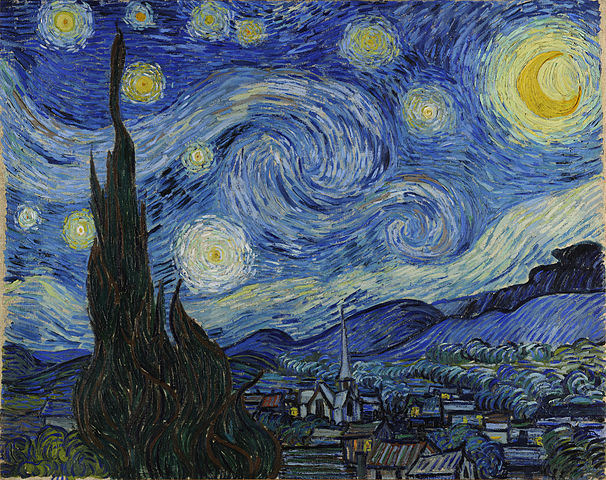
(安:假設梵高(Van Gogh)的一幅名畫,給一位有錢人甲,用一億元買下來。然後我們問,究竟那幅名畫的「價值」,是那幅畫本身的性質,還是有錢人甲的性質?

一方面,我們不可以說,那一億元的「價值」,純粹是那幅畫的性質,因為對於一個三餐不計的平民來說,「衣食豐足」遠勝過「一幅梵高大作」。甚至,他可能連「梵高」是誰,也不太知道。

另一方面,我們亦不可以說,那一億元的「價值」,純粹是那位有錢人甲的性質,因為對於甲來說,並不是任何一位畫家的任何一幅畫,都價值一億大元。)

— Me@2012.11.25

2012.11.25 Sunday (c) All rights reserved by ACHK
Superdeterminism 2.1

Paradox 9.2 | Bell’s theorem, 4.1

Bell’s theorem states that if Bell’s inequality is violated by experimental results, then the original quantum mechanics is correct in a sense that no local hidden variable theory is possible to replace it. Nature is either non-local or non-counterfactual-definite (or both).

1. The principle of locality:

There are two possible meanings of “locality” here.

1.1 The principle is correct in a sense that no causal influence can be faster than light.

1.2 The principle is incorrect in a sense that distant particles can be entangled. Correlation without causation can be instantaneous.

Assume that a pair of particles are entangled. Measuring one particle will collapse the wave function, which governs both particles, instantaneously.

2. Counterfactual definiteness:

2.1 It is correct in a sense that an object has a definite quantum state.

2.2 It is incorrect in a sense that, more often than not, the definite quantum state is not corresponding to a definite classical state (aka eigenstate). Instead, that quantum state is a superposition of different eigenstates. 

The meaning of the phrase “counterfactual definiteness” in quantum mechanics or Bell’s theorem is not the same as that in the superdeterminism theory. They are two different concepts.

— Me@2012-11-24 11:21:01 AM

2012.11.25 Sunday (c) All rights reserved by ACHK

A Word to the Wise

It turns out there is, and the key to the mystery is the old adage “a word to the wise is sufficient.” Because this phrase is not only overused, but overused in an indirect way (by prepending the subject to some advice), most people who’ve heard it don’t know what it means. What it means is that if someone is wise, all you have to do is say one word to them, and they’ll understand immediately. You don’t have to explain in detail; they’ll chase down all the implications.

— A Word to the Resourceful

— January 2012

— Paul Graham

2012.11.24 Saturday ACHK

Monty Hall problem 1.4.2

Frequency probability and Bayesian probability, 3.2.2

機會率哲學 3.2.2

這段改編自 2010 年 4 月 3 日的對話。

「頻率學派」和「貝葉斯學派」之中,究竟哪一個正確呢?又或者說,哪一個較為有用呢?

「機會率」既有客觀的成份,又有主觀的成份。留意,這裡「主觀」的意思,並不代表「不正確」。一方面,我們真的使用「機會率」,來描述外在事件;另一方面,「機會率」又真的會反映,一個人對一件外在事件的結果,無知程度的深淺。

「機會率」處理「未知」,但不一定處理「未來」,因為「未知」不一定代表「未來」。例如,剛才的例子中,骰子已擲,而我亦知道了結果,所以不是「未來」。但是,因為你還未看結果,所以相對你來說,那仍然是「未知」。你仍然需要使用「機會率」,來估計結果。大概而言,所有人也不知的,為之「未來」;精確而言,尚未發生的,才為之「未來」。

對於「機會率真義」這個問題,我的第一個解答是,其實「頻率學派」所講的「機會率」,和「貝葉斯學派」所講的「機會率」,根本是兩個不同的概念,有著不同的意思,雖然兩個意思十分相關,相關到會用同一個名字「機會率」,甚至很多時會有相同的數值。

既然是兩個不同的概念,我們何不索性賦予它們,兩個不同的名字。那就可以避免再混淆。我們可以把「頻率學派」的「機會率」,叫做「頻率機會率」、「客觀機會率」,或者「物理機會率」。然後,我們把「貝葉斯學派」的「機會率」,叫做「貝葉斯機會率」、「主觀機會率」,或者「知識機會率」。

— Me@2012.11.23

2012.11.23 Friday (c) All rights reserved by ACHK

Superdeterminism

Paradox 9

In the context of quantum mechanics, superdeterminism is a term that has been used to describe a hypothetical class of theories which evade Bell’s theorem by virtue of being completely deterministic. Bell’s theorem depends on the assumption of [non-] counterfactual definiteness, which technically does not apply to deterministic theories. It is conceivable, but arguably unlikely, that someone could exploit this loophole to construct a local hidden variable theory that reproduces the predictions of quantum mechanics.

… in a deterministic theory, the measurements the experimenters choose at each detector are predetermined by the laws of physics. It can therefore be argued that it is erroneous to speak of what would have happened had different measurements been chosen; no other measurement choices were physically possible. Since the chosen measurements can be determined in advance, the results at one detector can be affected by the type of measurement done at the other without any need for information to travel faster than the speed of light.

— Wikipedia on Superdeterminism

Even if there are no other physical possibilities for a measurement choice, there are other logical possibilities. The goal of quantum mechanics, or science in general, is to consider, for an identical system, what input results what output.

The problem of superdeterminism in quantum mechanics is not “claiming the observers’ action are deterministic”, but by claiming so, claiming also that there is no decoherence (wave function collapse).

When we say that the observer cannot be separated from the observed, we mean that we have to consider the whole (observed + observer), instead of shifting the system from the observed to the observer, and then ignoring the original observed itself.

— Me@2012-11-20 02:11:06 PM

2012.11.23 Friday (c) All rights reserved by ACHK

Monty Hall problem 1.4.1

Frequency probability and Bayesian probability, 3.2.1

機會率哲學 3.2.1

這段改編自 2010 年 4 月 3 日的對話。

「機會率」這門學問,有兩個主要的學派:「頻率學派」(frequentist probability)和「貝葉斯學派」(Bayesian probability)。兩派對「機會率」的詮釋,有相反的意見。

「頻率學派」認為,機會率的數值是客觀的,反映著被觀察系統的物理性質。例如,你把某一粒骰子擲了六千次。如果每一個數字出現的次數,都大概是一千次的話,你就可以宣稱,那一粒骰子是正常的。對於該粒骰子,你擲到任何一面的機會率,都是六分之一。「頻率學派」認為,「擲到任何一面機會都是六分之一」這句本身,其實間接地描述了,該粒骰子的物理性質,例如「骰子有六面」和「質量均勻分佈,沒有偏袒」等。

「貝葉斯學派」則認為,機會率的數值是主觀的,反映著觀察者對一個物理系統的知識多寡。即使是同一個系統的同一件事件的同一個可能結果,不同觀察者可以運算到,截然不同的機會率,而他們彼此都沒有錯。例如,我擲了一粒公平骰子後,立刻檢查一下結果,但又不給你看。我發現我擲到「三」。然後,我要你估一估計,結果是什麼。相對於我來說,我擲到「三」的機會率是 100%,而其他數字的機會則是 0%,因為我已經知道結果。但是,你卻仍然不知道結果。所以,相對於你來說,我擲到「三」的機會率只是六分之一,而不是 100%。

「頻率學派」和「貝葉斯學派」之中,究竟哪一個正確呢?又或者說,哪一個較為有用呢?

— Me@2012.11.22

2012.11.22 Thursday (c) All rights reserved by ACHK

Hero 4

Seen by itself the David’s body might be some unusually taut and vivid work of antiquity; it is only when we come to the head that we are aware of a spiritual force that the ancient world never knew. I suppose that this quality, which I may call heroic, is not a part of most people’s idea of civilisation. It involves a contempt for convenience and a sacrifice of all those pleasures that contribute to what we call civilised life. It is the enemy of happiness. And yet we recognise that to despise material obstacles, and even to defy the blind forces of fate, is man’s supreme achievement; and since, in the end, civilisation depends on man’s extending his powers of mind and spirit to the utmost, we must reckon the emergence of Michelangelo as one of the great events in the history of western man.

— Ch. 5: The Hero as Artist

— Civilisation (1969)

— Kenneth Clark

2012.11.21 Wednesday ACHK

Monty Hall problem 1.3

Frequency probability and Bayesian probability, 3.1

機會率哲學 3.1

這段改編自 2010 年 4 月 3 日的對話。

除了錯誤使用「機會均等假設」外,思考「蒙提霍爾問題」時,另一個典型錯誤是,一般人不明顯知道,各道門的中獎機會率,在遊戲中途可能有變,即使房車和山羊的位置,都維持原本。

「機會率」除了描述客觀的物理系統外,還會反映觀察者的主觀知識狀態。換句話說,隨著那位遊戲參賽者,對他所觀察的系統,獲得多一點資料,各個機會率就會有變。例如,第三道門原本的中獎機會,相對於參賽者來說,是三分之一。但是,當主持人打開了它,導致參賽者知道「門後是山羊」後,相對於參賽者來說,第三道門中獎機會率,就立刻變成零。

This is a public domain image.

即使外在客觀的系統沒有變,只要觀察者對該系統的主觀知識,有所增加,事件各個可能結果,所對應的機會率,就要全部重新運算。

同理,雖然根據題目的假設,原初每道門的中獎機會均等,都是三分之一,但是,因為參賽者在中途,獲得了多一點資料,餘下兩道門中獎的機會率,未必仍然和對方相同。   

This is a public domain image.

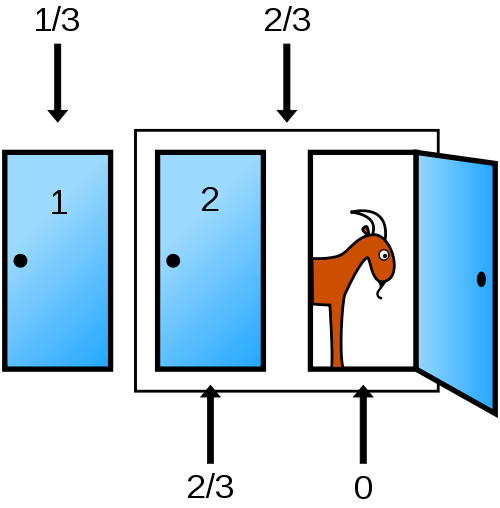
而正確的答案是,餘下的兩道門中獎機會,不再均等。原本的被選的那一道,中獎的機會是三分之一;另一道門中獎的機會,則變成了三分之二。

This is a public domain image.

— Me@2012.11.21

2012.11.21 Wednesday (c) All rights reserved by ACHK

機會率悲劇 1.2

Monty Hall problem 1.2

這段改編自 2010 年 4 月 3 日的對話。

.

「機會均等假設」如果胡亂使用,會得到很多荒唐的結論。例如,小明跟媽媽說:「在這次考試,我的成績有兩個可能。要麼我考到全班第一,要麼我考不到全班第一。所以,今次我有一半的機會,考到全班第一。」

媽媽回答:「荒謬!」

小明再解釋:「『考到全班第一』和『考不到全班第一』已經窮盡了,這次考試結果的所有可能。你不會想像到,有第三個情況出現。」

那樣,小明的媽媽,應該如何反駁他呢?

只有兩個可能的結果,並不代表各自的機會率是二分之一。除非題目假設,又或者有以往的實驗數據支持,例如小明在以往的考試中,平次每兩次中,就會有一次考第一;否則,你不能自己假設,機會率會平均分配於各個可能性。

而這個「故亂假設機會均等」的思考錯誤,往往形成塵世間很多悲劇,例如選錯配偶和選錯事業。「我加入這一行,要麼成功,要麼失敗。所以,我成功的機會有一半。」那即使不是顯意識的思考,大概也會是潛意識的想法。

這個錯誤來自,不必要地選擇無知。正當的做法是,先做功課,先做好資料搜集。以自己當時可以得到,最多和最準確的資訊,去評價自己,加入某一行時,成功和失敗的機會率,各佔多少。即使那個機會率不會十分詳細,例如「成功的機會是 57%」,你也至少要有個大概,知道成功的機會較大,還是失敗。如果成功的機會較大,是約略大多少呢?是不是大到,值得你投資未來五年的人生,去作嘗試呢?

雖然,那也不保證一定成功,但是至起碼,即使錯了,也可以問心無愧。而且,如果你是在做足功課的情況下失敗,你吸收到的知識經驗,將會是最豐富的。那將大大提高你,未來成功的機會率。

— Me@2012.11.19

.

.

2012.11.19 Monday (c) All rights reserved by ACHK

EPR paradox, 5

One important question raised by this ambiguity is whether Einstein’s theory of relativity is compatible with the experimental results demonstrating nonlocality. Relativistic quantum field theory requires interactions to propagate at speeds less than or equal to the speed of light, so “quantum entanglement” cannot be used for faster-than-light-speed propagation of matter, energy, or information.

Measurements of one particle will be correlated with measurements on the other particle, but this is only known after the experiment is performed and notes are compared, therefore there is no way to actually send information faster than the speed of light.

On the other hand, relativity predicts causal ambiguities will result from the nonlocal interaction. In terms of the EPR experiment, in some reference frames measurement of photon A will cause the wave function to collapse, but in other reference frames the measurement of photon B will cause the collapse.

— 02:57, 16 June 2012

— Wikipedia on Action at a distance (physics)

Correlation does not imply causation.

If two events A and B have no causal relationship, they can have different time orders in different frames of reference. In some frames, A happened at a time earlier than B. In some other frames, B happened at a time earlier than A.

However, if they have causal relationship, their time order is the same with respect to any frame of reference.

— Me@2012-11-18 10:44:59 PM

2012.11.19 Monday (c) All rights reserved by ACHK

機會率悲劇 1.1

Monty Hall problem 1.1

這段改編自 2010 年 4 月 3 日的對話。

(安:「蒙提霍爾問題」(Monty Hall problem)十分有趣。有趣的地方在於,一方面,大部分人都會答錯;另一方面,即使知道了答案及其運算方法,大部分人都仍然接受不到,因為答案嚴重違反一般人的直覺。甚至,很多受過「機會率」正式訓練的人士,都誤墮這個「機會率陷阱」。

「蒙提霍爾問題」的劇情是,有關一個「開門抽獎遊戲」。遊戲的大局是,在一位遊戲參加者的面前,會有三扇門。其中一扇門的後面,有一輛名貴房車。另外兩扇間後面,各有一隻山羊。

首先,主持人會叫那位參賽者,選擇其中一扇門。然後,主持人會打開那一扇門。遊戲的規則是,如果門後的是名貴房車,參賽者就可以得到它。

「蒙提霍爾問題」的第一個假設是,三扇門「門後有房車」的機會均等。換句話說,無論參賽者選擇哪一扇門,中獎的機會,同是三分之一。

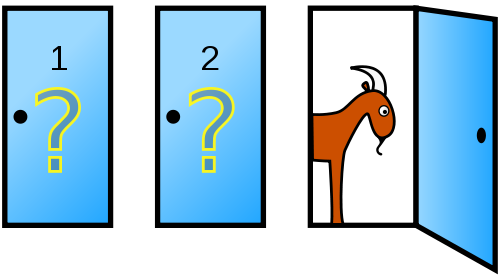
「蒙提霍爾問題」的第二個假設是,參賽者選了一扇門後,主持人在第一步,不會打開那扇門,反而,會先打開另外兩扇門的其中一扇。然後,大家會發現,開了的門後面,有一隻山羊。亦即是話,房車位於未開的兩扇門的其中一扇後面。這時,主持人會給予參賽者,一次重新選擇的機會。那位參賽者可以維持選擇,或者改為要另一扇門。

「蒙提霍爾問題」是,這個情況下,參賽者應否改變選擇?又或者說,參賽者如果改變選擇,可不可以提高他中獎的機會率呢?

This is a public domain image.

In search of a new car, the player picks a door, say 1. 
The game host then opens one of the other doors, say 3, 
to reveal a goat and offers to let the player pick door 2 instead of door 1.

— Wikipedia on Monty Hall problem

一般人的想法是,既然選兩扇門中的任何一個,機會都是二分之一,即使轉換選擇,也不會增加勝算。

但是,答案竟然不是那樣。原來,維持選擇的中獎機會,只有三分之一。改變選擇的中獎機會,卻有三分之二。)

這個結果震撼的地方在於,它違反人們一個根深柢固,但通常也錯的直覺。大部人也以為,各個可能結果的機會均等。如果一件事只有兩個可能的結果,每個結果的機會率,就一定是二分之一。這個「機會均等假設」大錯特錯。

— Me@2012.11.18

2012.11.18 Sunday (c) All rights reserved by ACHK
Noether’s theorem

Symmetry and conservation

… all conserved quantities come from symmetries in our universe. Because the laws of physics are the same no matter what direction you look in, angular momentum is conserved. Because they’re the same whether you move left or right, regular momentum is conserved. Because they’re the same now as they will be later in time, energy is conserved. Energy and momentum conservation come from two separate symmetries; …

— This work is licensed under a Creative Commons Attribution-ShareAlike 3.0 Unported License.

— Physics Stack Exchange

— Colin Fredericks

That is, conservation of momentum is a consequence of the fact that the laws of physics do not depend on position; this is a special case of Noether’s theorem.

— Wikipedia on Momentum

2012.11.17 Saturday ACHK

機會率哲學 2.7.2

The problem of induction 1.7.2 | Paradox 7.2

這段改編自 2010 年 4 月 3 日的對話。

(安:但是,你不能不考慮「機會率」。

例如,你發覺一粒骰子,一百次之中,全部一百次都是擲到「一」。那樣,你會認為,那一粒骰子不正常,不是公平的。你歸納到的規律是,那粒骰子次次也會擲到「一」。所以,你會預測,下次擲骰子的結果都是「一」。正如,因為以往的每天,太陽都由東邊升起,你自然會預期,明天都是那樣。這是一個「完全有規律」的例子。

又例如,你發覺一粒骰子,一百次之中,有九十次都是擲到「一」。你會覺得,「擲到一」的機會率,遠高於其他五個數字。你歸納到的規律是,那粒骰子傾向擲到「一」。所以,你會預測,下次擲骰子的結果都是「一」。這是一個「既不是完全沒有規律,亦不是完全有規律」的例子。一方面,這個事件並不是「完全不可預測」的,因為你相當有信心,骰子會擲到「一」。另一方面,這個事件亦不是「完全可預測」的,因為你的信心並不至於大到,願意用整副身家到擔保。

再例如,你發覺一粒骰子,一百次之中,有大概十六次是擲到「一」,而其他數字的出現次數,也是差不多。那樣,你會認為,那一粒骰子是正常公平的。這是一個「完全沒有規律」的例子。因為骰子對那六個數字,無所偏好,導致你「完全不可預測」,下一次會擲到哪一個數字。

但是,從另一層次看,「無所偏好」即是「隨機」。那樣,你就可以使用「機會率法則」。雖然你不可以預測,下一次會擲到哪一個數字,但是你可以宣稱,下一次擲到任何一個數字的機會率,都是六分之一。換句話說,如果你把骰子擲很多次,每個數字出現的次數,都會佔全部次數的大概六分之一。)

你的意思是,個別事件「完全不可預測」的話,即是在「個別事件層次」,完全沒有規律。那樣,如果提高一個層次,改為觀察「大量個別事件」,就反而會有明顯的規律。完全沒有規律的個別事件,即是「隨機事件」。既為「隨機事件」,就可以用「機會率」去處理。

又或者說,如果個別事件完全沒有「必然定律」,集體事件就會遵守「概然定律」。「概然」即是「大概而然」,亦即「集體而言」。「概然定律」,亦稱「機會率法則」。

— Me@2012.11.17

2012.11.17 Saturday (c) All rights reserved by ACHK

Single-world interpretation, 6.2.2

Information lost, 5

In the Many-worlds interpretation (MWI), when we say that “a + b” collapses to “a”, there is a shift of definition of “you”.

MWI is in one sense correct: choice b version of you still exists. But the trick is that he is not in another universe. He is in the environment of this universe.

And perhaps in reverse, you are also part of the environment of him.

— Me@2011.11.20

This environment theory is not totally accurate. For example, in the photon double slit experiment, during the wave function collapse, 

sqrt(2) | left > + sqrt(2) | right >

–> | left >    ,

| right > as the unchosen choice, or the lost information, goes to the environment.      

However, the macroscopic reality of | photon goes left > requires not only the state of the photon but also the state of its environment, including the lost information | right >_micro. Just the lost information itself is not enough to form a macroscopic reality.

— Me@2012.04.03

2012.11.16 Friday (c) All rights reserved by ACHK