EPR paradox, 11.3

Black hole information paradox, 2.2.3

.

It shouldn’t be so surprising that unitarity survives completely while causality doesn’t. After all, the basic postulates of quantum mechanics, including unitarity, the probabilistic interpretation of the amplitudes, and the linearity of the operators representing observables, seem to be universally necessary to describe physics of any system that agrees with the basic insights of the quantum revolution.

On the other hand, geometry has been downgraded into an effective, approximate, emergent aspect of reality. The metric tensor is just one among many fields in our effective field theories including gravity.

— Black hole information puzzle

— Lubos Motl

.

identical particles

~ some particles are identical, except having different positions

~ some particle trajectories are indistinguishable

.

trajectory indistinguishability

~ particle identity is an approximate concept

~ causality is an approximation

.

spacetime is defined by causality

~ so spacetime is also an approximation

— Me@2022-02-11 12:47:14 AM

— Me@2022-02-13 03:38:35 PM

.

.

2022.02.13 Sunday (c) All rights reserved by ACHK

EPR paradox, 11.2

Black hole information paradox, 2.2.2

.

physical definition

~ define the microscopic events in terms of observable physical phenomena such as the change of readings of the measuring device

~ define unobservable events in terms of observable events

— Me@2022-01-31 08:33:01 AM

.

superposition

~ lack of the existence of measuring device to provide the physical definitions for the (difference between) microscopic events

— Me@2022-01-31 08:33:01 AM

— Me@2022-02-12 10:22:09 AM

.

In the EPR experiment, how come the two always correlate if there are no definite states before the measurements?

When you actually know the results of your experiment, it does affect your expectations of the faraway results if there are correlations – and correlations are almost always there iff the two subsystems have interacted or been in contact in the past). — Lubos Motl

Microscopically, there is no time, in the sense that all the (past and future) quantum states have one-one correspondences. All results are deterministic. No causality violation required nor allowed. — Me@2016-10-14 07:55:48 PM

This is called quantum determinism, which may or may not be correct. But quantum determinism, even if true, is not necessary for explaining the EPR experiment, if we understand that:

1. Superposition is mathematical, not physical.

2. “Wave function collapse” is mathematical, not physical. It just means that we have to replace the wave function with another if we replace the system with another.

The system before and after the detectors activated should be regarded as two distinct systems. In other words, when you activate the detectors, you have actually replaced a system-without-detectors with a system-with-detectors.

“Wave function collapse” replaces the pure state wave function with a mixed state wave function. In other words, it replaces the pure state of superposition with a mixed state of eigenstates. In other other words, it replaces quantum probability with classical probability.

Before opening the box, the cat is not in a superposition state. Instead, it is in a mixed state.

The uncertainty is classical probability, which is due to lack of detailed knowledge, not quantum probability, which is due to lack of definition (in terms of physical phenomena difference).

— Me@2022-01-29 10:38:19 PM

— Me@2022-02-12 10:28:57 AM

.

.

2022.02.12 Saturday (c) All rights reserved by ACHK

EPR paradox, 11.1

Black hole information paradox, 2.2.1

.

superposition

~ lack of the existence of measuring device in the definition of the experimental setup to define the difference between microscopic events in terms of the difference between observable physical events

— Me@2022-01-31 08:33:01 AM

.

Note that superposition is mathematical, not physical. A wave function is not probabilities, nor a physical wave. Superposition applies only to wave functions, not to probabilities, nor to physical realities.

If superposition had been of probabilities or of physical realities, there would have been no interference patterns in the double-slit experiment.

— Me@2022-02-11 03:32:47 PM

.

For example, in the double-slit experiment, if no detector is installed, the system is in a quantum superposition state.

It is not that each individual photon is in a superposition, because an individual particle has no 100% objective identity, due to the indistinguishability of identical particles. Instead, it is that the system of the whole experimental setup is in a superposition.

This applies also to other more complicated experimental setups, such the EPR experiment, the delayed-choice experiment, the delayed-choice quantum eraser, etc.

— Me@2021-01-23 12:57 AM

— Me@2022-02-11 03:29 PM

.

physical definition

~ define the microscopic events in terms of observable physical phenomena such as the change of readings of the measuring device

~ define unobservable events in terms of observable events

— Me@2022-01-31 08:33:01 AM

.

a definite state

~ an eigenstate

~ a state that has given a physical definition

— Me@2022-02-11 01:19:57 PM

.

What we do in the present does not change the past, but changes we can see/say about the past. — Wheeler on Delayed choice quantum eraser, paraphrased, Me@2018-02-04 03:40:27 PM

Physics is not about reality, but about what one can say about reality. — Bohr, paraphrased

Physics should deduce what an observer would observe, not what it really is, for that would be impossible. — Me@2018-02-02 12:15:38 AM

It is because, tautologically, any state that cannot be physically defined is logically and physically meaningless.

In other words, any state that has no distinguishing observable effects does not make sense. For example, if in a double-slit experiment, no detector is allowed, then it is no point to label the state either as “go-left” or as “go-right”. Instead, we have to label the state as a superposition state.

Some unobservable (aka microscopic) variables are meaningless. It is not because of any philosophical points of view, but because we have not defined those variables in terms of observables or observable events, aka physical phenomena. In other words, those variables have no physical definitions yet.

— Me@2022-02-11 03:50:59 PM

.

Quantum mechanics, and physics in general, gives the rules of storytelling about reality. A story is a post hoc description of a physical event. In other words, quantum mechanics, and physics in general, is about phenomena, not noumena.

phenomenon (plural phenomena)

~ thing appearing to view

~ reality with respect to an observer

noumenon (plural noumena)

~ thing-in-itself

~ reality independent of any observers

— Me@2022-02-11 3:00 PM

.

.

2022.02.11 Friday (c) All rights reserved by ACHK

The superposition language

classical language

~ all particles are distinguishable

~ every particle has an objective identity

.

quantum language

~ some particles are identical

~ some particles are indistinguishable

~ Not every particle has an objective identity

.

[guess]

When you insist on using all-particles-are-distinguishable language on the maybe-indistinguishable particles, you get the superposition language.

[guess]

— Me@2022-02-05 09:26:26 PM

.

.

2022.02.10 Thursday (c) All rights reserved by ACHK

Photon dynamics in the double-slit experiment, 6.2

A wave function is used for calculating probability, but itself is not a probability.

However, like probability, a wave function is not a physical wave, which is located in physical space-time.

Like probability, a wave function is a mathematical tool that exists only in the conceptual space.

So, like probability, a wave function cannot be measured by any device.

— Me@2022-02-02 6:48 AM

.

.

2022.02.09 Wednesday (c) All rights reserved by ACHK

Photon dynamics in the double-slit experiment, 6

Why don’t we see superposition states for macroscopic objects?

.

A superposition state is not any “overlapping” of multiple physical states.

.

A superposition state is a wave function, which is not a physical wave located in physical space.

Instead, it is a mathematical tool to calculate probability distributions.

— Me@2022-02-01

.

EM waves are not photon wave functions because EM waves are physical, while wave functions are mathematical.

— Me@2022-02-01

.

In addition, the electromagnetic fields are observable (e.g. with an oscilloscope) while Schroedinger wave functions are not observable, even in principle. Clearly, then, the fields are not wavefunctions, are physical, observable fields, rather than merely what you take the modulus-square of to obtain the probability of finding a photon somewhere. The existence of some “wavefunction of the photon” is not a fully settled issue.

— Wikipedia on Photon dynamics in the double-slit experiment

.

.

2022.02.06 Sunday (c) All rights reserved by ACHK

Square root of probability, 3.2.3

Eigenstates 3.3.2.3

.

2.2

Decoherence is not a physical process.

Instead, it is a logical process of replacing one physical system (an experimental setup design) with another.

.

Sometimes, it seems to be a physical process when we perform physical operations based on its logic. For example, when we want to execute our plan of replacing a physical system with another one which is identical but with detectors activated.

We do not really need to create another physical system to achieve that. We just have to switch on the not-yet-activated detectors already installed in the original experimental setup. The effect is identical to replacing the original.

— Me@2022-02-04 08:27:23 PM

.

But for simplicity, we use the common quantum mechanics language for the time being:

The system has already decohered long before the radioactive trigger’s effect has reached the cat. Since radioactive atom touched the environment, the quantum state of the system has decohered.

Better language:

The behaviour of any macroscopic (aka observable) objects, before cat in the operation chain, has already provided the physical definitions of whether the atom has decayed and not.

— Me@2022-02-04 11:23:49 PM

.

Before opening the box, the cat is not in a superposition state. Instead, it is in a mixed state.

The uncertainty is classical probability, which is due to lack of detailed knowledge, not quantum probability, which is due to lack of definition (in terms of physical phenomena difference).

— Me@2022-01-29 10:38:19 PM

.

Most people will accept quantum mechanics once they realize that it follows the classical logic.

.

Wrong:

1.  go-left   

2.  not-go-left   

3.  both go-left and not-go-left

.

Correct but misleading:

1.  go-left   

2.  not-go-left   

3.  “go-left” and “not-go-left” are meaningless

because they are

not defined by physical observable events;

in other words, not defined in terms of physical phenomena yet

That is still misleading because it acts as if we have to use 3-valued logic.

But actually, 3-valued logic is not needed at all. 3-valued logic will appear only if we insist on using the one-layer presentation to represent the actually two-layered logic structure. It is actually binary logic all along:

1.  “go-left” and “not-go-left” are defined

“Going-left” and “not-going-left” are physically distinguishable, because detectors are allowed in the experimental setup.

1.1  go left

1.2  not go left

2.  “go left” and “not go left” are undefined

“Going-left” and “not-going-left” are physically indistinguishable, because detectors of any kind are not allowed in the experimental setup definition; so “going-left” and “non-going-left” are logically meaningless.

On any layer, there are only 2 cases:

For any proposition A, either A is true or \text{NOT}~A is true, but not both.

.

Most people will accept quantum mechanics once they realize that, in a sense, it actually creates the classical logic by making the world consistent.

— Me@2022-01-12 12:40:12 PM

— Me@2022-01-29 04:03:53 PM

.

.

2022.02.05 Saturday (c) All rights reserved by ACHK

Square root of probability, 3.2.2

Eigenstates 3.3.2.2

.

Actually, quantum mechanics does NOT allow any violation of these logical laws. A quantum superposition state is NOT any “overlapping” of multiple physical states. A quantum superposition state is ONE single physical state.

Contrary to popular belief, Schrödinger created the thought experiment to illustrate that a quantum superposition state should NOT be regarded as any “overlapping” of multiple physical states.

To explain that, we should use the most basic quantum experiment, the double-slit experiment, instead of the cat experiment, because:

1.

And more fundamentally:

2.1

The cat-alive state is a well-defined state. The cat-dead state also.

.

A quantum state must be a superposition state when in (the definition of) the experiment setup, some definitions of trajectories are missing.

The “definitions” here must be in terms of physical phenomena, because “trajectories” have no objective existence, due to the fact that fundamentally particles have no objective identities; fundamentally, identical particles are indistinguishable.

.

Which trajectory has a particle travelled along” is a hindsight story.

The electron at location x_1 at time t_1 and the electron at location x_2 at a later time t_2 are actually the same particle” is also a hindsight story.

These kinds of post hoc stories do not exist when some definitions of trajectories are missing in the overall definition of the experiment setup. In such a case, we can only use a superposition state to describe the state of the physical system.

Since such a situation has never happened in a classical (or macroscopic) system, it gives a probability distribution that has never existed before. Such a new kind of probability distribution can only be deduced by the mathematical representation of a superposition state. In other words, such a new kind of probability distribution is encoded in and only in the mathematical language of superposition state.

For example, in the double-slit experiment, if the experiment setup definition disallows any kinds of detectors (that can distinguish particle-go-left and particle-go-right), then tautologically, “go-left” and “go-right” are logically indistinguishable; “go-left” itself and “go-right” itself are both physically meaningless. So the system is actually in ONE single state, namely the superposition state.

Since “go-left” and “go-right” both have no physical meanings, “it is in a superposition state of going-left state and going-right state” means neither “the particle goes left and goes right” nor “the particle goes left or goes right“. Instead, it means that

2.11   going-left and going-right are logically indistinguishable so the system is actually logically ONE single physical state;

2.121   the probability distribution is not that of going-left nor that of going-right;

2.122   so this new kind of state requires a never-seen-before probability distribution,

2.123   which can be calculated from the mathematical expression of the superposition state, aka the wave function.

.

Indeterminacy in measurement was not an innovation of quantum mechanics, since it had been established early on by experimentalists that errors in measurement may lead to indeterminate outcomes. However, by the later half of the eighteenth century, measurement errors were well understood and it was known that they could either be reduced by better equipment or accounted for by statistical error models. In quantum mechanics, however, indeterminacy is of a much more fundamental nature, having nothing to do with errors or disturbance.

— Wikipedia on Quantum indeterminacy

.

Quantum indeterminacy is not due to physical limitations. Quantum indeterminacy is a definitional indeterminacy–some necessary definitions are not precise enough or even missing altogether.

It occurs when you do not allow installing any measuring devices (for some variables) in the experiment. It occurs when you define an experiment in such a way that you cannot define, for example, the difference between trajectories based on the difference between possible physical phenomena.

However, since the difference between the cat-alive state and cat-dead state is well-defined, there is no indeterminacy-due-to-undefined-difference (aka quantum indeterminacy). So there is no so-called “quantum superposition of cat-alive and cat-dead“. In other words, the cat itself is already a measuring device for the particle state.

.

For simplicity, assuming that in the box, there were no measuring devices. So before putting the cat there, the atom was in a superposition of decayed and not-decayed-yet.

That does not mean that the atom is physically in two states at the same time. Instead, it actually means that there is logically no difference between decayed and not-yet-decayed, because there is no existence of a measuring device that can make the definitional physical difference.

superposition

~ lack of the existence of measuring device in the definition of the experimental setup to define the difference between microscopic events in terms of the difference between observable physical events

physical definition

~ define the microscopic events in terms of observable physical phenomena such as the change of readings of the measuring device

~ define unobservable events in terms of observable events

However, while you are designing the experiment, once you allow the cat to be inside, you have actually provided a physical definition of “the atom has decayed” and “the atom has not decayed yet“. The cat is actually the measuring device whose existence provides that physical definition. That is the so-called “wave function collapse”.

The “wave function collapse” itself is not a physical process. It is actually a change of probability distribution due to the change of experimental design. The experiment with measurement device and that without measurement device are actually two distinct experiments with distinct probability distributions.

wave function collapse

~ probability distribution change (replacement) due to replacing “the experiment without measurement device” with “the experiment with measuring device

2.2

— Me@2022-01-31 08:33:01 AM

.

Although the final device in the chain of measurement needs to be macroscopic for a human being to read, the “measuring device” does not have to be macroscopic.

It even can be only one particle, as long as it can store the result of “going left” or “going right”.

In other words, if by adding an object in the experiment during the experiment design process, “go left” and “go right” acquire their physical definitions (physical meanings) by being distinguishable, then that object is a “measuring device”.

measuring device

~ logical case differentiator during the experiment design process

~ physical case differentiator during the experiment

— Me@2022-02-01 11:02:20 AM

.

.

2022.02.01 Tuesday (c) All rights reserved by ACHK

The square root of the probability, 3.2.1

Eigenstates 3.3.2.1

.

According to Schrödinger, the Copenhagen interpretation implies that the cat remains both alive and dead until the state has been observed. Schrödinger did not wish to promote the idea of dead-and-live cats as a serious possibility; on the contrary, he intended the example to illustrate the absurdity of the existing view of quantum mechanics.

— Wikipedia on Schrödinger’s cat

.

Quantum mechanics seems to be unacceptable not because it is strange. Any new science must be strange because it must contain something never known and never expected before.

Quantum mechanics seems to be unacceptable not because it is strange, but because common quantum mechanics education, especially popular science, is so misleading that it makes quantum mechanics look bad; people falsely believe that quantum mechanics violates some of Aristotle’s 3 laws of logic:

1. Law of identity

2. Law of non-contradiction

3. Law of excluded middle

These 3 laws basically mean that

For any proposition A, either A is true or \text{NOT}~A is true, but not both.

.

Actually, quantum mechanics does NOT allow any violation of these logical laws. A quantum superposition state is NOT any “overlapping” of multiple physical states. A quantum superposition state is ONE single physical state.

Contrary to popular belief, Schrödinger created the thought experiment to illustrate that a quantum superposition state should NOT be regarded as any “overlapping” of multiple physical states.

To explain that, we should use the most basic quantum experiment, the double-slit experiment, instead of the cat experiment, because:

1.

Although we can regard the cat itself as a system of fundamental particles, we should not do so in this case. Instead, we should just regard the cat itself as one classical object (system).

If we regard the cat itself as a system of fundamental particles, the superposition quantum state will need to include also the classically-makes-NO-sense particle configurations as component eigenstates. In other words, besides the cat-alive state and cat-dead state, the superposition quantum state will need to also include, for example:

1.1   the state of “the cat transforms into a dog”;

1.2   the state of “the cat disappears”;

1.3   the state of “half of the cat becomes a computer and half becomes a harddisk”;

1.4   etc.

.

The major fault of the many-worlds interpretation of quantum mechanics is that it includes only the eigenstates (worlds) that make common sense.

2.1

2.2

— Me@2022-01-30 04:21:17 PM

.

.

2022.01.30 Sunday (c) All rights reserved by ACHK

Inertial mass, 2

.

.

mass ~ (a kind of) potential energy

— Me@2022-01-25 12:25 AM

.

\displaystyle{a = \frac{F_{\text{net}}}{m}}

The bigger the value of the inertia mass, the more difficult it is to accelerate that object.

.

\displaystyle{m = m_0 + m_\text{extra}}

\displaystyle{m_\text{extra} = \frac{E}{c^2}}

The higher the energy content of an object, the more difficult it is to accelerate it.

— Me@2022-01-09 12:34 PM

.

.

2022.01.25 Tuesday (c) All rights reserved by ACHK
Momentum NOT as Spatial Energy, 1.2

能量空間版 1.2

.

那樣,能量平方 E^2 就去了左邊,成了數式的主角。

\displaystyle{ \begin{aligned} \frac{E^2}{c^2} &= \mathbf p \cdot \mathbf p + m^2 c^2 \\ \end{aligned}}

意思就可以講成:「能量(平方)E^2 有兩個構成部:動態(平方)部分 \mathbf p \cdot \mathbf p 和靜態(平方)部分 m^2 c^2。」

在這個上文下理中,(相對論版)三維動量,其實就是能量中的動態部分。運動,必在空間中。所以動態部分,就是「空間部分」。

而質量,則是能量中的靜態部分。所以,質量又稱「靜止能」。靜止,代表「不在空間中運動」;可以視為「只在時間方向移動」。所以靜態部分,就是「時間部分」。

.

把能量平方 \displaystyle{\frac{E^2}{c^2}} 的兩部分 \displaystyle{\mathbf{p} \cdot \mathbf{p}}\displaystyle{m^2 c^2},分別命名為「動態部分」和「靜態部分」,並無不妥。但是,再把它們標籤為「空間部分」和「時間部分」,則不恰當。

.

同理,你可以把能量一次方 E 的兩部分,分別命名為「動態部分」\displaystyle{E_k} 和「靜態部分」\displaystyle{E_r}

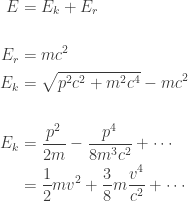
\displaystyle{\begin{aligned}  E_k &= {\sqrt {p^{2}c^{2}+m^{2}c^{4}}}-mc^{2} \\  E_r &= m c^2 \\ \\  E &= E_{k} + E_{r} \\  \end{aligned}}

但是,你不應該把它們,標籤為「空間部分」和「時間部分」。原因是,能量 E 本身,就已經是時空動量 p 中的「時間部分」。

.

之前講過,能量 E 是時空動量 p 中,時間方向的分量。

\displaystyle { p = \left(p^{0},p^{1},p^{2},p^{3}\right) = \left({E \over c},p_{x},p_{y},p_{z}\right) = \left({E \over c},\bf p \right) }

所以,你可以把能量 E,稱為「時間動量」。

但是,如果你再把能量 E,自己內部的兩部分 E_kE_r,標籤為「空間能量」和「時間能量」的話,它們就成了「空間時間動量」和「時間時間動量」。

這兩名字既奇怪,亦失準。

.

這兩標籤不正確的原因是,它們不似「能量 E 是『動量在時間方向的分量』(簡稱『時間動量』)」般,是客觀術詞數學事實,因為,它真的是四次元時空向量,四格中的最左一格:

\displaystyle { p = \left({E \over c},p_{x},p_{y},p_{z}\right)}

.

能量 E 自己內部的兩部分 E_kE_r,分別標籤為「動態部分」和「靜態部分」,亦是有根有據物理事實,因為,在物件靜止不動 (v = 0) 時,動態部分 E_k 真的等於零。它就是所謂的「動能」。

換句話說,動能 E_k,只會在物體有運動 (v \ne 0) 時,才會出現。

而「靜態能量」E_r,就是當物件,即使靜止不動 (v = 0) 時,身上仍然持有的能量。它就是所謂的「質量」。

\displaystyle{\begin{aligned}  E &= E_{k} + E_{r} \\ \\  E_r &= m c^2 \\  E_k &= {\sqrt {p^{2}c^{2}+m^{2}c^{4}}}-mc^{2} \\ \\    E_k  &= {\frac {p^{2}}{2m}}-{\frac {p^{4}}{8m^{3}c^{2}}} + \dotsb \\  &= {\frac {1}{2}}mv^{2}+{\frac {3}{8}}m{\frac {v^{4}}{c^{2}}} + \dotsb \\  \end{aligned}}

但是,如果再把「動態能量E_k 和「靜態能量E_r,標籤為「空間能量」和「時間能量」的話,那就沒有根據不是事實;極其量,只是主觀喜好文學修辭

首先,能量 E 的已知身份是「時間動量」。它本身就是,時間的特性。與它直接有關的,是時間。

而能量 E 與空間的關係,是間接的。

能量 E 與空間有關的原因是,它與時間有關,而時間又和空間有關。

.

相對論的重點是,時空是會互動的,各自也不能獨立運行。時間和空間,必定會影響對方。而那些數學細節,就是「時空畢氏定理」。

而「時空畢氏定理」的時空動量版本,就是

\displaystyle{ \begin{aligned}  p \cdot p &= -(p^0)^2 + (p^1)^2 + (p^2)^2 + (p^3)^2 \\  &= -(\frac{E}{c})^2 + (p_x)^2 + (p_y)^2 + (p_z)^2 \\ \\    p \cdot p &= -m^{2}c^{2} \\ \\    -m^{2}c^{2}  &= -(\frac{E}{c})^2 + (p_x)^2 + (p_y)^2 + (p_z)^2 \\    -m^{2}c^{2}  &= -(\frac{E}{c})^2 + |\mathbf{p}|^2 \\    \end{aligned} }

時空動量 p 的長度平方 p \cdot p,對於任何粒子而言,在任何情況下,都等於 \left(- m^{2}c^{2}\right)。由於這個硬性規定,能量(時間動量)E 和三次元動量(空間動量)\displaystyle { \left(p_{x},p_{y},p_{z}\right)} 並不能獨立變動。任何一方的數值改變,必定牽動另一方。

.

\displaystyle{\begin{aligned}  E &= E_{k} + E_{r} \\  \end{aligned}}

無論靜止或運動,能量數值 \displaystyle{ E = \sqrt{|\mathbf{p}|^2 c^2 + m^2 c^4} } 都不會零;意思是,無論靜止或運動,物體必在時間中「移動」。(三次元動量 \mathbf{p},則在物體沒有運動,即靜止時,立刻為零。)

記住,無論是總能量 E,或其動靜分部 (E_k, E_r) 部的任何一個,都是時間的「產物」;沒有所謂的「純空間」分部。所以,只把靜能(質量)E_{r} 標籤為「時間能量」,卻把動能 E_k 叫作「空間能量」,暗示其為「純空間能量」,並不恰當。

換句話說,把身份已知為「時間動量」的能量 E,再分拆為「時間能量」和「空間能量」,並不合理:

\displaystyle{\begin{aligned}  E &= E_{k} + E_{r} \\  \end{aligned}}

能量 E = 空間能量 + 時間能量

正確的分類和命名是:

\displaystyle { p = \left(p^{0},p^{1},p^{2},p^{3}\right) = \left({E \over c},p_{x},p_{y},p_{z}\right) = \left({E \over c},\bf p \right) }

時空動量 =(時動量, x 空動量,y 空動量,z 空動量)
時空動量 =(能量,動量)

.

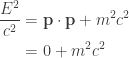
\displaystyle{ \begin{aligned} \frac{E^2}{c^2} &= \mathbf p \cdot \mathbf p + m^2 c^2 \\ \end{aligned}}

能量平方 = 動量平方 + 質量平方
能量平方 = 動態部分 + 靜態部分

.

\displaystyle{\begin{aligned}  E_k &= {\frac {p^{2}}{2m}}-{\frac {p^{4}}{8m^{3}c^{2}}} + \dotsb \\ &= {\frac {1}{2}}mv^{2}+{\frac {3}{8}}m{\frac {v^{4}}{c^{2}}} + \dotsb \\ \\    E_r &= m c^2 \\  E_k &= {\sqrt {p^{2}c^{2}+m^{2}c^{4}}}-mc^{2} \\ \\    E &= E_{k} + E_{r} \\  \end{aligned}}

能量 = 運動能量 + 靜止能量
能量 = 動能 + 質量

— Me@2022-01-20 11:33:48 AM

.

.

2022.01.21 Friday (c) All rights reserved by ACHK

Momentum as Spatial Energy

能量空間版

這段改編自 2021 年 12 月 5 日的對話。

.

In special relativity, four-momentum is the generalization of the classical three-dimensional momentum to four-dimensional spacetime. Momentum is a vector in three dimensions; similarly four-momentum is a four-vector in spacetime. The contravariant four-momentum of a particle with relativistic energy E and three-momentum p = (p_x, p_y, p_z) = \gamma m \bf v, where \bf v is the particle’s three-velocity and \gamma the Lorentz factor, is

\displaystyle{p=\left(p^{0},p^{1},p^{2},p^{3}\right)=\left({E \over c},p_{x},p_{y},p_{z}\right).}

The quantity m \bf v of above is ordinary non-relativistic momentum of the particle and m its rest mass. The four-momentum is useful in relativistic calculations because it is a Lorentz covariant vector. This means that it is easy to keep track of how it transforms under Lorentz transformations.

.

.

\displaystyle{ p\cdot p=\eta _{\mu \nu }p^{\mu }p^{\nu }=p_{\nu }p^{\nu }=-{E^{2} \over c^{2}}+|\mathbf {p} |^{2}=-m^{2}c^{2}}

— Wikipedia on Four-momentum

.

之前我講,動能(KE)是時間方向的動量(momentum)。

那是錯的。

正確的講法是,動量(momentum)是總能量(total energy )的空間方向分量。(這裡,總能量(total energy )的數值,已包含了動能(KE)部分。)

動量(momentum)不是真身,總能量(total energy )才是。

那都是錯的,因為,這裡有歧義。

.

在這裡,「動量」(momentum)這個詞語,有三個可能的意思:

1. Newtonian momentum 牛頓動量

\displaystyle{m \bf v}

2. Three-momentum 相對論三維動量

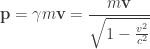
\displaystyle{\mathbf{p} = \gamma m \bf v}, \displaystyle{\gamma ={\frac {1}{\sqrt {1-{\frac {v^{2}}{c^{2}}}}}}}

3. Four-momentum 時空動量(相對論四維動量)

\displaystyle {  p   = \left(p^{0},p^{1},p^{2},p^{3}\right)  = \left({E \over c},p_{x},p_{y},p_{z}\right)  = \left({E \over c},\bf p \right)  }

如果「動量」是指,時空動量 p 的話,總能量 E 的確是,時間方向的分量。(而時空動量 p 的空間分量,則是相對論三維動量 \bf p。)

留意,這裡的 E 是總能量,而不是動能 KE。

在這個背景下,「動量」和「能量」被統一成「時空動量」。換句話說,動量 \bf p 和能量 E 其實是,時空動量 p 中的,兩個部分。動量 \bf p 就是,時空動量 p 中是「空間動量」;而能量 E,則是「時間動量」。

.

但是,如果現在考慮的「動量」,不是指時空動量 p 本身,而是它的數值 \displaystyle{\| p \|}(或稱「向量長度」)的話,則會得到這些公式:

\displaystyle{ \begin{aligned}   \| p \| &= \sqrt{p \cdot p} \\ \\  p \cdot p &= -(p^0)^2 + (p^1)^2 + (p^2)^2 + (p^3)^2 \\   \end{aligned}}

第零分量 p^0 的平方 (p^0)^2 的平方,之前要加負號的原因是,它並非純空間上的畢氏定理,而是時空版本的畢氏定理。而在這「時空畢氏定理」中,凡是屬於時間方向的,必須加負號。

那樣,時空動量數值平方 \displaystyle{ p \cdot p },就會等於:

\displaystyle{   \begin{aligned}   p \cdot p   &= -(p^0)^2 + (p^1)^2 + (p^2)^2 + (p^3)^2 \\  &= -(\frac{E}{c})^2 + (p_x)^2 + (p_y)^2 + (p_z)^2 \\  \end{aligned}  }

在這裡,如果沿用剛才,「能量 E 是,時空動量 \displaystyle{   \begin{aligned}   p &= \left({E \over c},p_{x},p_{y},p_{z}\right) \\   \end{aligned}  } 中,在時間方向的分量」講話風格的話,我們可以把

\displaystyle{   \begin{aligned}   \| p \|  &= \sqrt{p \cdot p}   &= \sqrt{- \left(\frac{E}{c}\right)^2 + (p_x)^2 + (p_y)^2 + (p_z)^2} \\  \end{aligned}  }

說成:「能量 E 的數值,構成了時空動量 p 的數值 \| p \| 的一部分。」換句話說,時空動量長度 \| p \|,由能量 E 和三維動量 \left( p_x, p_y, p_z \right) 兩部分組成。

這個講法雖然可以,但有少許弱點。

平時同「構成」或「組成」這字眼時,通常是指貢獻。但是,在 \| p \| 的公式中,能量平方 E^2 之前的,是負號;即是負累,不是貢獻。所以,很多時,物理學家會將該公式,調成

\displaystyle{   \begin{aligned}   \left(\frac{E}{c}\right)^2 &= (p_x)^2 + (p_y)^2 + (p_z)^2 -  p \cdot p \\   \left(\frac{E}{c}\right)^2 &= |\mathbf {p} |^{2} -  p \cdot p \\   \end{aligned}  }

.

留意一個有趣的事實:

\displaystyle{   \begin{aligned}   p \cdot p &= -m^{2}c^{2} \\   \end{aligned}  }

時空動量 p 的長度平方 \| p \|^2,即是 p \cdot p,在任何情況下,對於任何粒子而言,都等於 \left(- m^{2}c^{2}\right)。(平方竟然為負數的原因是,這裡的「平方」只是比喻,並非平時數學中的二次方。)

那樣,能量平方 E^2 就去了左邊,成了數式的主角。

\displaystyle{ \begin{aligned} \frac{E^2}{c^2} &= \mathbf p \cdot \mathbf p + m^2 c^2 \\ \end{aligned}}

意思就可以講成:「能量(平方)E^2 由兩個構成部:動態(平方)部分 \mathbf p \cdot \mathbf p 和靜態(平方)部分 m^2 c^2。」

在這個上文下理中,(相對論版)三維動量,其實就是能量中的動態部分。運動,必在空間中。所以動態部分,就是「空間部分」。

而質量,則是能量中的靜態部分。所以,質量又稱「靜止能」。靜止,代表「不在空間中運動」;可以視為「只在時間方向移動」。所以靜態部分,就是「時間部分」。

.

概念上,精簡而言,能量是動量的一部分——能量 E 是時間方向的動量(momentum)。精準來說,能量 E 是時空動量 \displaystyle { p = \left({E \over c},p_{x},p_{y},p_{z}\right)} 中,時間方向的分量。

數值上,精簡而言,動量是能量的一部分——動量(momentum)是總能量(total energy )的空間部分。精準來說,能量 E 是的數值中,包括了(相對論版)三次元動量 \displaystyle{\mathbf{p}} 的貢獻。

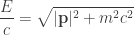
\displaystyle{ \begin{aligned} \frac{E^2}{c^2} &= \mathbf p \cdot \mathbf p + m^2 c^2 \\ \\    \frac{E}{c} &= \sqrt{|\mathbf p |^2 + m^2 c^2} \\ \end{aligned}}

.

留意,暫時從來沒有提及過,動能 KE。剛才只是說,能量平方 E^2 可以分成兩部分——動態部分(空間部分)和靜態部分(時間部分)。

\displaystyle{ \begin{aligned} \frac{E^2}{c^2} &= \mathbf p \cdot \mathbf p + m^2 c^2 \\ \end{aligned}}

但是,暫時從來沒有提及過,要將能量 E 本身,分成兩部分。

\displaystyle{ \begin{aligned} \frac{E}{c} &= \dotsb + \dotsb \\ \end{aligned}}

動能 KE 是我們在,企圖將能量一次方 E,分成動靜兩部分時,出現的副產物。

.

剛才提過,因為在能量平方的公式 \displaystyle{ \left( \frac{E^2}{c^2} = \mathbf p \cdot \mathbf p + m^2 c^2 \right) } 中,質量平方 \displaystyle{ \left( m^2 c^2 \right)}代表靜態部分,所以,質量又名「靜止能」。

而質量可稱為「靜止能」的另一個理據是,如果物體靜止,它的三次元動量 | \bf p |,就會等於零。那樣,

\displaystyle{ \begin{aligned} \frac{E^2}{c^2}     &= \mathbf p \cdot \mathbf p + m^2 c^2 \\     &= 0 + m^2 c^2 \\     \end{aligned}}

亦即是話,

\displaystyle{ \begin{aligned}     \frac{E^2}{c^2} &= m^2 c^2 \\ \\     E &= m c^2 \\     \end{aligned}}

所以,「質量 m c^2 是『靜止能』」的意思是,物體靜止時,身上僅有的能量數值,就是質量 m c^2

.

然後,透過這個「靜能」,就可以定義到,所謂的「動能 KE」。

清晰起見,「質量 mc^2」命名為「靜能 E_r」:

\displaystyle{ \begin{aligned} E_r &= m c^2 \\ \end{aligned}}

總能量 E

\displaystyle{ \begin{aligned} \frac{E}{c} &= \sqrt{|\mathbf p |^2 + m^2 c^2} \\ \end{aligned}}

簡化起見,暫只考慮直線(即是一次元空間)上的運動。那樣,三次元動量 \bf p,就會降級成一次元動量 p

\displaystyle{ \begin{aligned}   \frac{E}{c} &= \sqrt{p^2 + m^2 c^2} \\ \\  E &= c \sqrt{p^2 + m^2 c^2} \\   \end{aligned}}

然後,我們把總能量 E,減去靜能 E_r 部分;把餘量命名為 E_k

\displaystyle{     \begin{aligned}     E_k &= E - E_r \\     &= \sqrt{p^2 c^2 + m^2 c^4} - m c^2 \\     \end{aligned}}

物理量 E_k 的真正全名是「總能量 E 減去靜能 E_r 部分後的餘額」。由於這名字實在太長,我們簡稱它為「動能」;意思是,原本靜止的物體,因為運動而多了出來的能量。

原本靜止的物件,如果要令它,以速度 v 運動,你就需要給予它,動能 E_k 數值的能量。

.

留意,這個所謂的「動量 E_k」,是由人工合成,再由後天標籤而成的。

\displaystyle{ \begin{aligned} E_k &= \sqrt{p^2 c^2 + m^2 c^4} - m c^2 \\ \end{aligned}}

運算操作而言,動量 E_k 就是那麼的論盡;並沒有精簡的版本,除非取其近似值。

理論架構來說,動量 E_k 不是主角,只為配角;重要性並不如:

1. Four-momentum 時空動量

\displaystyle{p=\left(p^{0},p^{1},p^{2},p^{3}\right)=\left({E \over c},p_{x},p_{y},p_{z}\right)}

2. Total energy 總能量

\displaystyle{E = p^0 c}

3. Three-momentum (3-space momentum) 相對論三次元空間動量

\displaystyle{\mathbf{p} = \left(p^{1},p^{2},p^{3}\right) = \left( p_x, p_y, p_z \right)}

\displaystyle{\mathbf{p} = \gamma m \mathbf{v} = \frac{m \mathbf{v}}{\sqrt {1-{\frac {v^{2}}{c^{2}}}}}}

這三位主角,各自會守恆不變:

1. 總能量 \displaystyle{E} 會因為,時間的均勻性而守恆。「時間均勻性」的意思是,物理定律不會隨時間改變。

2. 空間動量 \displaystyle{\mathbf{p}} 會因為,空間的均勻性而守恆。「空間均勻性」的意思是,宇宙間任何兩個不同地方,物理定律必為相同。

3. 結果,因為時間分量 \displaystyle{\frac{E}{c}} 和空間分量 \displaystyle{\mathbf{p}} 都守恆,時空動量 \displaystyle{p=\left({E \over c},\mathbf{p}\right)} 作為整體,亦會守恆。

.

但是,動能 E_k,則從來沒有,對應的守恆定律,所以用處較少。動能 E_k 作為「未必守恆量」,只能作大配角。

\displaystyle{\begin{aligned}     E_{\text{k}}   &= {\sqrt {p^{2}c^{2}+m^{2}c^{4}}}-mc^{2} \\  &= {\frac {p^{2}}{2m}}-{\frac {p^{4}}{8m^{3}c^{2}}} + \dotsb \\ \\  E_{\text{k}} &\approx {\frac {p^{2}}{2m}}-{\frac {p^{4}}{8m^{3}c^{2}}}    \end{aligned}}

— Me@2022-01-16 05:39:11 PM

— Me@2022-01-17 01:17:51 PM

.

I would flip it and say momentum [is] energy in the space-like direction. When at rest (four velocity u = (c, {\bf 0})), you are moving entirely in the time direction. Four momentum is:

\displaystyle{p_{\mu} = mu_{\mu} = (mc^2, {\bf 0})}

For a observer boosted to velocity \displaystyle{ \bf v }:

\displaystyle{p_{\mu} = mu_{\mu} =\gamma(mc^2, m{\bf v}c)=(mc^2+T, {\bf p}c)}

[Y]our rest mass (energy) now appears as momentum (and the timelike term has kinetic energy added to it).

That last equality may make it clear that when in motion (c=1):

\displaystyle{m \rightarrow m+T}

\displaystyle{{\bf 0}\rightarrow {\bf 0} + {\bf p}}

which could be interpreted as “Kinetic energy is momentum in the time-like direction”.

— answered Apr 25 ’18 at 1:13

— JEB

— Physics Stack Exchange

.

.

2022.01.17 Monday (c) All rights reserved by ACHK

時光起源

The Origin of Time

這段改編自 2021 年 12 月 5 日的對話。

.

昨日的那段影片說,個別的粒子,其實都是質量零;以光速行走,感受不到時間。

但是,把一堆粒子圈成一件東西的話,那件東西整體而言,就會有質量;就會低於光速行走;就會感受到時間。

變相來說,時間的來源就是,你將一堆粒子組成一個物件、一個身份、一個自我時,那個自我就會,感受到時間。

— Me@2022-01-04 12:23:25 PM

.

To form an object (an observer), the component particles cannot all always move at light speed in the same direction, for that would prevent the object as a whole from feeling time.

Anything moving at the speed of light cannot feel the passage of time. If a set of particles all moves at light speed in the same direction all the time, they cannot feel time either as individuals or as a whole; so they cannot form an “object”.

To form an object (an observer), the component particles need to interact. So some component particles need to move in other directions sometimes.

.

An object requires an internal structure to exist and evolve. The component particles need to interact in order to evolve as a single identity. So different particles need to move in different directions sometimes. As a result, the component particles as a whole, aka “the object”, will move slower than light.

— Me@2021-12-08 08:09:17 AM

.

.

2022.01.05 Wednesday (c) All rights reserved by ACHK

Visualizing higher dimensions, 2

Geometry is global.

Space is what we can see at once.

Dynamics is local.

Time is what we cannot see at once.

— Me@2017-02-07 10:11:34 PM

.

If we could see, for example, several minutes at once, that several minutes would become a spatial dimension.

In other words, that dimension is visualized for us.

— Me@2017-02-03 07:31:25 AM

.

.

2021.08.23 Monday (c) All rights reserved by ACHK

Logical arrow of time, 9.4

The second law of thermodynamics’ derivation (Ludwig Boltzmann’s H-theorem) is with respect to an observer.

How does an observer keep losing microscopic information about a system?

— Me@2017-02-12 07:37:54 PM

.

This drew the objection from Loschmidt that it should not be possible to deduce an irreversible process from time-symmetric dynamics and a time-symmetric formalism: something must be wrong (Loschmidt’s paradox).

The resolution (1895) of this paradox is that the velocities of two particles after a collision are no longer truly uncorrelated. By asserting that it was acceptable to ignore these correlations in the population at times after the initial time, Boltzmann had introduced an element of time asymmetry through the formalism of his calculation.

— Wikipedia on Molecular chaos

.

Physical entropy’s value is with respect to an observer.

— Me@2017-02-12 07:37:54 PM

.

This “paradox” can be explained by carefully considering the definition of entropy. In particular, as concisely explained by Edwin Thompson Jaynes, definitions of entropy are arbitrary.

As a central example in Jaynes’ paper points out, one can develop a theory that treats two gases as similar even if those gases may in reality be distinguished through sufficiently detailed measurement. As long as we do not perform these detailed measurements, the theory will have no internal inconsistencies. (In other words, it does not matter that we call gases A and B by the same name if we have not yet discovered that they are distinct.) If our theory calls gases A and B the same, then entropy does not change when we mix them. If our theory calls gases A and B different, then entropy does increase when they are mixed. This insight suggests that the ideas of “thermodynamic state” and of “entropy” are somewhat subjective.

— Wikipedia on The mixing paradox

— Wikipedia on Gibbs paradox

.

.

2021.08.07 Saturday (c) All rights reserved by ACHK

Causal diamonds in time travel

Quantum mechanics is a set of rules that allows an observer to predict, explain, and/or verify observations (and especially their mutual relationships) that he has access to.

No observer can detect inconsistencies within the causal diamonds. However, inconsistencies between “stories” as told by different observers with different causal diamonds are allowed (and mildly encouraged) in general (as long as there is no observer who could incorporate all the data needed to see an inconsistency).

— Raphael Bousso is right about firewalls

— Lubos Motl

.

There is no “god’s eye view” in physics.

— Me@2021-04-17 03:12:58 PM

.

Macroscopic time is with respect to an observer. Actually, physics is with respect to an observer.

In the real universe, any observer’s observations must be consistent. When two observers compare their observations, their results must be consistent, because the comparison itself is an observation of an observer.

Time travel in the absolute sense is logically impossible. Let’s assume that it is logically possible.

If a time travel story follows the principle of “an observer’s observations must be consistent”, each character in that story must see a consistent timeline, even if different characters’ timelines may be inconsistent. That is fine as long as such inconsistent observers never meet to compare their results.

If two of such observers choose to meet to compare their results, the action to “meet to compare” itself will render the results consistent. It is similar to the resolution of the twin paradox in special relativity.

There is no “god’s eye view” in physics. Every physical event must be described with respect to an observer. Every physical event, even if the event is “to compare observation results”, must be described with respect to an observer.

— Me@2017-05-10 07:45:36 AM

.

.

2021.04.17 Saturday (c) All rights reserved by ACHK

Universal wave function, 21

For all, 9

.

A problem of universal wave function (universe) is that universe is a relative concept.

Another problem is that wave function is also.

— Me@2017-05-10 05:46:44 PM

— Me@2021-04-09 06:25:07 PM

.

universe ~ 100%

But 100% of what?

— Me@2021-04-09 05:20:23 PM

.

The wave function is expressed in terms of basis state vectors.

So it will have a different form if you choose a different basis.

— Me@2021-04-09 06:29:20 PM

.

.

2021.04.09 Friday (c) All rights reserved by ACHK